
Context:
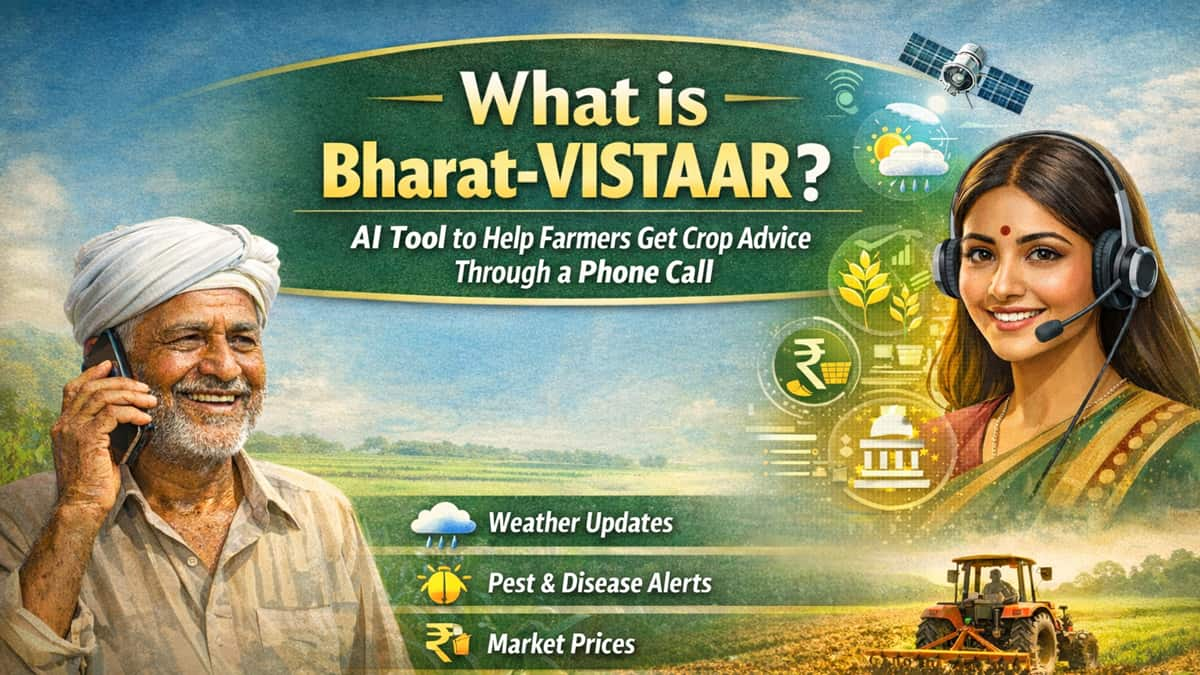
Recently, The Ministry of Agriculture and Farmers’ Welfare launched Bharat-VISTAAR (Virtually Integrated System to Access Agricultural Resources), an AI-enabled digital platform, aims to provide farmers with data-driven, customized advisory services, enhancing decision-making and productivity at the farm level.
Features of Bharat-VISTAAR:
-
-
- Multilingual AI Platform: Initially available in Hindi and English, with plans to expand to 11 regional languages, making it accessible to farmers across India.
- Integrated AgriStack & ICAR Knowledge Base: Combines portals under the AgriStack framework and the Indian Council of Agricultural Research (ICAR) package on farm practices with AI systems.
- Farmer-Centric Support: Provides guidance on weather forecasts, soil health, crop management, pests and diseases, and market prices.
- Central Scheme Integration: Includes information on schemes like Pradhan Mantri Fasal Bima Yojana and Soil Health Card, with plans to cover all major central agricultural schemes.
- Direct Query System: Farmers can ask questions in their local language, receiving immediate advice on sowing, crop protection, and market rates.
- Multilingual AI Platform: Initially available in Hindi and English, with plans to expand to 11 regional languages, making it accessible to farmers across India.
-
Significance for Indian Agriculture:
-
-
- Enhanced Productivity: AI-driven insights allow farmers to optimize irrigation, fertilization, and pest management.
- Risk Reduction: Predictive analytics help anticipate weather events, pest outbreaks, and market fluctuations, reducing crop losses.
- Decision-Making Efficiency: Direct advisory reduces the need for multiple office visits or navigating complex digital tools.
- Inclusive Access: Multilingual support ensures equitable access for small and marginal farmers, bridging the digital divide.
- Enhanced Productivity: AI-driven insights allow farmers to optimize irrigation, fertilization, and pest management.
-
AI in Agriculture: Applications and Benefits:
-
-
- Precision Farming: AI-powered drones and IoT sensors monitor crop health and soil moisture, optimizing resource use.
- Weed & Pest Management: Robots and computer vision systems target affected areas, reducing chemical use.
- Predictive Analytics: Machine learning forecasts market trends, optimal harvest times, and climate risks.
- Supply Chain Optimization: Real-time tracking improves transportation efficiency and reduces spoilage.
- Autonomous Machinery: AI-driven tractors and equipment mitigate labor shortages.
- Precision Farming: AI-powered drones and IoT sensors monitor crop health and soil moisture, optimizing resource use.
-
Policy and Strategic Implications:
-
-
- Digital Empowerment: Bharat-VISTAAR aligns with Digital India and Atmanirbhar Bharat missions, promoting technology adoption in agriculture.
- Sustainable Agriculture: Data-driven practices reduce resource wastage and promote environmentally sustainable farming.
- Innovation and Research: Launch of AI Hackathon and Agri Kosh AI Strategy Roadmap encourages innovative solutions to agricultural challenges.
- Global Positioning: Strengthens India’s role in AI-driven agri-tech solutions, setting an example for emerging economies.
- Digital Empowerment: Bharat-VISTAAR aligns with Digital India and Atmanirbhar Bharat missions, promoting technology adoption in agriculture.
-
Conclusion:
Bharat-VISTAAR represents a paradigm shift in Indian agriculture, leveraging artificial intelligence to empower farmers, increase productivity, and enhance sustainability. By integrating technology, policy, and knowledge systems, it bridges the gap between scientific research and field-level application, ensuring India’s agriculture remains resilient, efficient, and future-ready.



