
Bangladesh's Foreign Minister Visit to India
Context:
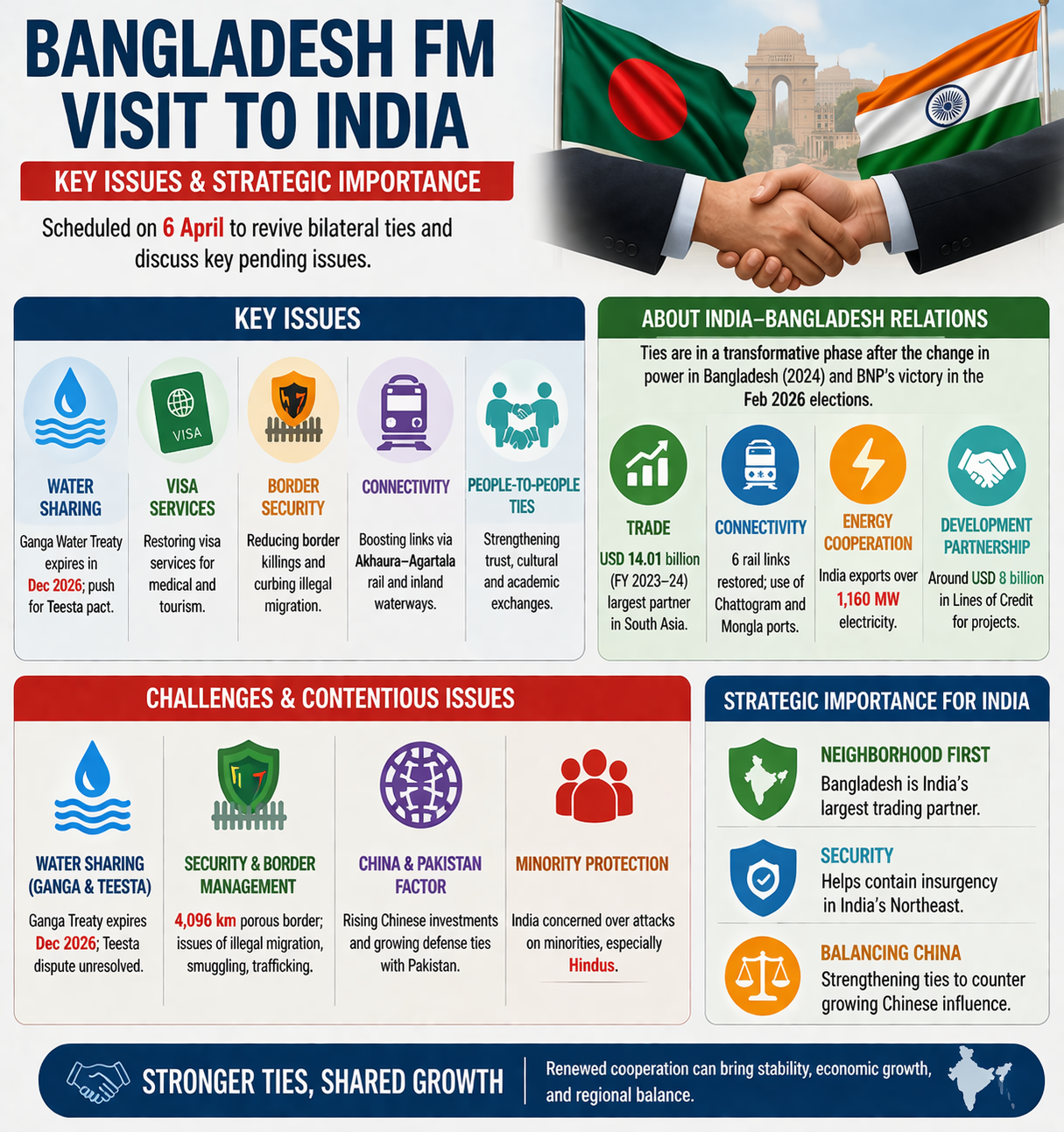
The Foreign Minister of Bangladesh is scheduled to visit India on 6 April. The primary objective of this visit is to revive bilateral relations following the fall of the Sheikh Hasina government and to discuss the renewal of the Ganga Water Treaty (1996).
Key Issues for the Foreign Minister’s Visit:
-
-
- Water Sharing: The 30-year Ganga Water Treaty is set to expire in December 2026. Bangladesh seeks timely renewal and progress on the Teesta River Agreement.
- Visa Services: Since August 2024, Indian visa services for Bangladeshi citizens have been curtailed. Restoring them, especially for medical and tourism purposes, is a priority.
- Border Security: Reducing border killings and preventing illegal migration remains a sensitive issue.
- Connectivity: Enhancing access to India’s Northeast through the Akhaura–Agartala rail link and inland waterways.
- Water Sharing: The 30-year Ganga Water Treaty is set to expire in December 2026. Bangladesh seeks timely renewal and progress on the Teesta River Agreement.
-
About India-Bangladesh Relations:
Bilateral relations between India and Bangladesh are currently undergoing a significant and transformative phase. The change in power in August 2024 and the subsequent victory of the Bangladesh Nationalist Party (BNP), led by Tarique Rahman, in the February 2026 general elections have introduced new dynamics and challenges in the bilateral relationship.
Key Areas of Cooperation:
-
-
- Economic Relations: Bangladesh is India’s largest trading partner in South Asia. Bilateral trade in FY 2023–24 amounted to approximately USD 14.01 billion.
- Connectivity: Six rail links between the two countries have been restored, including the Maitree, Bandhan, and Mitali Expresses. Additionally, India now uses the Chattogram and Mongla ports for its northeastern states.
- Energy Cooperation: India exports over 1,160 MW of electricity to Bangladesh. Key projects include the Maitree Super Thermal Power Plant and the India-Bangladesh Maitree Pipeline (for diesel supply).
- Development Partnership: India has extended approximately USD 8 billion in Lines of Credit (LoC) for infrastructure development in Bangladesh.
- Economic Relations: Bangladesh is India’s largest trading partner in South Asia. Bilateral trade in FY 2023–24 amounted to approximately USD 14.01 billion.
-
Challenges and Contentious Issues:
-
-
- Water Sharing (Ganga & Teesta): The 1996 Ganga Water Treaty expires in December 2026. Technical-level joint measurement processes for renewal have begun, but the Teesta River dispute remains unresolved.
- Security and Border Management: The 4,096 km porous border faces challenges including illegal migration, human trafficking, and cattle smuggling.
- China and Pakistan Factor: Increasing Chinese investment in Bangladesh (through BRI projects) and growing defense ties with Pakistan are strategic concerns for India.
- Minority Protection: India has expressed serious concern over attacks on minorities, particularly Hindus, in Bangladesh in recent years.
- Water Sharing (Ganga & Teesta): The 1996 Ganga Water Treaty expires in December 2026. Technical-level joint measurement processes for renewal have begun, but the Teesta River dispute remains unresolved.
-
Strategic Importance for India:
-
-
- Neighborhood First Policy: Bangladesh is India’s largest trading partner.
- Security: Cooperation with Bangladesh is crucial to contain insurgency in India’s northeastern states.
- Balancing China: India needs to strengthen soft power and infrastructure projects to counter growing Chinese influence in Bangladesh.
- Neighborhood First Policy: Bangladesh is India’s largest trading partner.
-



