
Bail under the UAPA Act
Context:
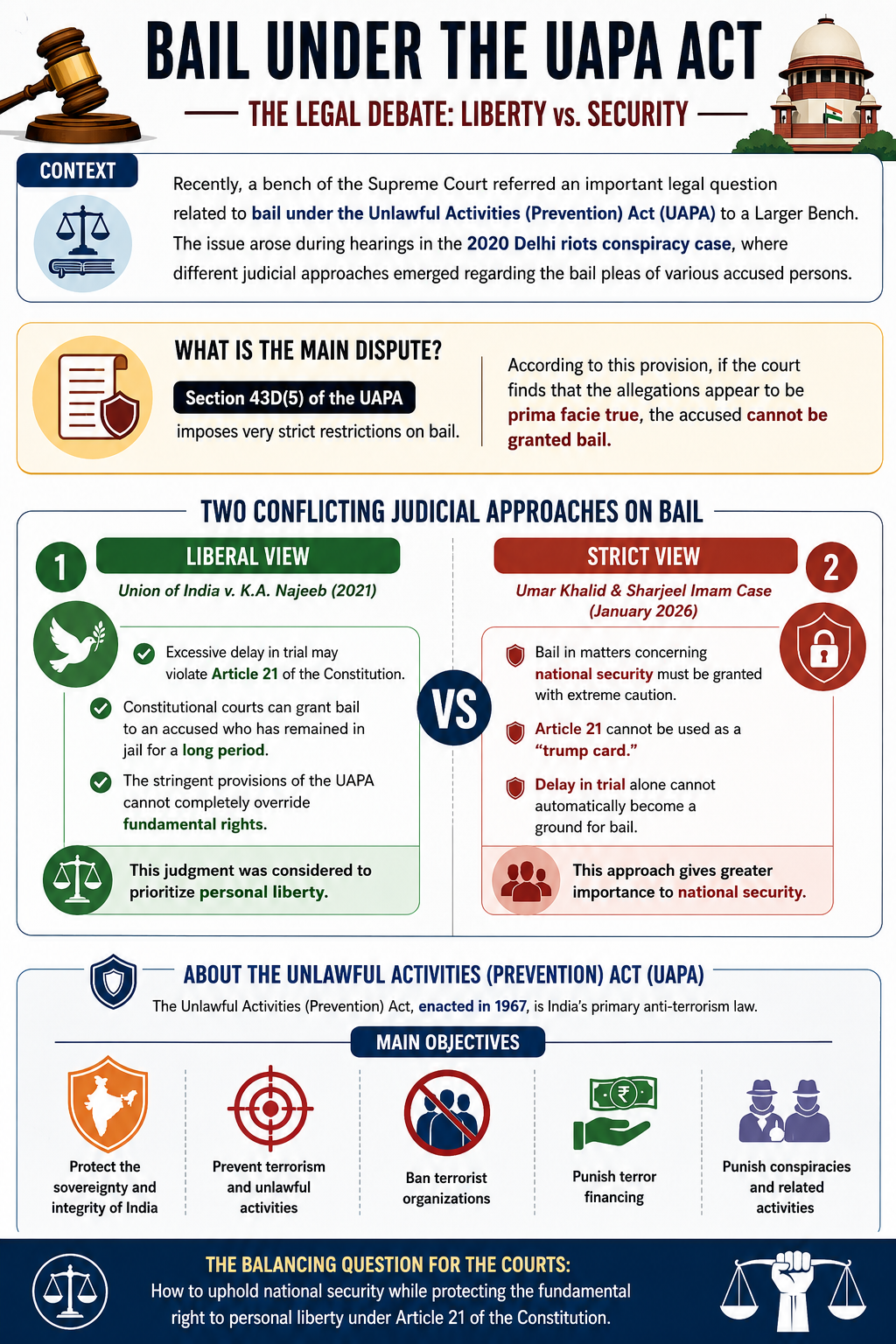
Recently, a bench of the Supreme Court referred an important legal question related to bail under the Unlawful Activities (Prevention) Act (UAPA) to a Larger Bench. The issue arose during hearings in the 2020 Delhi riots conspiracy case, where different judicial approaches emerged regarding the bail pleas of various accused persons.
What is the main dispute?
Section 43D(5) of the UAPA imposes very strict restrictions on bail.
According to this provision, if the court finds that the allegations appear to be prima facie true, the accused cannot be granted bail.
Two Conflicting Judicial Approaches on bail:
-
-
- Liberal View: In the 2021 case of Union of India v. K.A. Najeeb, the Supreme Court held that:
- Excessive delay in trial may violate Article 21 of the Constitution.
- Constitutional courts can grant bail to an accused who has remained in jail for a long period.
- The stringent provisions of the UAPA cannot completely override fundamental rights.
- This judgment was considered to prioritize personal liberty.
- Excessive delay in trial may violate Article 21 of the Constitution.
- Strict View: In January 2026, another bench of the Supreme Court rejected the bail pleas of Umar Khalid and Sharjeel Imam and observed that:
- Bail in matters concerning national security must be granted with extreme caution.
- Article 21 cannot be used as a “trump card.”
- Delay in trial alone cannot automatically become a ground for bail.
- This approach gives greater importance to national security.
- Bail in matters concerning national security must be granted with extreme caution.
- Liberal View: In the 2021 case of Union of India v. K.A. Najeeb, the Supreme Court held that:
-
Supreme Court’s Observation:
-
-
- The Court clarified that two Coordinate Benches of equal strength cannot criticize each other’s judgments. If there is disagreement with an earlier decision, the matter must be referred to a Larger Bench through the proper judicial process.
- The Court also stated that the K.A. Najeeb judgment is not a “mathematical formula” under which every accused detained for a long time must automatically receive bail. In every case, a practical balance between national security and personal liberty is necessary.
- The Court clarified that two Coordinate Benches of equal strength cannot criticize each other’s judgments. If there is disagreement with an earlier decision, the matter must be referred to a Larger Bench through the proper judicial process.
-
Importance of the Reference:
This reference by the Supreme Court is highly significant because the Larger Bench will provide clarity on the following questions:
-
-
- What should be the correct legal interpretation of bail under the UAPA?
- Does prolonged imprisonment violate Article 21?
- How should the balance between national security and individual liberty be maintained?
- What should be the correct legal interpretation of bail under the UAPA?
-
About the Unlawful Activities (Prevention) Act (UAPA):
The Unlawful Activities (Prevention) Act, enacted in 1967, is India’s primary anti-terrorism law.
Main Objectives:
-
-
- Protect the sovereignty and integrity of India
- Prevent terrorism and unlawful activities
- Ban terrorist organizations
- Punish terror financing and conspiracies
- Protect the sovereignty and integrity of India
-
Key Features of the UAPA:
-
-
- Power to Declare Individuals as Terrorists: After the 2019 amendment, the government can designate an individual as a terrorist. Earlier, this provision applied only to organizations.
- Bail is Extremely Difficult: According to Section 43D(5), if the allegations appear *prima facie* true, bail cannot be granted. For this reason, the UAPA is considered one of India's most stringent criminal laws.
- Extended Time for Filing Chargesheet: Under ordinary criminal law, a chargesheet must generally be filed within 60–90 days. However, under the UAPA, the investigation period may be extended up to 180 days. This allows prolonged pre-trial detention.
- Power to Declare Individuals as Terrorists: After the 2019 amendment, the government can designate an individual as a terrorist. Earlier, this provision applied only to organizations.
-
Conclusion:
This case highlights the constitutional balance between national security and personal liberty within India’s criminal justice system. The Larger Bench’s decision will play an important role in bringing clarity, consistency, and future judicial direction regarding bail laws under the UAPA.



