
Context:
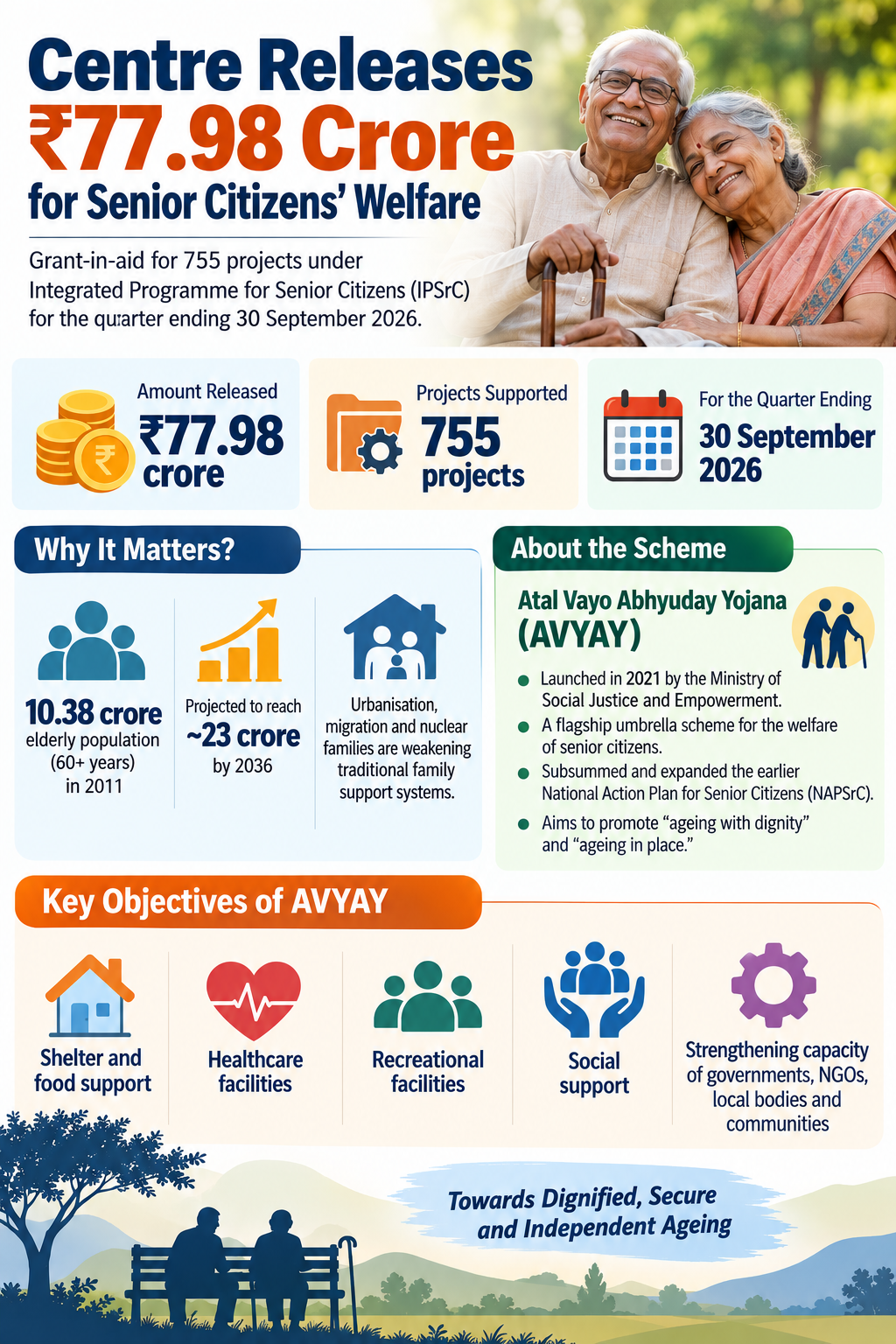
Recently, the Union Ministry of Social Justice and Empowerment released ₹77.98 crore as grant-in-aid for 755 projects under the Integrated Programme for Senior Citizens (IPSrC) for the quarter ending 30 September 2026. The programme is a component of the Atal Vayo Abhyuday Yojana (AVYAY) and aims to promote dignified, secure and independent ageing.
Background:
-
-
- India is undergoing a demographic transition characterised by an increasing elderly population, declining fertility and rising life expectancy. According to the 2011 Census, India had 10.38 crore people aged 60 years and above, comprising 5.11 crore males and 5.27 crore females.
- Their population is projected to reach approximately 23 crore by 2036. Urbanisation, migration and the growth of nuclear families are also weakening traditional family-based support systems, increasing the need for institutional and community-based elderly care.
- India is undergoing a demographic transition characterised by an increasing elderly population, declining fertility and rising life expectancy. According to the 2011 Census, India had 10.38 crore people aged 60 years and above, comprising 5.11 crore males and 5.27 crore females.
-
About Atal Vayo Abhyuday Yojana (AVYAY):
-
-
- Launched in 2021 by the Ministry of Social Justice and Empowerment, AVYAY is a flagship umbrella scheme aimed at promoting “ageing with dignity” and “ageing in place.” It subsumed and expanded the earlier National Action Plan for Senior Citizens (NAPSrC), bringing multiple interventions for elderly welfare under a unified framework.
- The scheme seeks to provide shelter, food, healthcare, recreational facilities and social support to senior citizens. It also strengthens the capacity of governments, non-governmental organisations, local bodies and communities to deliver elderly care.
- Launched in 2021 by the Ministry of Social Justice and Empowerment, AVYAY is a flagship umbrella scheme aimed at promoting “ageing with dignity” and “ageing in place.” It subsumed and expanded the earlier National Action Plan for Senior Citizens (NAPSrC), bringing multiple interventions for elderly welfare under a unified framework.
-
Major Components:
-
-
- Integrated Programme for Senior Citizens (IPSrC): IPSrC provides financial assistance to eligible implementing agencies, including voluntary organisations and other approved institutions, for operating and maintaining facilities such as senior citizen homes and continuous-care homes. The recent release of ₹77.98 crore for 755 projects seeks to strengthen institutional care and related welfare services.
- State Action Plan for Senior Citizens (SAPSrC): Under SAPSrC, State and Union Territory governments prepare and implement action plans according to their specific needs. Financial support from the Centre enables States to develop locally appropriate interventions for elderly welfare.
- Community-Based Care: The scheme promotes ageing in familiar surroundings through accessible healthcare, suitable home modifications, community participation and support services that enable older persons to maintain independence.
- Integrated Programme for Senior Citizens (IPSrC): IPSrC provides financial assistance to eligible implementing agencies, including voluntary organisations and other approved institutions, for operating and maintaining facilities such as senior citizen homes and continuous-care homes. The recent release of ₹77.98 crore for 755 projects seeks to strengthen institutional care and related welfare services.
-
Constitutional and Legal Provisions:
-
-
- Article 41, a Directive Principle of State Policy, directs the State to provide public assistance in cases including old age, subject to its economic capacity and development. Article 46 promotes the educational and economic interests of weaker sections, while Article 21 has been interpreted to protect the right to live with dignity.
- The Maintenance and Welfare of Parents and Senior Citizens Act, 2007 provides a legal framework for maintenance of parents and senior citizens, establishment of old-age homes and protection of their life and property.
- Article 41, a Directive Principle of State Policy, directs the State to provide public assistance in cases including old age, subject to its economic capacity and development. Article 46 promotes the educational and economic interests of weaker sections, while Article 21 has been interpreted to protect the right to live with dignity.
-
Significance:
The initiative strengthens social security, promotes intergenerational equity and addresses the healthcare and care needs associated with population ageing. It can reduce the burden on vulnerable families, support community-based care and promote the social inclusion of older persons.



