
Context:
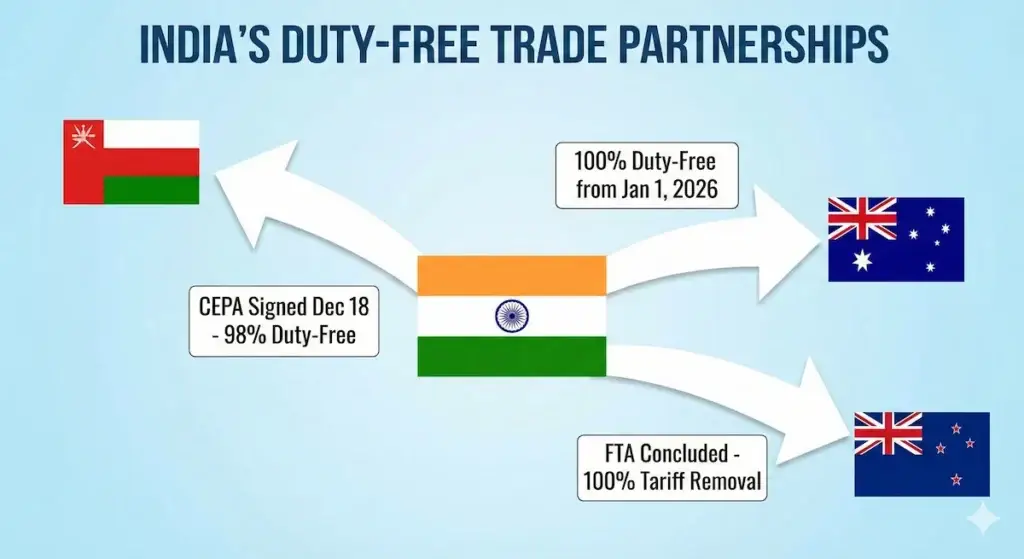
Australia will eliminate tariffs on 100% of its tariff lines for Indian exports with effect from January 1, 2026, marking a major shift in bilateral trade relations between the two democracies. This development takes place under the framework of the India–Australia Economic Cooperation and Trade Agreement (ECTA) and represents a significant deepening of economic integration.
Background:
The India–Australia Economic Cooperation and Trade Agreement (ECTA) is a preferential trade agreement designed to strengthen economic engagement between India and Australia. The agreement was signed in April 2022 and came into force on 29 December 2022, laying the foundation for progressive tariff liberalisation and enhanced trade facilitation.
Recent Progress and Key 2025 Milestones:
1. Complete Tariff Elimination
-
-
-
- From January 1, 2026, 100% of Australian tariff lines will become zero-duty for Indian exports, up from 96.4% under the existing ECTA framework.
- This move ensures full duty-free access for Indian goods in the Australian market.
- From January 1, 2026, 100% of Australian tariff lines will become zero-duty for Indian exports, up from 96.4% under the existing ECTA framework.
-
-
2. Growth in Bilateral Trade
-
-
-
- In 2024–25, India’s exports to Australia grew by approximately 8%, reaching nearly USD 8.58 billion.
- Total bilateral merchandise trade stood at around USD 24.1 billion during the same period.
- These trends indicate increasing trade diversification and improving competitiveness of Indian exports.
- In 2024–25, India’s exports to Australia grew by approximately 8%, reaching nearly USD 8.58 billion.
-
-
3. Sectoral Gains
Notable export growth has been recorded in several sectors, including:
-
-
-
- Gems and jewellery (up by about 16% during April–November 2025)
- Pharmaceuticals
- Textiles and apparel
- Coffee and other agricultural products
- Gems and jewellery (up by about 16% during April–November 2025)
-
-
These gains are particularly significant for labour-intensive sectors and micro, small, and medium enterprises (MSMEs).
4. Trade Facilitation Measures
-
-
-
- A Mutual Recognition Arrangement (MRA) for organic products was signed in 2025, reducing compliance costs and simplifying certification requirements.
- Such non-tariff facilitation measures complement tariff liberalisation and improve overall ease of doing trade.
- A Mutual Recognition Arrangement (MRA) for organic products was signed in 2025, reducing compliance costs and simplifying certification requirements.
-
-
Transition from ECTA to CECA:
Building on the success of ECTA, India and Australia are actively working to upgrade the agreement into a Comprehensive Economic Cooperation Agreement (CECA), aimed at deeper and broader economic integration.
Status of CECA Negotiations:
-
-
- The 11th round of CECA negotiations concluded in August 2025 in New Delhi.
- Key areas under discussion include:
- Digital trade
- Rules of origin
- Services market access
- Investment facilitation
- Digital trade
- The 11th round of CECA negotiations concluded in August 2025 in New Delhi.
-
Ambitious Targets:
-
-
- Both countries have set a target of achieving bilateral trade worth AUD 100 billion by 2030.
- The proposed CECA is expected to cover over 135 service sub-sectors, along with expanded commitments in investment and the digital economy.
- Both countries have set a target of achieving bilateral trade worth AUD 100 billion by 2030.
-
Conclusion:
Australia’s decision to scrap tariffs on all Indian exports from January 1, 2026, under the India–Australia ECTA represents a landmark in bilateral economic cooperation. The move is expected to accelerate export growth, particularly in labour-intensive and MSME-driven sectors, while strengthening supply-chain integration. Strategically, it complements India’s efforts to diversify export markets and deepen engagement with Indo-Pacific trade networks. Continued negotiations towards a Comprehensive Economic Cooperation Agreement are likely to further consolidate economic ties between the two countries.



