
ASUSE 2025: Growth, Employment & Digital Adoption in India’s Unincorporated Sector
Context:
Recently, The Annual Survey of Unincorporated Sector Enterprises (ASUSE) 2025 was released by the Ministry of Statistics and Programme Implementation. The survey highlights robust growth in establishments, employment, and Gross Value Added (GVA) in India’s informal non-agricultural sector, indicating strong post-pandemic recovery and resilience.
What is the Unincorporated Sector?
The unincorporated sector comprises small, informal, non-agricultural enterprises that are not registered as companies. These include units engaged in manufacturing, trade, and services (excluding construction).
Key features:
-
-
- Operate as proprietorships, partnerships, cooperatives, etc.
- Characterised by low capital, labour-intensive operations
- Employ a large share of India’s informal workforce
- Act as linkages in domestic value chains, supporting the formal sector
- Operate as proprietorships, partnerships, cooperatives, etc.
-
Thus, the sector is a critical pillar of employment and grassroots economic activity in India.
Key Findings of ASUSE 2025:
-
-
- The ASUSE 2025 results reveal a broad-based expansion and increasing resilience of India’s unincorporated sector. The number of establishments grew from 7.34 crore to 7.92 crore, registering a 7.97% increase, indicating a strong revival and expansion of informal economic activity.
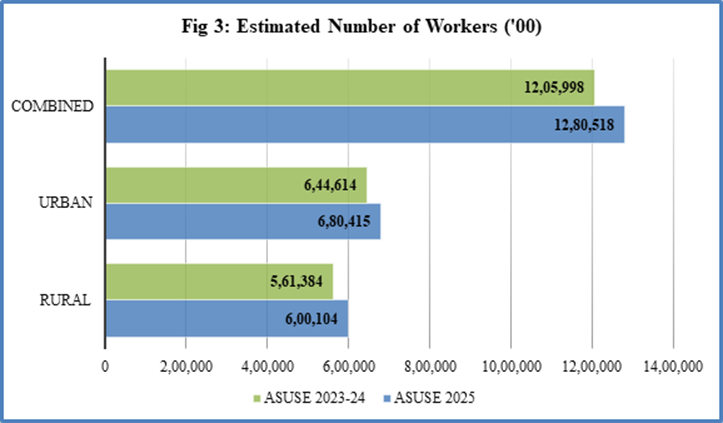
- Employment generation remained robust, with the sector employing 12.81 crore workers and adding over 74.52 lakh new jobs, reflecting a 6.18% growth. The “Other Services” segment emerged as a key driver, showing the highest growth in establishments (10.29%), highlighting the ongoing structural shift towards services.
- Economic output, measured by Gross Value Added (GVA), grew by 10.87%, reaching nearly ₹19.93 trillion. This growth was primarily driven by the trade sector (16.77%), followed by manufacturing (8.52%) and services (7.36%), indicating strong market activity and demand recovery.
- Productivity indicators also improved, with GVA per worker rising to ₹1.56 lakh, up from ₹1.49 lakh, suggesting enhanced efficiency and better utilisation of labour and capital.
- A notable trend is the rapid digital adoption, with the share of establishments using the internet increasing sharply from 26.7% to 39.4%, reflecting growing integration with the digital economy and gradual formalisation.
- Further, women entrepreneurship showed a modest but positive rise, with women-owned enterprises increasing to 27%, indicating gradual progress in gender inclusion. Wage conditions also improved, as emoluments per hired worker rose by 3.88%, suggesting a moderate increase in income levels.
- Overall, the findings highlight that India’s informal sector is not only expanding in size and employment but is also undergoing a qualitative transformation through improved productivity, digital penetration, and inclusivity, pointing towards a gradual transition from informality to semi-formalisation.
- The ASUSE 2025 results reveal a broad-based expansion and increasing resilience of India’s unincorporated sector. The number of establishments grew from 7.34 crore to 7.92 crore, registering a 7.97% increase, indicating a strong revival and expansion of informal economic activity.
-
Conclusion:
The ASUSE 2025 results underline that India’s unincorporated sector remains a dynamic engine of employment and economic activity. While rising digital adoption and productivity gains are encouraging, challenges like low formalisation, limited credit access, and vulnerability persist. A targeted policy approach focusing on digital inclusion, financial access, and social security is essential to transform this sector into a stronger pillar of sustainable and inclusive growth.



