
Context
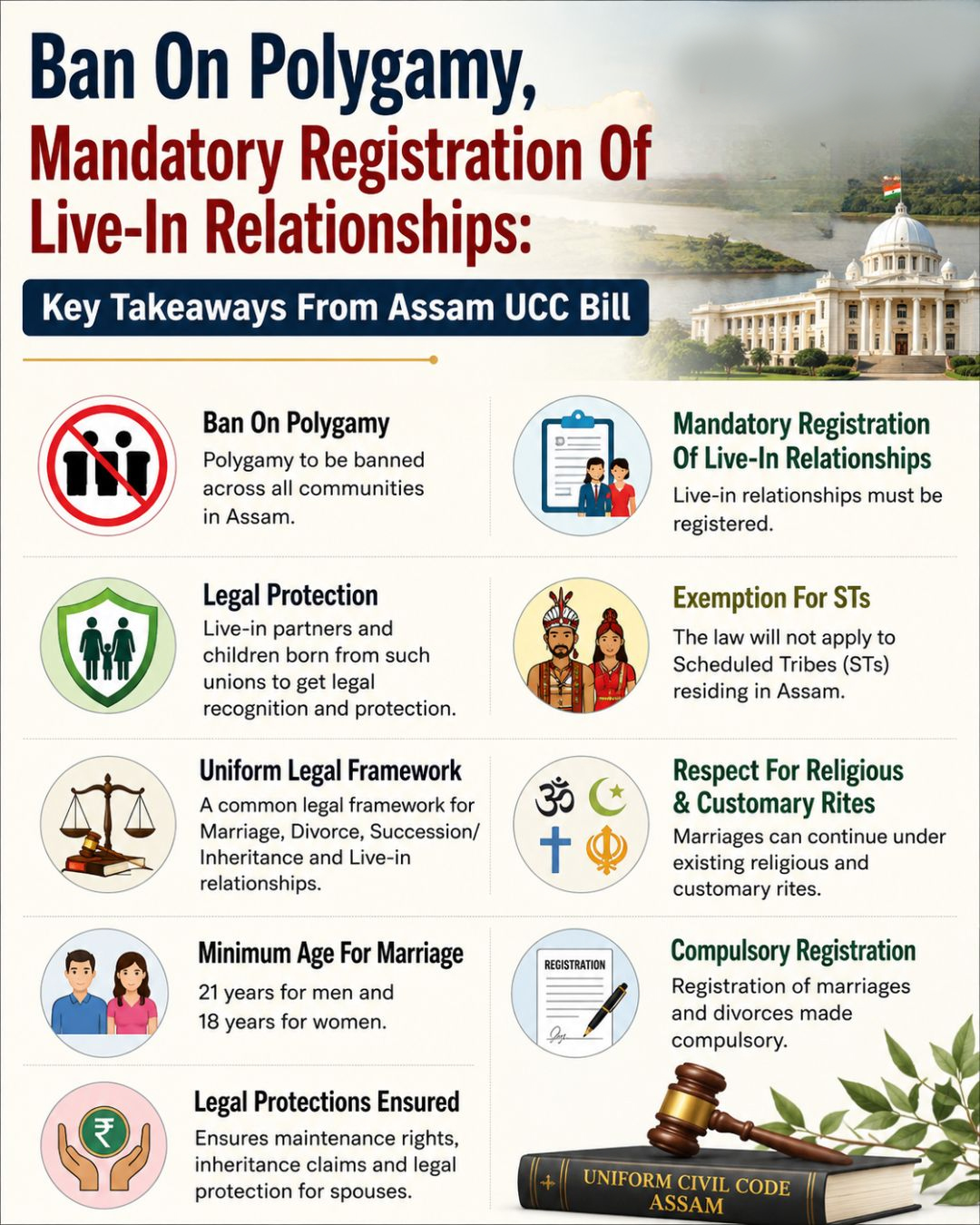
Recently, the Government of Assam introduced a Uniform Civil Code (UCC) Bill aimed at bringing uniformity in personal laws related to marriage, divorce, succession, and live-in relationships. The Bill seeks to create a common legal framework for all residents of Assam, although it exempts Scheduled Tribes, who form a significant portion of the state’s population.
Objective of the Bill:
The primary objective of the Assam UCC Bill is to establish a uniform system governing personal laws. It aims to standardise rules for marriage and divorce, regulate live-in relationships, and create a uniform inheritance framework. It also seeks to ensure legal consistency for all residents of Assam, including those living outside the state.
Key Provisions:
-
-
- Marriage Regulations: The Bill sets minimum marriage age at 21 for men and 18 for women and mandates free consent without coercion or fraud. It prohibits marriage within 37 degrees of prohibited relationships (including first cousins). All marriages must be registered within 60 days, including those performed outside Assam, and records will be open for inspection.
- Divorce Provisions: A uniform divorce system is introduced with mandatory registration within 60 days of court decree. Recognised grounds include cruelty, desertion, and mutual consent, ensuring standardisation across communities.
- Live-in Relationship Regulation: The Bill mandates compulsory registration of live-in relationships, even for Assam residents living outside the state. Termination must also be registered. Registration is denied in cases of minority, existing marriage, prohibited relationships, or invalid consent.
- Penalties:
- Up to 3 months’ imprisonment or ₹10,000 fine for non-registration
- Up to 6 months’ imprisonment or ₹25,000 fine for continued non-compliance
- It also grants maintenance rights to deserted women and recognises children from such relationships as legitimate.
- Up to 3 months’ imprisonment or ₹10,000 fine for non-registration
- Succession and Inheritance: The Bill introduces a uniform, gender-neutral inheritance system for intestate succession. Class I heirs include spouse, children, and parents, aiming to simplify disputes and ensure equality across communities.
- Marriage Regulations: The Bill sets minimum marriage age at 21 for men and 18 for women and mandates free consent without coercion or fraud. It prohibits marriage within 37 degrees of prohibited relationships (including first cousins). All marriages must be registered within 60 days, including those performed outside Assam, and records will be open for inspection.
-
About Uniform Civil Code (UCC):
-
-
- The UCC, under Article 44 of the Directive Principles of State Policy, proposes a common set of personal laws for all citizens covering marriage, divorce, inheritance, adoption, and succession. India currently follows religion-based personal laws, though states like Uttarakhand and Gujarat have initiated UCC-related frameworks.
- While the UCC aims to promote equality, gender justice, and national integration, it also faces criticism over concerns related to religious freedom and cultural diversity.
- The UCC, under Article 44 of the Directive Principles of State Policy, proposes a common set of personal laws for all citizens covering marriage, divorce, inheritance, adoption, and succession. India currently follows religion-based personal laws, though states like Uttarakhand and Gujarat have initiated UCC-related frameworks.
-
Important Decisions of the Supreme Court:
-
-
- Sarla Mudgal (1995): Highlighted the need for a UCC to prevent misuse of religious conversion for bigamy.
- Shayara Bano (2017): Struck down triple talaq, prioritising gender justice and equality over discriminatory practices in personal law.
- Sarla Mudgal (1995): Highlighted the need for a UCC to prevent misuse of religious conversion for bigamy.
-
Conclusion:
The Assam UCC Bill represents a major step toward legal uniformity in personal laws. While it aims to promote equality, clarity, and modernisation of family laws, it also raises significant debates on privacy, diversity, and constitutional balance. Its evolution will play an important role in shaping India’s broader discourse on the Uniform Civil Code.



