
Artemis 2 Mission
Context:
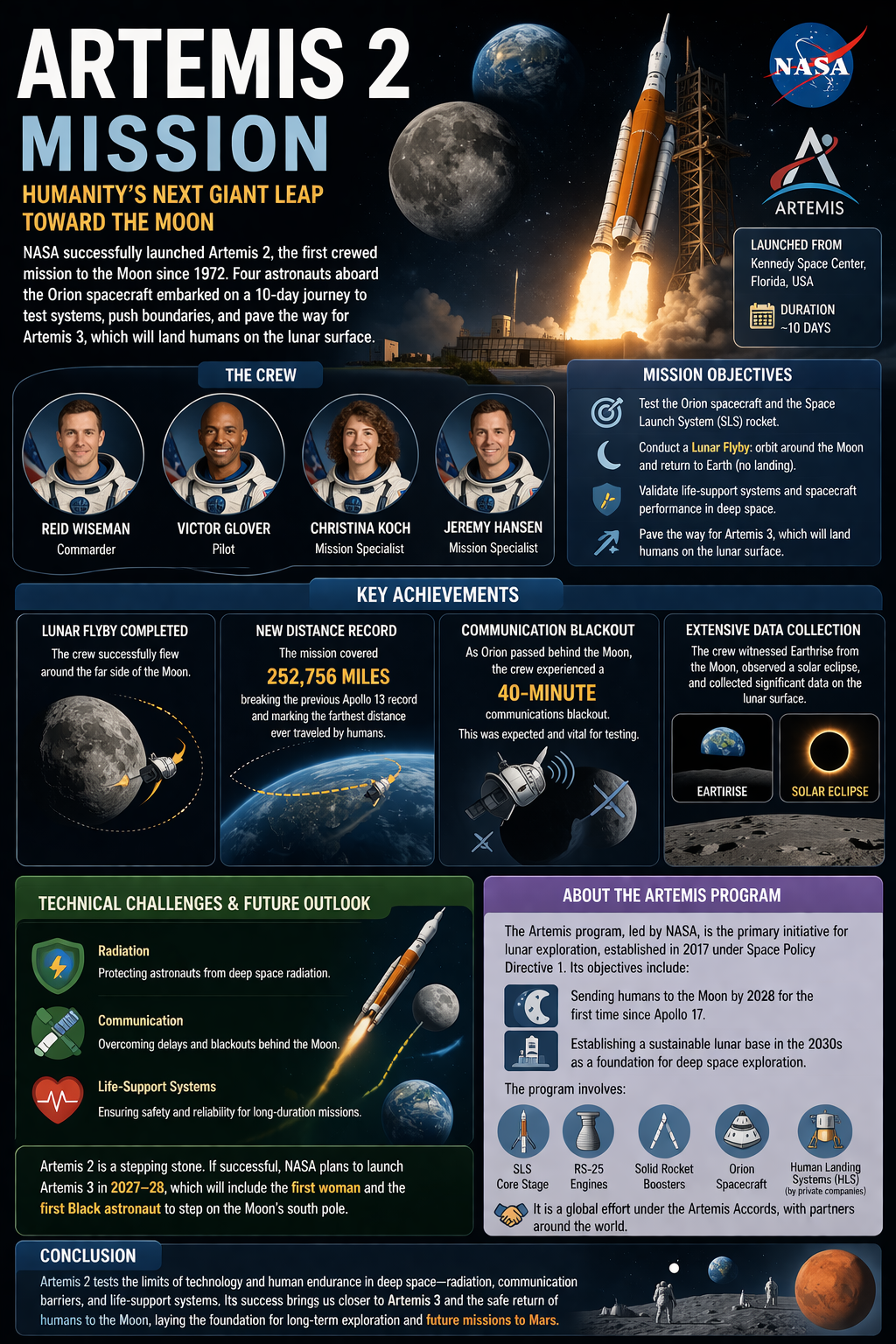
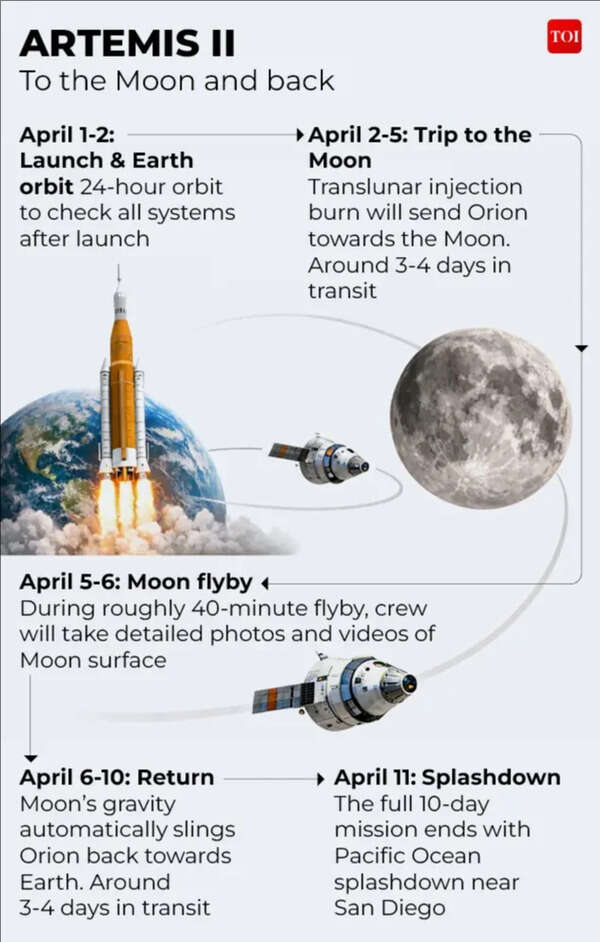
Recently, NASA successfully launched the second phase of the Artemis Mission, Artemis 2, from the Kennedy Space Center in Florida. This is the first crewed mission to the Moon since 1972, with four astronauts, Reid Wiseman, Victor Glover, Christina Koch and Jeremy Hansen, embarking on a 10-day journey aboard the Orion capsule.
Mission Objectives:
-
-
- The primary goal of Artemis 2 is to test the capabilities of the Orion spacecraft and the Space Launch System (SLS) rocket.
It is a Lunar Flyby mission, meaning the astronauts will not land on the Moon but will orbit around it and return to Earth. - Through this mission, NASA aims to ensure that life-support systems function reliably in deep space, paving the way for future Artemis 3 missions, which will safely land humans on the lunar surface.
- The primary goal of Artemis 2 is to test the capabilities of the Orion spacecraft and the Space Launch System (SLS) rocket.
-
Key Achievements:
-
-
- Lunar Flyby Completed: The crew successfully flew around the far side of the Moon.
- New Distance Record: The mission covered 252,756 miles, breaking the previous Apollo 13 record, marking the farthest distance ever traveled by humans.
- Communication Blackout: As the Orion spacecraft passed behind the Moon, the crew experienced a 40-minute communications blackout, which was expected and vital for testing.
- Extensive Data Collection: The crew witnessed Earthrise from the Moon, observed a solar eclipse, and collected significant data on the lunar surface.
- Lunar Flyby Completed: The crew successfully flew around the far side of the Moon.
-
Technical Challenges and Future Outlook:
This mission is a stepping stone toward sending humans to the Moon. Artemis 2 helps scientists understand how to deal with radiation and communication challenges in deep space. If successful, NASA plans to launch Artemis 3 in 2027–28, which will include the first woman and the first Black astronaut to step on the Moon’s south pole.
About the Artemis Program:
-
-
- The Artemis program, led by NASA, is the primary initiative for lunar exploration, established in 2017 under Space Policy Directive 1. Its objectives include:
- Sending humans to the Moon by 2028 for the first time since Apollo 17.
- Establishing a sustainable lunar base in the 2030s as a foundation for deep space exploration.
- The program involves the Space Launch System (SLS) core stage, RS-25 engines, solid rocket boosters, Orion spacecraft, and Human Landing Systems (HLS) developed by private companies, with international collaboration under the Artemis Accords.
- The Artemis program, led by NASA, is the primary initiative for lunar exploration, established in 2017 under Space Policy Directive 1. Its objectives include:
-
Conclusion:
This mission not only tests technical capabilities through lunar orbit but also aids in understanding the challenges of human missions in deep space, such as radiation, communication barriers, and life, support systems. Its success will enable the safe return of humans to the Moon under the Artemis III mission, thereby strengthening the foundation for long-term space exploration and future missions to Mars.



