
Context:
Recently, the Defence Research and Development Organisation (DRDO) has shortlisted three contenders to design and develop prototypes for the Advanced Medium Combat Aircraft (AMCA), India’s ambitious indigenous fifth-generation stealth fighter. The shortlisted entities are Tata Advanced Systems Ltd (TASL), two consortia led by L&T, Bharat Forge for making fighter jets.
About the AMCA:
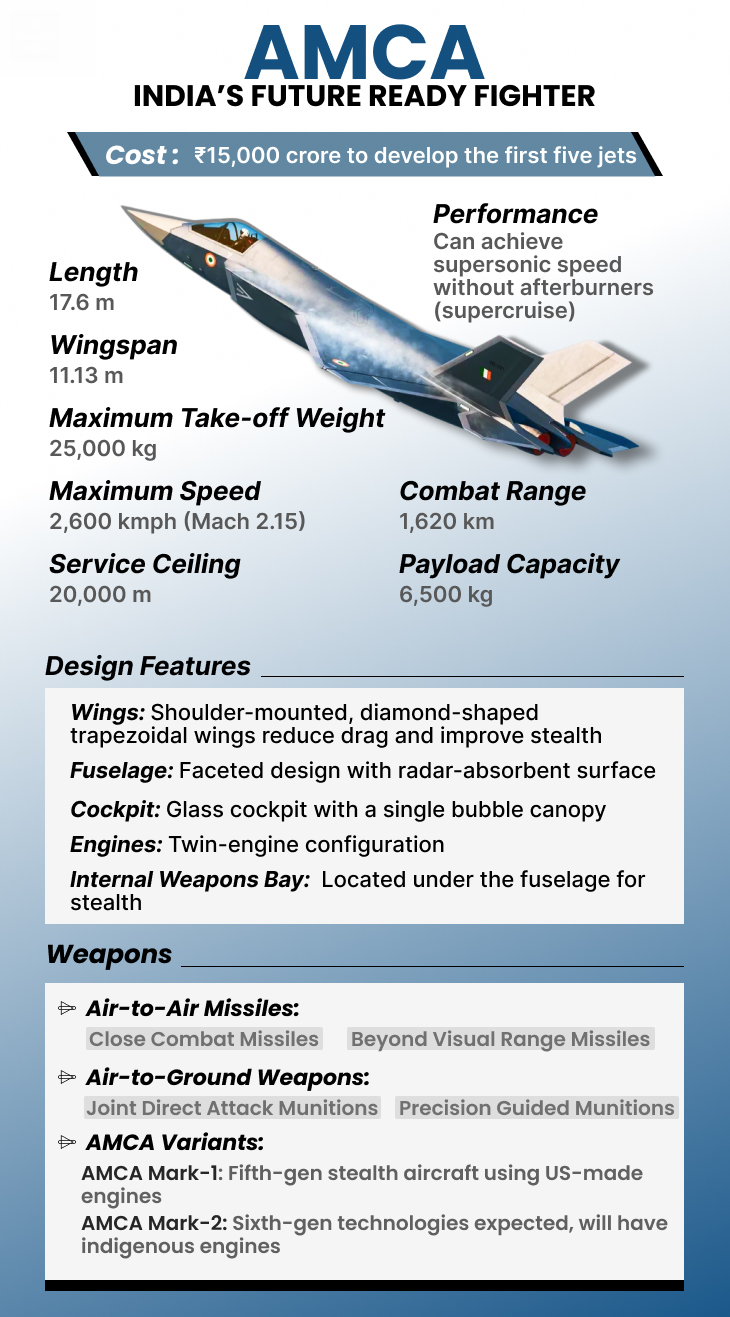
The AMCA is a single-seat, twin-engine, all-weather multirole stealth fighter being developed for the Indian Air Force (IAF) and the Indian Navy. Designed by the Aeronautical Development Agency (ADA), an autonomous design body under the Ministry of Defence, the aircraft aims to combine advanced stealth capabilities with supercruise performance, internal weapons bays, and multirole operational versatility.
Intended Roles and Capabilities:
-
-
-
- Air supremacy and ground-strike operations
- Suppression of Enemy Air Defences (SEAD)
- Electronic warfare missions
- Optimised design for low radar cross-section and supercruise capability
- Planned to replace the Sukhoi Su-30MKI, the backbone of the IAF fighter fleet
- Air supremacy and ground-strike operations
-
-
Timeline:
Serial production is expected to begin by 2035, with over 125 aircraft planned for induction. The AMCA will make India one of the few countries operating fifth-generation fighters alongside the United States (F-22/F-35), China (J-20), and Russia (Su-57).
Development History:
-
-
-
- The AMCA programme originated as the Medium Combat Aircraft (MCA) programme, launched in 2010, parallel to the Indo-Russia Sukhoi/HAL FGFA project. Originally envisioned as a 20-tonne-class fighter, the current AMCA design has evolved into a 25-tonne-class aircraft, reflecting advancements in avionics, stealth coatings, and engine technology.
- As of February 2025, the programme is in the prototype development phase, following the completion of:
- Feasibility study
- Preliminary design stage
- Detailed design phase
- Feasibility study
- Currently, the AMCA is India’s only fifth-generation fighter under development, symbolising a significant leap in domestic aerospace capability.
- The AMCA programme originated as the Medium Combat Aircraft (MCA) programme, launched in 2010, parallel to the Indo-Russia Sukhoi/HAL FGFA project. Originally envisioned as a 20-tonne-class fighter, the current AMCA design has evolved into a 25-tonne-class aircraft, reflecting advancements in avionics, stealth coatings, and engine technology.
-
-
Strategic and Industrial Significance:
-
-
-
- Boosting Indigenous Capability: The AMCA programme seeks to reduce dependence on foreign suppliers and cultivate a self-reliant aerospace industrial base.
- Technological Advancement: Prototype funding and development are expected to encourage innovations in stealth technology, avionics, propulsion systems, and composite materials.
- Enhancing Air Power: The AMCA will modernise India’s fighter fleet, complementing acquisitions such as Rafale jets and P-8I maritime surveillance aircraft, thereby enhancing operational flexibility and strategic autonomy in the Indo-Pacific region.
- Boosting Indigenous Capability: The AMCA programme seeks to reduce dependence on foreign suppliers and cultivate a self-reliant aerospace industrial base.
-
-
Way Forward:
The shortlisted firms will now receive government funding to build AMCA prototypes. Final manufacturing rights will be granted following successful prototype validation, ensuring a multi-stage, quality-driven approach to development. With private sector participation at the forefront, the AMCA project exemplifies India’s strategic ambition to emerge as a hub for advanced military aviation technology, potentially transforming the country’s aerospace and defence landscape by the mid-2030s.



