
Context:
Recently, India successfully test-fired the Agni-IV Intermediate-Range Ballistic Missile (IRBM) from the Integrated Test Range (ITR), Chandipur, Odisha, under the aegis of the Strategic Forces Command (SFC). The successful launch validated all operational and technical parameters, reaffirming the missile's operational readiness and strengthening India's strategic deterrence capability.
About Agni-IV:
Agni-IV is an indigenously developed, nuclear-capable Intermediate-Range Ballistic Missile (IRBM) designed by the Defence Research and Development Organisation (DRDO). It is part of the Agni missile series, developed under the Integrated Guided Missile Development Programme (IGMDP), and forms a key component of India's credible minimum deterrence and No First Use (NFU) nuclear doctrine.
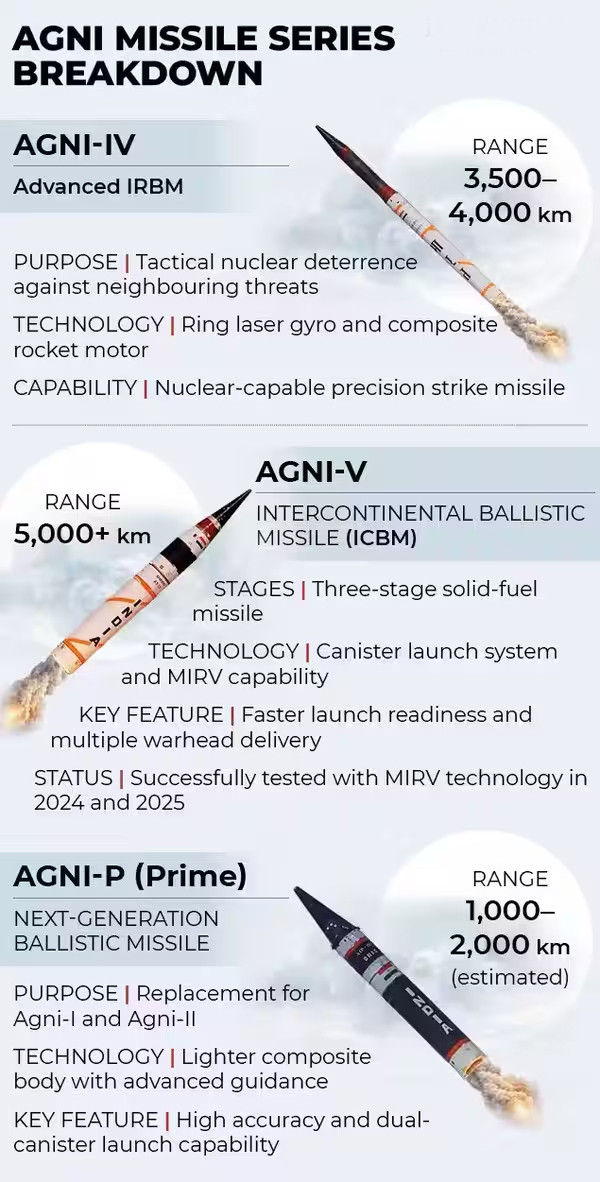
Key Features:
-
-
- Agni-IV is a two-stage, solid-fuel-powered, nuclear-capable Intermediate-Range Ballistic Missile (IRBM).
- It has a strike range of 3,500–4,000 km.
- The missile is approximately 20 metres long and weighs around 17 tonnes.
- It can carry a 1,000 kg conventional or nuclear warhead.
- Agni-IV is deployed on a road-mobile and canister-compatible launch platform, ensuring rapid deployment, enhanced mobility, and greater survivability.
- It is equipped with a Ring Laser Gyroscope-based Inertial Navigation System (RINS) integrated with a Micro Navigation System (MINS), enabling highly accurate target engagement.
- Additionally, the missile features an advanced Re-entry Heat Shield, capable of withstanding temperatures exceeding 3,000°C during atmospheric re-entry, thereby protecting the warhead and onboard electronic systems.
- Agni-IV is a two-stage, solid-fuel-powered, nuclear-capable Intermediate-Range Ballistic Missile (IRBM).
-
Significance:
Agni-IV significantly enhances India's long-range precision strike capability and provides credible deterrence against regional threats. Its solid-fuel propulsion and mobile launch platform ensure quick deployment, while indigenous technologies reduce dependence on foreign systems and strengthen the Aatmanirbhar Bharat initiative in defence manufacturing. The missile complements India's strategic triad and enhances national security by supporting a robust second-strike capability.
Agni Missile Series:
The Agni series represents India's family of nuclear-capable ballistic missiles with varying operational ranges:
-
-
- Agni-I: 700–1,200 km (Short Range).
- Agni-II: 2,000–3,000 km (Medium Range).
- Agni-III: 3,000–3,500 km (Intermediate Range).
- Agni-IV: 3,500–4,000 km (Advanced Intermediate Range).
- Agni-V: 5,000–5,500+ km (Long Range, Canisterised).
- Agni-Prime (Agni-P): 1,000–2,000 km; next-generation, lighter, highly manoeuvrable missile.
- Agni-I: 700–1,200 km (Short Range).
-
Conclusion:
The successful test of Agni-IV reinforces India's strategic deterrence architecture and showcases the country's growing self-reliance in advanced defence technologies. As a vital element of India's nuclear doctrine, the missile enhances national security while contributing to regional strategic stability through a credible and reliable deterrence posture.



