
Aghanashini–Vedavathi River-Linking Project: UNESCO Concerns and Environmental Impact
Context:
The UNESCO has recently raised concerns regarding India’s proposed Aghanashini–Vedavathi river-linking project in Karnataka. The organization has urged India to strictly adhere to World Heritage conservation norms, as the project could potentially impact ecologically sensitive regions, including areas associated with the Western Ghats World Heritage Site.
About the Aghanashini–Vedavathi River-Linking Project:
-
-
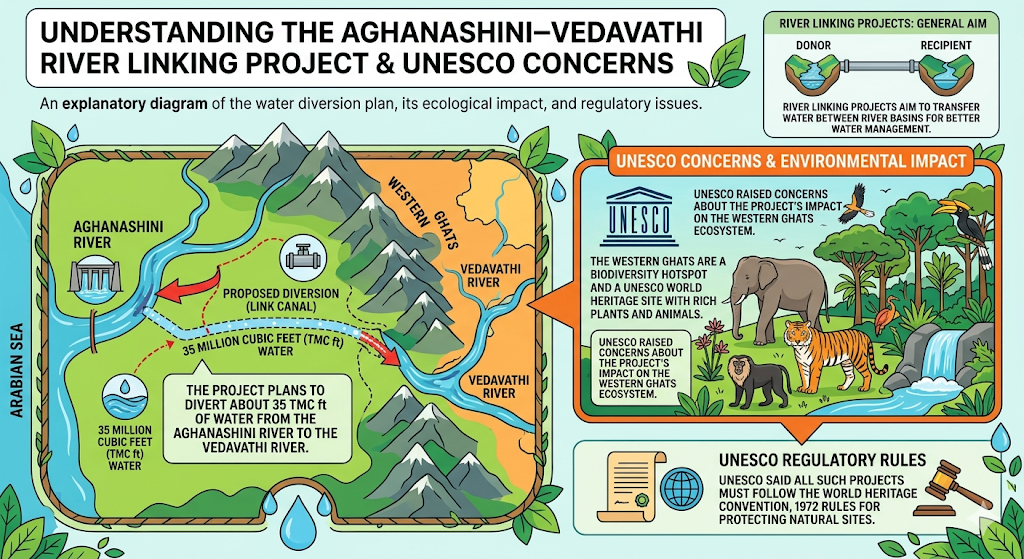
- The project proposes to divert approximately 35 TMC ft of water from the Aghanashini River to the Vedavathi River. Its primary objectives include drought mitigation and improving irrigation and drinking water supply in water-scarce regions. The initiative forms part of India’s broader river interlinking programme aimed at optimizing water distribution across regions.
- The Aghanashini River is considered a pristine, free-flowing river known for its rich estuarine ecosystems and minimal human interference. In contrast, the Vedavathi River, a tributary of the Krishna River, flows through drought-prone areas and faces seasonal water shortages. Importantly, the project region overlaps with the Western Ghats, which significantly raises ecological concerns.
- The project proposes to divert approximately 35 TMC ft of water from the Aghanashini River to the Vedavathi River. Its primary objectives include drought mitigation and improving irrigation and drinking water supply in water-scarce regions. The initiative forms part of India’s broader river interlinking programme aimed at optimizing water distribution across regions.
-
UNESCO’s Observations:
-
-
- UNESCO has emphasized strict compliance with the World Heritage Convention, highlighting that development projects must follow sustainable practices and avoid disturbing ecological balance. It reiterated that member states bear the responsibility of protecting heritage sites.
- The organization also expressed concern about ecologically fragile areas such as the Western Ghats, one of the world’s most important biodiversity hotspots. It stressed that any intervention must not adversely affect natural hydrology or essential ecosystem services.
- Significance of the Observations:
- The observations have major implications for India, particularly in balancing development needs with environmental conservation. They bring attention to the persistent conflict between infrastructure expansion and ecological sustainability, especially in sensitive regions.
- UNESCO’s intervention reflects growing international scrutiny of environmental governance. It also underscores the need for robust Environmental Impact Assessments (EIA) and sustainable river basin planning to ensure that development does not compromise ecological integrity.
- UNESCO has emphasized strict compliance with the World Heritage Convention, highlighting that development projects must follow sustainable practices and avoid disturbing ecological balance. It reiterated that member states bear the responsibility of protecting heritage sites.
-
About UNESCO:
UNESCO was established in 1945 and is headquartered in Paris, France. Its core objective is to promote education, science, culture and communication while fostering peace through international cooperation.
World Heritage Convention, 1972:
Adopted on 16 November 1972 in Paris and enforced in 1975, this international treaty aims to protect cultural and natural heritage of “Outstanding Universal Value (OUV).” It has nearly universal membership with around 196 countries.
World Heritage Committee:
Constituted under UNESCO, the committee consists of 21 member countries. It selects World Heritage Sites, monitors conservation efforts, and provides financial and technical assistance.
India & World Heritage Convention:
India ratified the convention in 1977 and hosts several cultural and natural heritage sites, including the Taj Mahal and the Western Ghats.
Conclusion:
UNESCO’s advisory on the Aghanashini–Vedavathi project highlights the importance of aligning development initiatives with global conservation standards. It serves as a crucial example for India in addressing the challenge of balancing economic growth with the preservation of ecologically fragile regions like the Western Ghats, reinforcing the need for sustainable and responsible development.



