
Context:
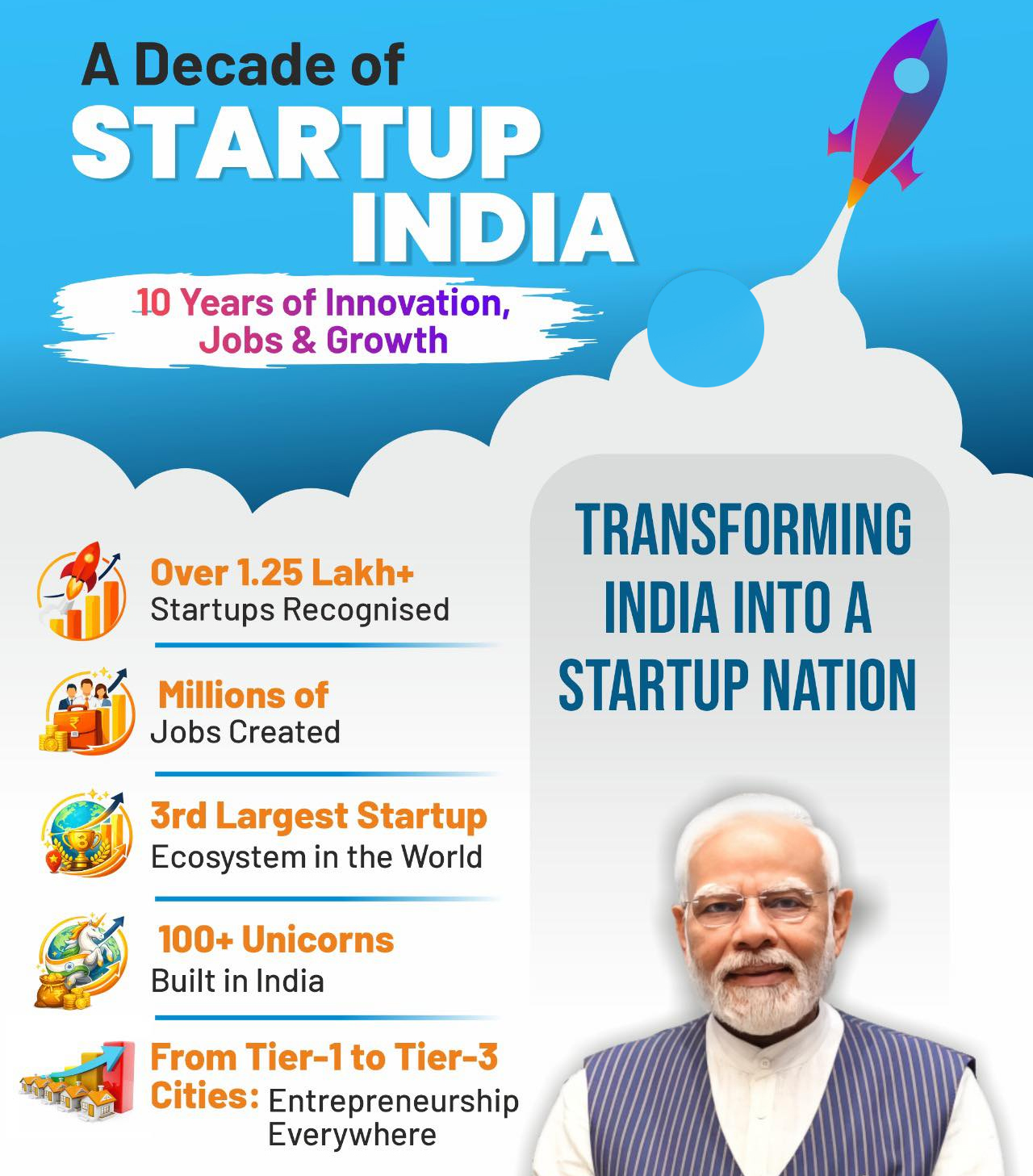
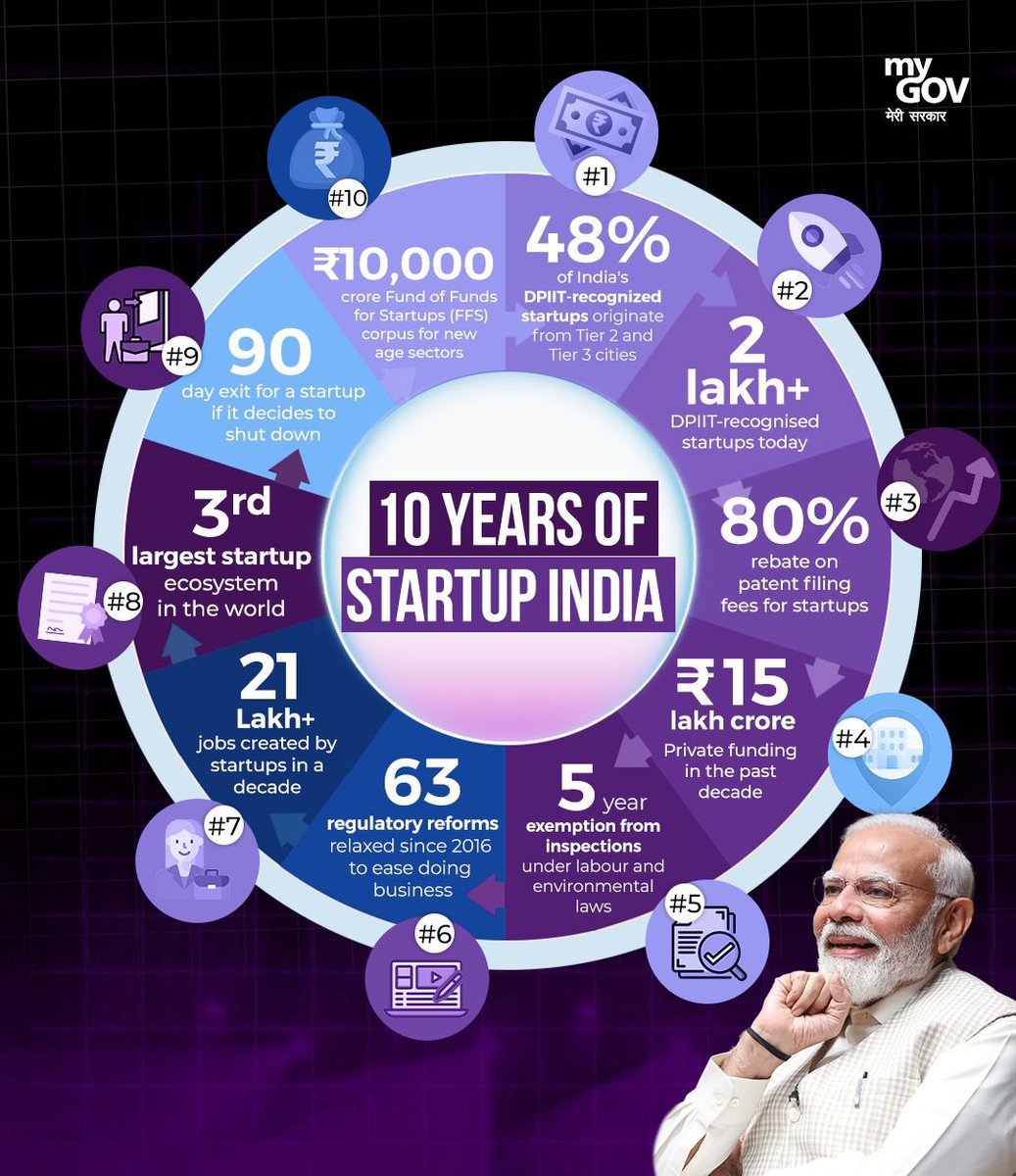
January 16, 2026, marks a decade of the Startup India Initiative, launched in 2016 under the Department for Promotion of Industry and Internal Trade (DPIIT), Ministry of Commerce and Industry. Over the past ten years, the initiative has transformed India into one of the world’s largest startup ecosystems, with over 2 lakh DPIIT-recognised startups as of December 2025. Notably, around 50% of these startups originate from Tier-II and Tier-III cities, reflecting the democratisation of entrepreneurship and the promotion of inclusive regional development.
Role of Startups in India’s Economy:
-
-
-
- Startups have emerged as a vital pillar of India’s economic transformation by:
- Driving technological innovation and productivity
- Generating employment opportunities, both direct and indirect
- Promoting financial inclusion and digital adoption
- Bridging rural–urban divides through solutions in agri-tech, telemedicine, microfinance, ed-tech, and clean energy
- Driving technological innovation and productivity
- Women-led startups have played a critical role in advancing inclusive growth, with over 45% of recognised startups having at least one woman Director or Partner. This underscores entrepreneurship as a powerful lever for both economic empowerment and social equity.
- Startups have emerged as a vital pillar of India’s economic transformation by:
-
-
Key Government Initiatives and Platforms:
1. Funding and Finance:
-
-
-
-
- Fund of Funds for Startups (FFS): A ₹10,000 crore corpus invested through over 140 Alternative Investment Funds (AIFs), supporting more than 1,370 startups.
- Credit Guarantee Scheme for Startups (CGSS): Facilitates collateral-free loans for eligible startup borrowers.
- Startup India Seed Fund Scheme (SISFS): A ₹945 crore allocation to over 215 incubators for early-stage startup support.
- Fund of Funds for Startups (FFS): A ₹10,000 crore corpus invested through over 140 Alternative Investment Funds (AIFs), supporting more than 1,370 startups.
-
-
-
2. Ecosystem Development:
-
-
-
-
- Startup India Hub: A digital platform connecting startups with investors, mentors, incubators, and corporate partners.
- National Mentorship Portal (MAARG): Provides strategic and sectoral guidance to startups through structured mentorship.
- States’ Startup Ranking Framework (SRF): Encourages competitive federalism in promoting startup ecosystems across states.
- Startup India Hub: A digital platform connecting startups with investors, mentors, incubators, and corporate partners.
-
-
-
3. Innovation and Deep-Tech Programmes:
-
-
-
-
- Atal Innovation Mission (AIM 1.0 & 2.0): Fosters innovation through Atal Tinkering Labs, Community Innovator Fellowship, Youth Co:Lab, and targeted programmes for underserved regions.
- GENESIS and MeitY Startup Hub: Promote deep-tech innovation, particularly in Tier-II and Tier-III cities.
- TIDE 2.0 and NIDHI Programmes: Support ICT- and technology-driven entrepreneurship, with a focus on Tier-II/III cities, women entrepreneurs, and persons with special abilities.
- Atal Innovation Mission (AIM 1.0 & 2.0): Fosters innovation through Atal Tinkering Labs, Community Innovator Fellowship, Youth Co:Lab, and targeted programmes for underserved regions.
-
-
-
4. Rural and Grassroots Entrepreneurship:
-
-
-
-
- Startup Village Entrepreneurship Programme (SVEP): Has supported over 3.74 lakh rural enterprises, strengthening local livelihoods.
- ASPIRE: Promotes innovation, skilling, and micro-enterprise creation in rural areas.
- PMEGP: Provides margin money support for self-employment and grassroots enterprise creation, with special incentives for SC/ST communities, women, and aspirational regions.
- Startup Village Entrepreneurship Programme (SVEP): Has supported over 3.74 lakh rural enterprises, strengthening local livelihoods.
-
-
-
Impact Over a Decade:
-
-
-
- Growth from 4 unicorns in 2014 to over 120 high-value startups, collectively valued at more than $350 billion.
- Strong representation from smaller cities, signalling decentralised and inclusive innovation.
- Structural integration of startups across key sectors such as agri-tech, clean mobility, ed-tech, and financial inclusion.
- Generation of employment for lakhs of youth, alongside facilitation of technology transfer, industrial collaboration, and global market access.
- Growth from 4 unicorns in 2014 to over 120 high-value startups, collectively valued at more than $350 billion.
-
-
Way Forward:
As India transitions from rapid expansion to sustainable scaling, startups are poised to drive innovation-led economic growth, employment generation, and global competitiveness. Anchored in robust digital public infrastructure, a demographic dividend, and reform-oriented governance, startups will remain central to India’s vision of a $7.3 trillion economy by 2030 and the broader Viksit Bharat 2047 roadmap.
Conclusion:
A decade of Startup India exemplifies the evolution of India’s innovation ecosystem from a policy initiative into a structural driver of economic growth. By fostering inclusivity, regional balance, deep-tech advancement, and global integration, startups are not only shaping India’s present economic trajectory but also embodying the nation’s aspiration to emerge as a future-ready, innovation-led economy.



