
Context:
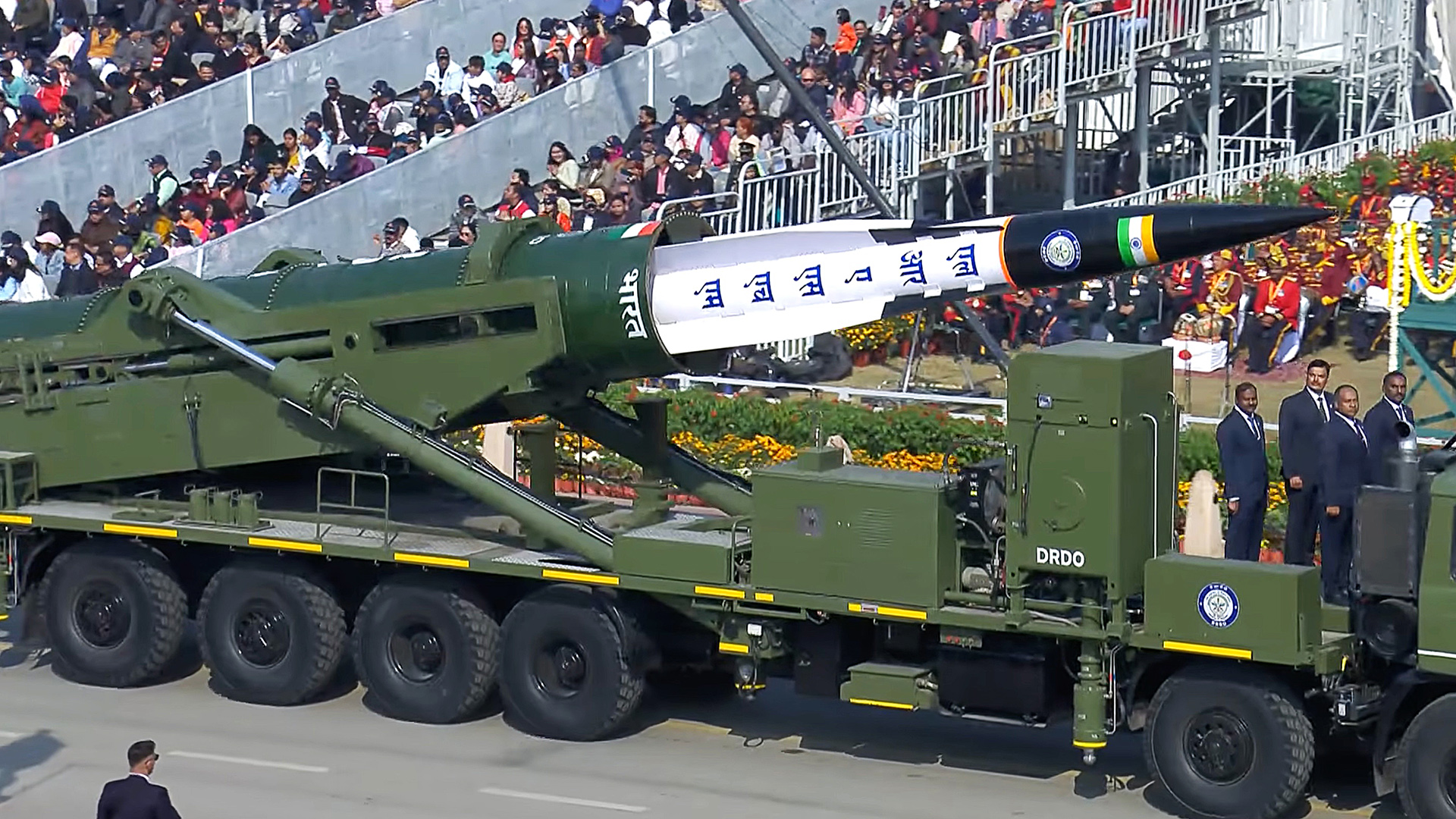
At the 77th Republic Day Parade on 26 January 2026, India’s Defence Research and Development Organisation (DRDO) unveiled the Long Range Anti-Ship Hypersonic Missile (LR-AShM), a watershed achievement in the country’s defence technology landscape.
About LR-AShM:
-
-
- The LR-AShM is a hypersonic glide missile developed by DRDO to engage both static and moving sea targets at extended ranges of approximately 1,500 kilometres. It was showcased alongside its mobile launcher during the Republic Day parade at Kartavya Path, New Delhi.
- The missile follows a quasi-ballistic trajectory, beginning like a ballistic missile but operating at lower altitudes with atmospheric “skips”, enabling high agility and reduced detectability. It achieves hypersonic speeds, initial bursts around Mach 10 and sustaining an average of Mach 5 making it difficult for enemy radars and air-defence systems to detect or intercept.
- The LR-AShM is a hypersonic glide missile developed by DRDO to engage both static and moving sea targets at extended ranges of approximately 1,500 kilometres. It was showcased alongside its mobile launcher during the Republic Day parade at Kartavya Path, New Delhi.
-
Key Technological Features:
-
-
- Hypersonic Flight and Manoeuvrability: The LR-AShM uses a two-stage solid propulsion rocket system. The first stage accelerates the missile to hypersonic velocity, after which the second stage propels it further before transitioning into an unpowered glide phase marked by controlled manoeuvres that enhance survivability and unpredictability.
- Low Detectability: Flying at low altitude at hypersonic speeds, the missile evades ground-based and ship-borne radar systems, reducing enemy reaction times and neutralising layered air-defence responses.
- Indigenous Technologies: The LR-AShM is built with fully indigenous avionics, sensor packages, and guidance systems, reflecting India’s push towards Atmanirbhar Bharat in defence technology.
- Hypersonic Flight and Manoeuvrability: The LR-AShM uses a two-stage solid propulsion rocket system. The first stage accelerates the missile to hypersonic velocity, after which the second stage propels it further before transitioning into an unpowered glide phase marked by controlled manoeuvres that enhance survivability and unpredictability.
-
Strategic Significance:
-
-
- Enhanced Sea-Denial Capability: By enabling long-range anti-ship strikes, the LR-AShM significantly strengthens India’s sea-denial posture, a critical aspect in the strategically vital IOR, where naval influence directly impacts commerce, security, and geopolitical stability.
- Rapid Response and Deterrence: With its hypersonic speed, the missile can traverse its maximum range in roughly 15 minutes, dramatically shrinking enemy decision and reaction windows. This compresses the sensor-to-shooter cycle and increases deterrence against maritime adversaries.
- Multi-Domain Potential: While the initial focus is on coastal battery deployment for the Indian Navy, future variants could see ship-launched, air-launched, and even Army or Air Force derivatives, making it a versatile, multi-platform asset.
- Enhanced Sea-Denial Capability: By enabling long-range anti-ship strikes, the LR-AShM significantly strengthens India’s sea-denial posture, a critical aspect in the strategically vital IOR, where naval influence directly impacts commerce, security, and geopolitical stability.
-
Implications:
-
-
- The unveiling of the LR-AShM positions India within the elite group of nations possessing advanced hypersonic weapon capabilities, alongside the United States, Russia, and China. This breakthrough underscores India’s progress in materials science, propulsion technologies, and high-speed aerodynamics, critical for sustained hypersonic flight and manoeuvrability.
- Beyond glide vehicles like LR-AShM, DRDO is also pursuing hypersonic cruise missile technologies driven by scramjet propulsion systems, reflecting a two-pronged approach to hypersonic warfare capability development.
- The unveiling of the LR-AShM positions India within the elite group of nations possessing advanced hypersonic weapon capabilities, alongside the United States, Russia, and China. This breakthrough underscores India’s progress in materials science, propulsion technologies, and high-speed aerodynamics, critical for sustained hypersonic flight and manoeuvrability.
-
Conclusion:
DRDO’s LR-AShM hypersonic missile represents a paradigm shift in India’s strategic and technological capabilities. Its integration into India’s defence architecture enhances deterrence, maritime reach, and rapid strike potential, elevating the country’s position in the global defence technology order. As India continues to innovate in next-generation weapons systems, it not only fortifies national security but also fosters greater self-reliance and technological edge in an era defined by high-speed warfare.



