
Context:
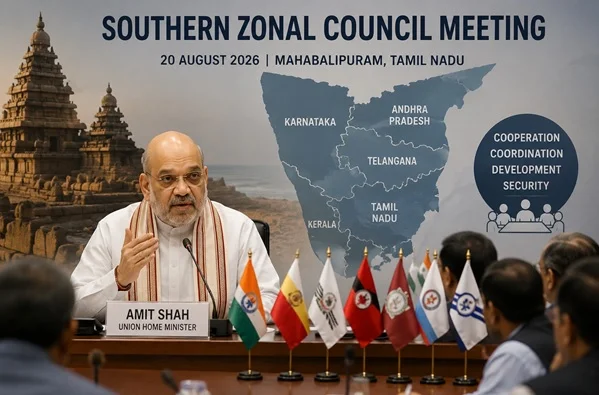
Union Home Minister Amit Shah chaired the 31st meeting of the Southern Zonal Council at Mamallapuram, Tamil Nadu, on August 20, 2026. The meeting focused on resolving pending inter-State issues, particularly water disputes, cooperative federalism, internal security and regional development.
Key Highlights of the meeting:
-
-
- The Home Minister emphasised early resolution of inter-State water disputes through dialogue and coordination among the Centre, Inter-State Council and concerned States.
- He advocated river interlinking, particularly the Godavari–Cauvery system, to strengthen long-term water security, promote inland waterways and reduce transportation costs.
- He also proposed transferring surplus floodwater through the Godavari–Krishna–Pennar–Cauvery linkage and taking up the Ganga–Cauvery link as a national project.
- The Home Minister emphasised early resolution of inter-State water disputes through dialogue and coordination among the Centre, Inter-State Council and concerned States.
-
Institutional Mechanisms:
-
-
- Zonal Councils: These are statutory bodies established under the States Reorganisation Act, 1956. The Union Home Minister serves as their common Chairman. They provide a platform for consultation and cooperation among States.
- Inter-State Council: Established under Article 263 of the Constitution, it facilitates consultation and coordination between the Union and States on matters of common interest.
- Inter-State River Water Disputes: Such disputes are governed by the Inter-State River Water Disputes Act, 1956, which provides for negotiation and, where settlement fails and statutory conditions are satisfied, adjudication through Water Disputes Tribunals.
- Zonal Councils: These are statutory bodies established under the States Reorganisation Act, 1956. The Union Home Minister serves as their common Chairman. They provide a platform for consultation and cooperation among States.
-
Other Issues that discussed:
-
-
- The Home Minister called for swift investigation and expeditious disposal of cases involving rape of women and children, including offences under the POCSO Act, through Fast Track Special Courts.
- He also highlighted malnutrition, stunting and school dropouts as major challenges affecting India's future human capital. Further, he stressed coordinated action by the Centre and States under a three-year roadmap for a drug-free India.
- The meeting also discussed fiscal federalism, delimitation, women's representation, tourism and regional development. Southern States emphasised the need for fair and equitable treatment in fiscal devolution and development, while highlighting their contribution to India's economic growth.
- The Home Minister called for swift investigation and expeditious disposal of cases involving rape of women and children, including offences under the POCSO Act, through Fast Track Special Courts.
-
Significance:
-
-
- The meeting highlights the importance of cooperative federalism in resolving inter-State disputes. Timely resolution of water disputes can strengthen water security, agricultural productivity and regional development.
- However, river interlinking requires careful assessment of ecological impacts, displacement, downstream requirements, inter-basin equity and the concerns of participating States. A sustainable approach should therefore balance developmental objectives with environmental sustainability and federal consensus.
- The meeting highlights the importance of cooperative federalism in resolving inter-State disputes. Timely resolution of water disputes can strengthen water security, agricultural productivity and regional development.
-



