
Context:
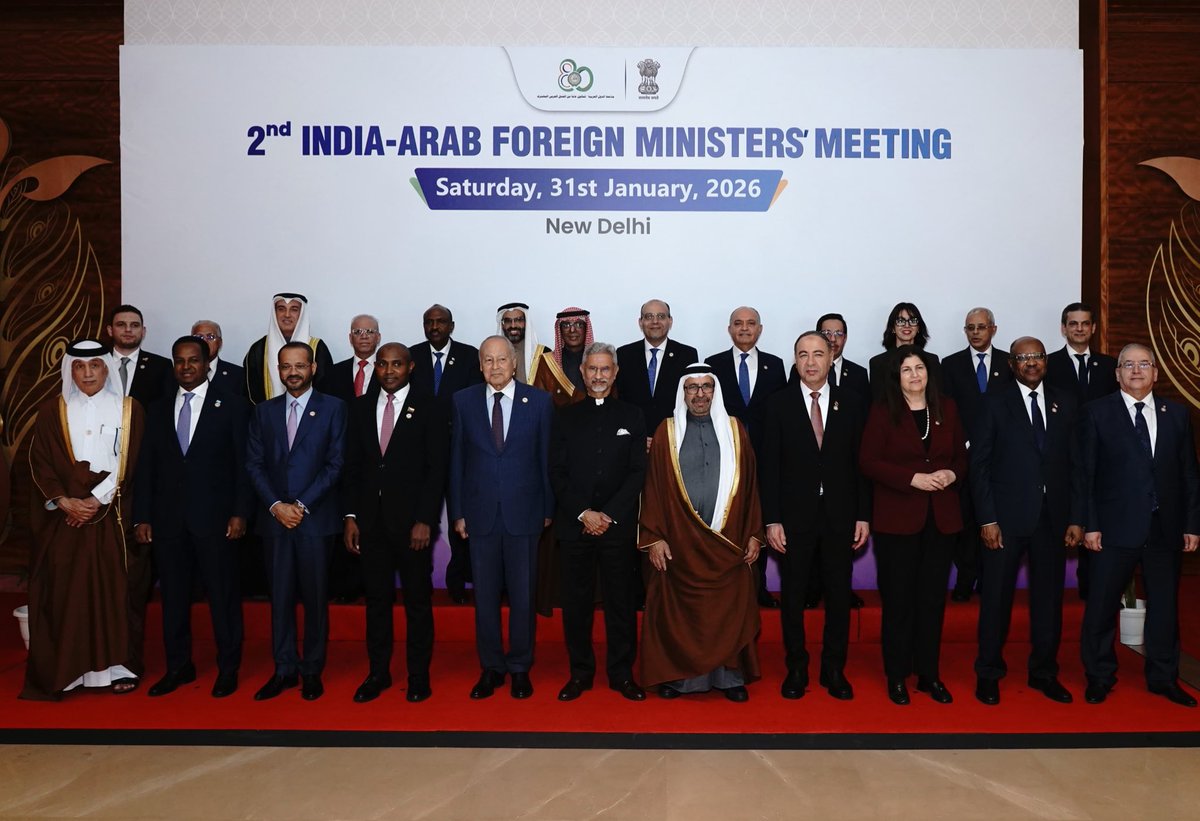
Recently, India hosted the 2nd India-Arab Foreign Ministers’ Meeting in New Delhi after a gap of ten years. The meeting was co-chaired by India and the United Arab Emirates (UAE). Foreign Ministers from all 22 member states of the Arab League, along with the League’s Secretary-General, attended the meeting to deepen political, economic, security, and cultural cooperation.
About the Arab League (League of Arab States):
-
-
- The Arab League, officially known as the League of Arab States (LAS), is a regional intergovernmental organisation comprising 22 member states from the Middle East and North Africa. It was established in Cairo on 22 March 1945 to foster political, economic, and cultural cooperation and to safeguard the sovereignty of its members.
- Each member state has one vote in the League Council, and decisions are binding only on those states that adopt them. The headquarters of the Arab League is located in Cairo, Egypt.
- The League’s members include founding states such as Egypt, Iraq, Jordan, Lebanon, Saudi Arabia, Syria, and Yemen, along with other members like Algeria, Bahrain, Kuwait, Morocco, Oman, Qatar, the UAE, and Tunisia. India holds observer status in the Arab League.
- The Arab League, officially known as the League of Arab States (LAS), is a regional intergovernmental organisation comprising 22 member states from the Middle East and North Africa. It was established in Cairo on 22 March 1945 to foster political, economic, and cultural cooperation and to safeguard the sovereignty of its members.
-
About India–Arab League Engagement:
-
-
- India’s engagement with the Arab League was formalised in March 2002 through a Memorandum of Understanding (MoU) to institutionalise political dialogue. In December 2008, the Arab–India Cooperation Forum (AICF) was established to expand cooperation across multiple sectors, with its first meeting held in January 2016 in Bahrain.
- In 2010, India’s Ambassador to Egypt was designated as the Permanent Representative to the Arab League, further strengthening diplomatic ties.
- Economic engagement between India and Arab countries is substantial, with bilateral trade exceeding USD 240 billion, including major energy imports that are vital to India’s economy. Initiatives such as the India–Arab Partnership and Investment Summit and the India–Arab Chamber of Commerce, Industry and Agriculture (2026) aim to further enhance trade, investment, technology collaboration, and people-to-people linkages.
- India’s engagement with the Arab League was formalised in March 2002 through a Memorandum of Understanding (MoU) to institutionalise political dialogue. In December 2008, the Arab–India Cooperation Forum (AICF) was established to expand cooperation across multiple sectors, with its first meeting held in January 2016 in Bahrain.
-
Key Outcomes of the 2nd Meeting:
-
-
- New Delhi Declaration and Strategic Cooperation: India and Arab states adopted the New Delhi Declaration, reaffirming cooperation across political, economic, and security domains, along with an Executive Programme (2026–28) to guide future collaboration.
- Counter-Terrorism: Both sides reaffirmed a zero-tolerance approach to terrorism, condemned cross-border terrorism, and agreed to strengthen joint efforts against terrorism and transnational crime.
- Regional Stability: Leaders discussed regional crises, including Gaza, Sudan, Yemen, Lebanon, and Libya, underscoring the need for peaceful resolution and regional stability. India reiterated its support for a just and lasting peace in the Middle East.
- Economic and Technological Cooperation: The meeting reaffirmed cooperation in trade, energy, connectivity, digital technologies, innovation, and people-to-people contacts, as outlined in the AICF’s Executive Programme.
- Institutional Momentum: The meeting generated momentum for regular high-level engagements, including future Senior Officials’ Meetings (SOMs), partnership conferences, and cultural and educational initiatives.
- New Delhi Declaration and Strategic Cooperation: India and Arab states adopted the New Delhi Declaration, reaffirming cooperation across political, economic, and security domains, along with an Executive Programme (2026–28) to guide future collaboration.
-
Conclusion:
The 2nd India-Arab Foreign Ministers’ Meeting underscores India’s expanding diplomatic footprint in West Asia and reinforces its strategic partnerships with Arab states. It institutionalises cooperation across a broad spectrum-ranging from energy security and trade to counter-terrorism and cultural exchanges, thereby aligning India’s foreign policy with evolving regional and global dynamics.



