
2026 RSF World Press Freedom Index
Context:
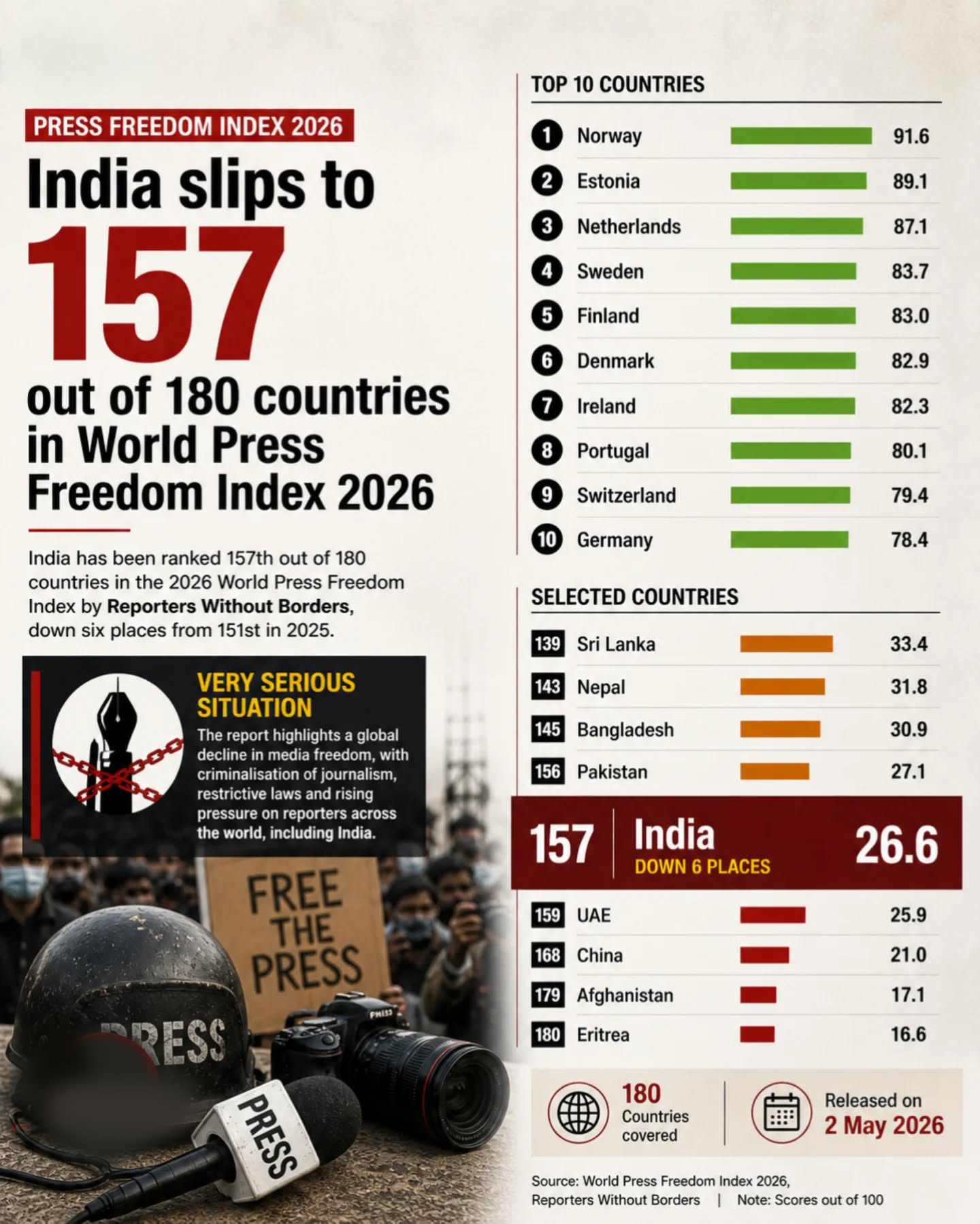
Recently, Reporters Without Borders (RSF) released the 2026 World Press Freedom Index, highlighting a sharp global decline in press freedom. The report noted that press freedom scores fell in 100 out of 180 countries and territories, while the global average score reached its lowest level in 25 years.
About the Index:
-
-
- The World Press Freedom Index is published annually by RSF since 2002. It assesses the level of press freedom in 180 countries and territories based on five indicators:
- Political context
- Legal framework
- Economic conditions
- Sociocultural environment
- Safety of journalists
- Political context
- The Index measures the ability of journalists to work freely and independently without political pressure, censorship or violence.
- The World Press Freedom Index is published annually by RSF since 2002. It assesses the level of press freedom in 180 countries and territories based on five indicators:
-
Key findings of the Index:
-
-
- For the first time, over 52% of countries were classified as having a “difficult” or “very serious” situation for journalism.
- The legal indicator recorded the steepest global decline due to increasing misuse of:
- National security laws,
- Anti-terror laws,
- Strategic lawsuits against journalists (SLAPPs).
- National security laws,
- The Middle East and North Africa remained the most dangerous region for journalists.
- Rising political pressure, violence, censorship and media monopolisation were major concerns globally.
- For the first time, over 52% of countries were classified as having a “difficult” or “very serious” situation for journalism.
-
Ranking of Countries:
-
-
- Top Ranked Countries:
- Norway
- Netherlands
- Estonia
- Denmark
- Sweden
- Norway
- Bottom Ranked Countries:
- Eritrea (180th)
- North Korea
- China
- Iran
- Saudi Arabia
- Eritrea (180th)
- Top Ranked Countries:
-
India’s Ranking:
India ranked 157th out of 180 countries, falling six places from 151st in 2025. RSF cited:
-
-
- Violence against journalists,
- Concentrated media ownership,
- Political pressure,
- Misuse of national security laws,
as key reasons for India’s poor ranking.
- Violence against journalists,
-
Implications:
-
-
- Declining press freedom weakens democracy, transparency and accountability.
- Suppression of independent journalism reduces citizens’ access to reliable information.
- Excessive state control and legal intimidation can undermine civil liberties and democratic institutions.
- Economic concentration of media ownership may reduce plurality of opinions.
- Declining press freedom weakens democracy, transparency and accountability.
-
About Reporters Without Borders:
Reporters Without Borders (RSF, Reporters sans frontières) is a Paris-based international non-governmental organization that defends the fundamental human right to access free and reliable information. Founded in 1985, it is best known for compiling the annual World Press Freedom Index and advocating for the protection of journalists globally.
Conclusion:
The 2026 RSF Index reflects growing global challenges to free and independent journalism. Protecting press freedom is essential for democratic governance, informed public discourse and protection of fundamental rights. Countries must strengthen legal safeguards, ensure journalist safety and promote independent media institutions to uphold democratic values.



