
Context:
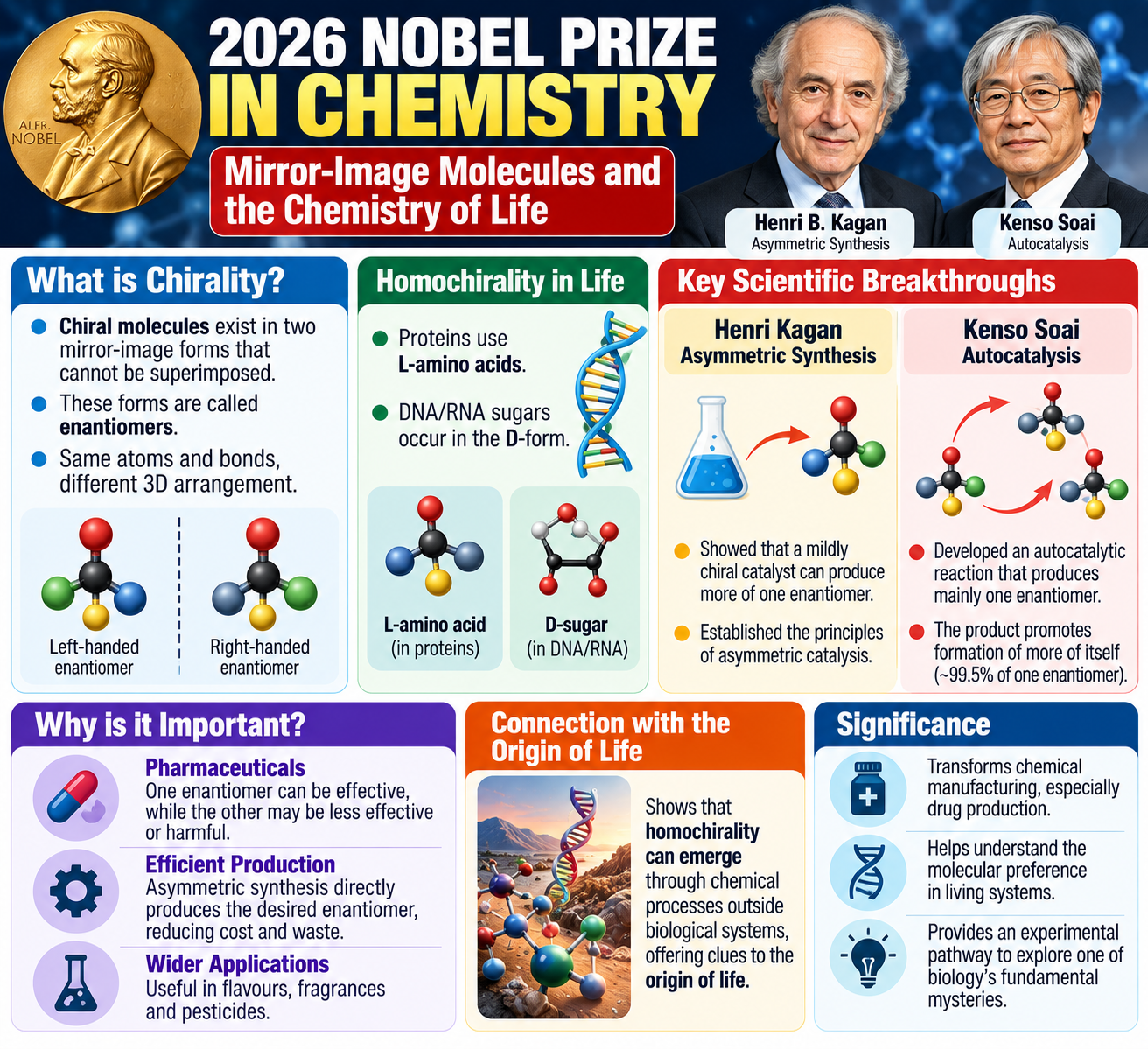
The 2026 Nobel Prize in Chemistry has been awarded to Henri B. Kagan and Kenso Soai for pioneering work on chirality and asymmetric synthesis, demonstrating how a chemical reaction can preferentially produce one mirror-image form of a molecule. Their work has major implications for pharmaceuticals and understanding the chemistry underlying life.
What is Chirality?
-
- Chiral molecules exist in two forms that are mirror images of each other but cannot be superimposed, analogous to the left and right hands.
- These forms are called enantiomers.
- Although they contain the same atoms and chemical bonds, their three-dimensional arrangement differs.
- Biological systems display homochirality — a strong preference for one enantiomer.
- Proteins predominantly use L-amino acids.
- DNA/RNA sugars predominantly occur in the D-form.
- Proteins predominantly use L-amino acids.
- Chiral molecules exist in two forms that are mirror images of each other but cannot be superimposed, analogous to the left and right hands.
Key Scientific Breakthroughs
Henri Kagan – Asymmetric Synthesis
Earlier, ordinary chemical reactions generally produced both enantiomers in nearly equal amounts. Kagan demonstrated that this was not necessarily the case.
-
- In the 1980s, he showed that even a mildly chiral catalyst could generate a much larger imbalance between the two enantiomers.
- This established important principles of asymmetric catalysis, enabling chemists to selectively produce a desired molecular form.
- In the 1980s, he showed that even a mildly chiral catalyst could generate a much larger imbalance between the two enantiomers.
Kenso Soai – Autocatalysis:
Soai subsequently explored autocatalytic reactions, in which the product of a reaction itself acts as a catalyst.
-
-
- He developed an autocatalytic reaction capable of producing predominantly one enantiomer.
- The selected enantiomer could promote formation of more of itself — a self-reinforcing/self-replicating process.
- The reaction achieved about 99.5% of one enantiomer, approaching the strong molecular preference observed in biological systems.
- He developed an autocatalytic reaction capable of producing predominantly one enantiomer.
-
Why is it Important?
Pharmaceutical Applications:
Chirality is crucial in drug development because biological receptors and enzymes can distinguish between enantiomers.
-
-
- One enantiomer may provide the desired therapeutic effect while the other may be less effective or potentially harmful.
- Earlier, pharmaceutical manufacturers often produced mixtures and subsequently separated the desired enantiomer.
- Asymmetric synthesis can directly produce the required enantiomer, reducing cost, waste and processing complexity.
- One enantiomer may provide the desired therapeutic effect while the other may be less effective or potentially harmful.
-
The significance extends beyond medicines to flavours, fragrances and pesticides, which interact with biological systems.
Connection with the Origin of Life:
The work shows that homochirality can emerge through chemical processes outside biological systems. However, it does not by itself explain why life selected one particular molecular orientation. It provides an experimental pathway for investigating this long-standing question.
Conclusion:
The 2026 Chemistry Nobel highlights how controlling the three-dimensional orientation of molecules can transform chemical manufacturing, particularly drug production, while also offering clues to one of biology's fundamental mysteries — why life overwhelmingly prefers one mirror-image form of certain molecules.



