
Context:
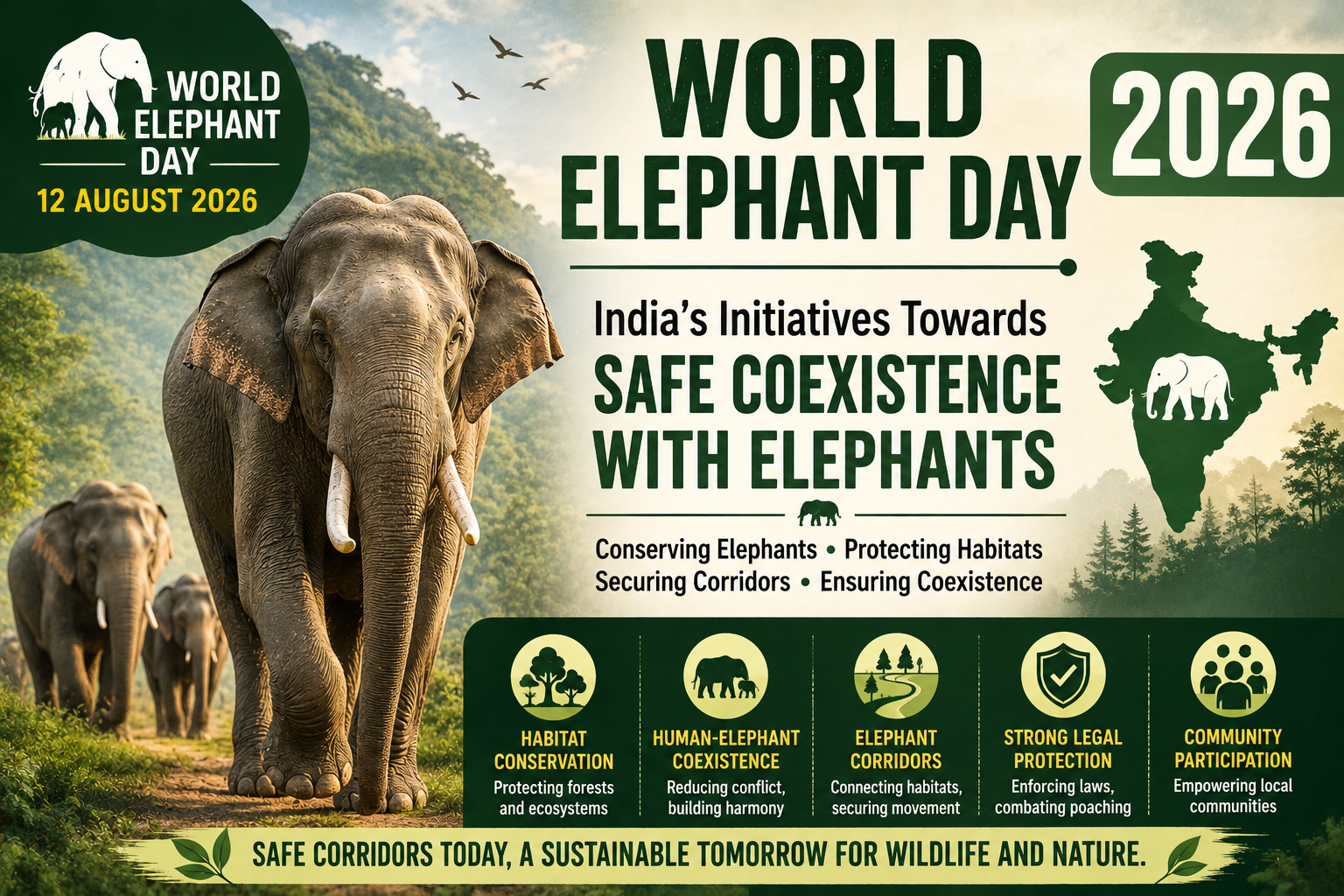
World Elephant Day is observed every year on 12 August. Its objective is to raise global awareness about elephant conservation, protection of their natural habitats, and the human-induced threats they face. The initiative for World Elephant Day was launched in 2012.
Elephant conservation is particularly important for India because the country is home to approximately 60% of the world’s wild Asian elephant population. Therefore, India’s conservation policy is not limited to maintaining elephant numbers; it also focuses on protecting their habitats, ecological corridors, and ensuring human-elephant coexistence.
Asian Elephant: An Important Part of India’s Ecosystem
The Asian elephant (Elephas maximus) is the largest terrestrial mammal in Asia. It is found in the Indian subcontinent and parts of Southeast Asia, with its largest population occurring in India.
The elephant is known as a ‘Keystone Species’ and an ‘Ecosystem Engineer’. Through their feeding and movement activities, elephants influence the structure of forest ecosystems. They contribute to seed dispersal, nutrient cycling, and forest regeneration. The paths and water sources created or used through their movements can also benefit other wildlife species.
Recognising this wider ecological importance, India declared the elephant a ‘National Heritage Animal’ in 2010.
Current Status of Elephants in India:
The Synchronous All India Elephant Estimation (SAIEE) 2021–25 was conducted to assess the elephant population in India. For the first time, DNA-based genetic techniques were incorporated on a large scale, and India’s wild elephant population was estimated at 22,446.
Due to the use of a new methodology, it would not be appropriate to directly compare this figure with previous population estimates. Its significance lies in establishing a more scientific and reliable baseline for elephant conservation.
Major Biological and Behavioural Characteristics of Elephants
- Gestation Period: Approximately 22 months, making it one of the longest gestation periods among terrestrial mammals.
- Social Structure: Elephant herds are primarily matriarchal, generally led by experienced adult females.
- Adult Males: Adult male elephants generally live alone or occur in groups of males.
- Ecological Role: Elephants function as both keystone species and ecosystem engineers.
- Habitat: Forests, grasslands and mixed landscapes, particularly areas with adequate food and water availability.
Project Elephant:
The Government of India launched Project Elephant in 1992 as a Centrally Sponsored Scheme under the Ministry of Environment, Forest and Climate Change (MoEFCC).
Its primary objective is to conserve wild elephants, their habitats and migratory routes, while reducing human-elephant conflict.
Major Objectives:
- Conservation of elephant populations and their natural habitats.
- Protection of elephant corridors and movement routes.
- Reduction of human-elephant conflict.
- Promotion of better conservation and management of captive elephants.
- Providing financial and technical assistance to elephant-range states.
- Increasing scientific monitoring and the use of modern technologies.
Technology is increasingly being used in elephant conservation, including DNA-based monitoring, radio-collaring, camera traps, early-warning systems and other technological tools.
Elephant Reserves and Ecological Corridors:
India currently has 33 notified Elephant Reserves, spread across approximately 80,777 square kilometres in 14 elephant-range states. Since 2014, the number of Elephant Reserves has increased from 26 to 33 by 2025–26.
However, simply increasing the number of protected areas is not sufficient for elephant conservation. Elephants travel long distances for food, water and breeding and move between different forest areas. Therefore, wildlife corridors connecting their habitats are extremely important.
According to the ‘Elephant Corridors of India, 2023’ report, 150 elephant corridors have been identified in India. These corridors connect fragmented forest landscapes and help elephants move relatively safely from one habitat to another.
Protecting these corridors is essential because activities such as roads, railways, mining, agricultural expansion and urbanisation can obstruct their natural movement routes.
Legal and International Protection:
The Asian elephant is classified as ‘Endangered’ on the IUCN Red List.
In India, it is included in Schedule I of the Wildlife (Protection) Act, 1972, providing it with the highest level of legal protection. In addition, the Asian elephant is listed under Appendix I of CITES.
The MIKE (Monitoring the Illegal Killing of Elephants) programme is important for monitoring elephant poaching. It operates under CITES and helps monitor trends related to the illegal killing and poaching of elephants.
It is important to note that Elephant Reserves do not constitute a separate statutory category under the Wildlife (Protection) Act equivalent to Tiger Reserves. However, forests and other lands included within them may receive protection through various existing laws and conservation mechanisms.
Conservation of Captive Elephants:
Along with wild elephants, the government is also focusing on the conservation and management of captive elephants.
The Gaj Soochna Mobile Application links important information related to captive elephants with a national genetic database. It includes details such as elephant DNA profiles, morphological characteristics and ownership information. The objective is to strengthen controls against illegal trade and unauthorised transfer of elephants.
In addition, the Captive Elephant (Transfer or Transport) Rules, 2024 regulate the transfer and transportation of captive elephants. Prescribed procedures and monitoring are particularly important in cases of inter-state transfers.
Human-Elephant Conflict:
One of the most complex challenges facing elephant conservation in India is Human-Elephant Conflict (HEC).
Fragmentation of forests, expansion of agricultural land, growth of human settlements and increasing human activities in elephant corridors are bringing humans and elephants into greater contact. This results in human deaths and injuries, crop losses and property damage.
To address this challenge, emphasis is being placed on identification and mapping of conflict-prone areas, Rapid Response Teams, early-warning systems, participation of local communities, and better coordination between state and district administrations.
The elephant-specific guidelines for reducing human-elephant conflict issued in 2023 aim to reduce conflict and promote safe and peaceful coexistence between humans and elephants.
In this context, simply relocating elephants to other areas cannot be considered a long-term solution. A more effective strategy is to protect their traditional movement routes and make local communities active partners in conservation.
Major Challenges:
India continues to face the following major challenges in elephant conservation:
- Habitat fragmentation and loss of forest areas.
- Encroachment and infrastructure pressure on elephant corridors.
- Road and railway accidents.
- Human-elephant conflict and crop damage.
- Poaching and illegal ivory trade.
- Pressure from mining, industrial activities and unplanned development.
- Changes in food and water availability due to climate change.
- Need for greater coordination among states in elephant-range areas.
Way Forward:
Elephant conservation needs to be approached as landscape-level conservation rather than merely species-based conservation.
For this purpose:
- Scientific identification and legal protection of elephant corridors should be ensured.
- Wildlife Passage Plans should be made mandatory for road and railway projects passing through elephant habitats.
- Underpasses, overpasses and other wildlife-friendly infrastructure should be expanded.
- AI, camera traps, radio collars and sensor-based early-warning systems should be effectively deployed.
- Rapid compensation and relief mechanisms should be strengthened in human-elephant conflict areas.
- Local communities should be made direct partners and beneficiaries of conservation initiatives.
- Interstate and transboundary cooperation should be promoted for protecting elephant corridors.
- Potential impacts of climate change should be incorporated into elephant conservation plans.
Conclusion:
World Elephant Day is not merely an occasion to express concern for elephants; it is also a reminder of the need to restore balance in the relationship between humans and nature.
In India, elephant conservation is not merely a wildlife conservation programme. It is a broader issue linked to biodiversity, forest ecology, local livelihoods and sustainable development. Safe corridors for elephants are, in fact, safe corridors for healthy forest ecosystems.
Therefore, India’s long-term conservation strategy should not focus solely on increasing elephant numbers. Instead, it should aim to develop connected habitats, safe movement corridors and sensitive human-wildlife management systems that can maintain a balance between development and conservation.



