
Context:
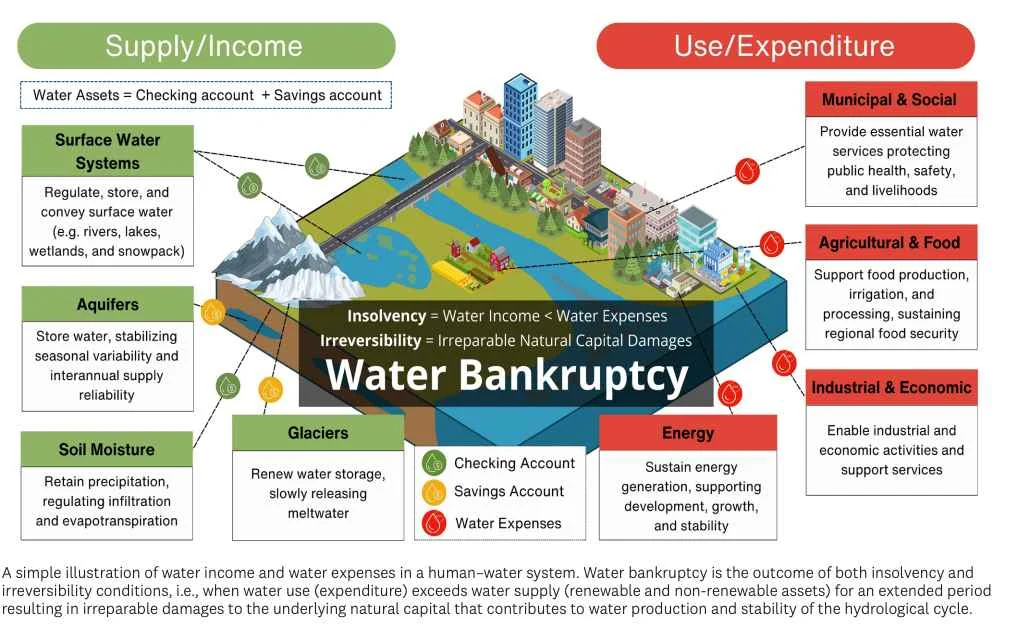
The latest report released in January 2026 by the United Nations University – Institute for Water, Environment and Health (UNU-INWEH), titled “Global Water Bankruptcy: Living Beyond Our Hydrological Means”, signals a major shift in the global discourse on water security. The report moves beyond the traditional and temporary notion of a “water crisis” and places the far more severe concept of “Water Bankruptcy” at the centre of analysis.
-
-
- Water bankruptcy arises when a nation’s annual water extraction consistently exceeds its natural recharge capacity, leading to irreversible depletion of ecological resources. India, the world’s largest user of groundwater, accounts for over 25% of global groundwater extraction. The report thus serves as a serious warning for India.
- Water bankruptcy arises when a nation’s annual water extraction consistently exceeds its natural recharge capacity, leading to irreversible depletion of ecological resources. India, the world’s largest user of groundwater, accounts for over 25% of global groundwater extraction. The report thus serves as a serious warning for India.
-
Concept of Water Bankruptcy:
The UN report explains this concept through two key principles:
-
-
- Hydrological Insolvency: This condition is analogous to economic bankruptcy. Just as an individual who spends more than their income falls into a debt trap, societies that consume more water than their hydrological income (rainfall and natural sources) begin to deplete their groundwater principal capital. This amounts to exploiting the water sustainability of future generations.
- Irreversibility: The most dangerous aspect of water bankruptcy is its irreversible nature. When excessive extraction causes geological aquifers to collapse or centuries-old glaciers to disappear entirely, their restoration becomes impossible. This represents a permanent loss of ecological capital that cannot be recovered even through economic investment.
- Hydrological Insolvency: This condition is analogous to economic bankruptcy. Just as an individual who spends more than their income falls into a debt trap, societies that consume more water than their hydrological income (rainfall and natural sources) begin to deplete their groundwater principal capital. This amounts to exploiting the water sustainability of future generations.
-
Groundwater Dependency and Crisis in Indian Context:
-
-
- India’s water security and economy are fundamentally dependent on groundwater. Nearly 62% of irrigation requirements are met through groundwater. About 85% of rural drinking water supply and nearly 50% of urban water demand, amid rapid urbanisation, rely on groundwater sources.
- Rising population, agricultural intensification and unregulated industrial expansion have pushed India’s groundwater reserves into a critical condition. The Indo-Gangetic plains, once considered water-abundant, are now being identified as global water-stress hotspots. Groundwater levels here are declining by several metres annually, posing a direct threat to India’s food security.
- India’s water security and economy are fundamentally dependent on groundwater. Nearly 62% of irrigation requirements are met through groundwater. About 85% of rural drinking water supply and nearly 50% of urban water demand, amid rapid urbanisation, rely on groundwater sources.
-
Multidimensional Causes of the Water Crisis:
-
-
- Spread of Pollution: Unregulated discharge of industrial effluents, excessive use of fertilisers in agriculture, and naturally occurring arsenic and fluoride have severely affected groundwater quality. Even where water is physically available, contamination renders it unfit for use.
- Human-Induced Drought: Easy access to modern drilling technologies and electric pumps has increased groundwater extraction rates far beyond natural recharge levels. This has led to the Tragedy of the Commons, where public resources are destroyed for individual gain.
- Food Security versus Water Security: Nearly 90% of India’s total water extraction is used in agriculture. Excessive reliance on water-intensive crops such as rice and sugarcane has pushed the country towards water stress. Crop diversification and a transition towards millets are essential solutions.
- Circular Water Economy: Instead of a “use and discard” mindset, the principles of Reduce, Reuse and Recycle must be adopted. In urban India, 100% treatment of wastewater represents a form of “recovered income” capable of balancing the water bankruptcy ledger.
- Spread of Pollution: Unregulated discharge of industrial effluents, excessive use of fertilisers in agriculture, and naturally occurring arsenic and fluoride have severely affected groundwater quality. Even where water is physically available, contamination renders it unfit for use.
-
India’s Policy, Preventive and Corrective Initiatives:
India has adopted a comprehensive and multi-dimensional approach to water management. Through the Ministry of Jal Shakti, the central government provides technical and financial assistance to states, supported by a multi-tier governance framework.
1. Model Groundwater (Regulation and Control of Development and Management) Bill: As water is a state subject, the central government has proposed a model legal framework to regulate indiscriminate groundwater extraction and make rainwater harvesting legally mandatory. As of January 2026, 21 states and Union Territories have adopted the model bill, marking a significant achievement in cooperative federalism.
2. Jal Shakti Abhiyan: Catch the Rain (JSA-CTR): Launched on 22 March 2021 on World Water Day, this nationwide campaign promotes awareness and collective action for water conservation. It focuses on:
-
-
-
-
- Water conservation and rainwater harvesting
- Identification, geo-tagging and inventory of all water bodies
- Establishment of Jal Shakti Kendras in all districts
- Focused afforestation
- Public awareness generation
- Water conservation and rainwater harvesting
-
-
-
3. Jal Sanchay Jan Bhagidari (JSJB)
-
-
-
-
- Launched in September 2024 to transform water conservation into a mass movement.
- Focuses on rainwater harvesting, aquifer recharge, borewell recharge and recharge shafts.
- Designed as a scalable and sustainable local-level model integrated with advanced monitoring systems.
- By January 2026, nearly 4 million artificial recharge and storage structures had been completed.
- Launched in September 2024 to transform water conservation into a mass movement.
-
-
-

4. Mission Amrit Sarovar
-
-
-
-
- Launched on 24 April 2022 to create water bodies in every district.
- Acts as a local buffer against water bankruptcy by enhancing water storage and recharge.
- Launched on 24 April 2022 to create water bodies in every district.
-
-
-
5. Atal Bhujal Yojana (Atal Jal)
-
-
-
-
- With a total outlay of ₹6,000 crore, this is among the world’s largest community-based groundwater management programmes. It focuses on the most water-stressed regions of seven states: Gujarat, Haryana, Karnataka, Madhya Pradesh, Maharashtra, Rajasthan and Uttar Pradesh.
Its innovative feature is outcome-based incentives. By 30 December 2025, 6,271 Digital Water Level Recorders (DWLRs) and 8,201 rain-gauging stations had been installed, enabling data-driven management.
- With a total outlay of ₹6,000 crore, this is among the world’s largest community-based groundwater management programmes. It focuses on the most water-stressed regions of seven states: Gujarat, Haryana, Karnataka, Madhya Pradesh, Maharashtra, Rajasthan and Uttar Pradesh.
-
-
-
6. Scientific Foundation: NAQUIM 2.0
The National Aquifer Mapping and Management Programme (NAQUIM 2012–2023) aimed to:
-
-
-
-
- Characterise aquifers based on hydrogeological properties
- Assess groundwater availability and quality
- Prepare detailed aquifer maps
- Develop sustainable groundwater management strategies
- Characterise aquifers based on hydrogeological properties
-
-
-
Under NAQUIM 2.0, high-resolution aquifer maps are now available down to the Panchayat level. The programme also offers location-specific solutions for challenges such as saline intrusion in coastal areas and urban waterlogging.
Way Forward:
The UN’s warning and India’s proactive efforts converge on a single conclusion, management is no longer an option but a condition for survival. India must focus on:
-
-
-
- Hydrological Auditing: Preparing annual water budgets at the Panchayat and municipal levels to balance recharge and consumption.
- Technology Integration: Using IoT and Artificial Intelligence for micro-irrigation and real-time leakage monitoring.
- Ecological Restoration: Protecting river catchments and wetlands that act as natural sponges for aquifer recharge.
- Global Cooperation: Leading regional water diplomacy in South Asia for scientific management of shared aquifers.
- Hydrological Auditing: Preparing annual water budgets at the Panchayat and municipal levels to balance recharge and consumption.
-
-
Conclusion:
Groundwater lies at the heart of India’s water security, sustaining agriculture, drinking water supply, ecosystems and economic activities. However, over-extraction, declining quality and climate variability have made sustainable groundwater management imperative. While India has undertaken multiple policy initiatives, ultimate success depends on behavioural change. A secure water future is the foundation of India’s sustainable and prosperous future.
| UPSC / PCS Main Examination Practice Question- Groundwater is central to India’s water security. Examine India’s dependence on groundwater in the context of over-extraction, quality degradation and climate change. Discuss the effectiveness of government initiatives in ensuring water security. |



