
Context:
Rural employment has been a cornerstone of India’s social protection framework for nearly two decades. Since its enactment in 2005, the Mahatma Gandhi National Rural Employment Guarantee Act (MGNREGA) played a key role in providing wage employment, stabilising rural incomes and creating basic infrastructure. Over time, however, the structure and objectives of rural India have evolved significantly. Rising incomes, expanded connectivity, widespread digital penetration and diversified livelihoods have altered the nature of rural employment needs.
-
-
- Against this backdrop, the President of India has given assent to the Viksit Bharat-Guarantee for Rozgar and Ajeevika Mission (Gramin) (VB-G RAM G) Bill, 2025 marking a significant milestone in the transformation of rural employment policy. The Viksit Bharat-Guarantee for Rozgar and Ajeevika Mission (Gramin) (VB-G RAM G) Act, 2025 represents a comprehensive statutory overhaul of MGNREGA, aligning rural employment with the long-term vision of Viksit Bharat 2047, while strengthening accountability, infrastructure outcomes and income security.
- Against this backdrop, the President of India has given assent to the Viksit Bharat-Guarantee for Rozgar and Ajeevika Mission (Gramin) (VB-G RAM G) Bill, 2025 marking a significant milestone in the transformation of rural employment policy. The Viksit Bharat-Guarantee for Rozgar and Ajeevika Mission (Gramin) (VB-G RAM G) Act, 2025 represents a comprehensive statutory overhaul of MGNREGA, aligning rural employment with the long-term vision of Viksit Bharat 2047, while strengthening accountability, infrastructure outcomes and income security.
-
Objectives and Pillars of the New Act:
-
-
- The primary objectives of the VB-G-RAM-G Act are to:
- Enhance employment security for rural households through a higher statutory guarantee of work.
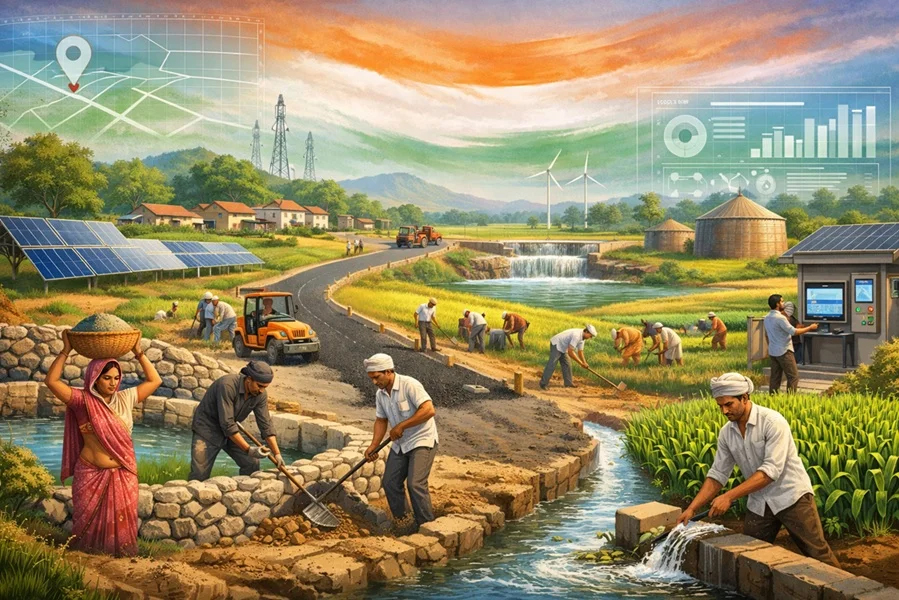
- Promote durable asset creation and rural infrastructure through structured and integrated planning.
- Integrate multiple rural development schemes at the village level.
- Leverage technology and data for efficient planning, monitoring, and transparency.
- Overall, the Act seeks to transition from the earlier rights-based, demand-driven framework to a more planned, outcome-oriented rural employment ecosystem.
- Enhance employment security for rural households through a higher statutory guarantee of work.
- The primary objectives of the VB-G-RAM-G Act are to:
-

Key Features of the VB-G-RAM-G Act:
-
-
- Employment Guarantee
- The Act provides a statutory guarantee of 125 days of unskilled wage employment per rural household in a financial year, increasing the limit from 100 days under MGNREGA.
- The Act provides a statutory guarantee of 125 days of unskilled wage employment per rural household in a financial year, increasing the limit from 100 days under MGNREGA.
- Normative Allocation and Funding Pattern
- Introduces normative financial allocations to states for rural employment budgets.
- Any expenditure beyond the prescribed allocation must be borne by the state government.
- Converts the scheme into a centrally sponsored programme, with a 60:40 Centre–State funding pattern (90:10 for North-Eastern and Himalayan states, and Union Territories without legislatures).
- States continue to bear the cost of unemployment allowances.
- Introduces normative financial allocations to states for rural employment budgets.
- Seasonal Flexibility
- To address agricultural labour requirements, states are permitted to notify work pauses of up to 60 days during peak agricultural seasons such as sowing and harvesting.
- To address agricultural labour requirements, states are permitted to notify work pauses of up to 60 days during peak agricultural seasons such as sowing and harvesting.
- Planning and Implementation
- Rural works are to be identified through Viksit Gram Panchayat Plans (VGPPs), prepared by gram panchayats.
- These plans are integrated with national planning frameworks, including PM Gati Shakti.
- This replaces MGNREGA’s relatively general project selection process and emphasises durable, outcome-oriented works.
- Rural works are to be identified through Viksit Gram Panchayat Plans (VGPPs), prepared by gram panchayats.
- Technology and Transparency
- The Act envisages a comprehensive digital governance framework, including:
- Biometric authentication for worker attendance
- GPS- and mobile-based monitoring of worksites
- Use of AI tools for planning, audits, and fraud detection
- Real-time dashboards and enhanced public disclosure mechanisms
- These measures aim to reduce leakages and strengthen accountability.
- Biometric authentication for worker attendance
- The Act envisages a comprehensive digital governance framework, including:
- Monitoring and Institutional Framework
- Establishment of Central and State Gramin Rozgar Guarantee Councils and Steering Committees for policy coordination and review.
- Panchayati Raj Institutions (PRIs) remain central to planning, implementation, and oversight.
- Establishment of Central and State Gramin Rozgar Guarantee Councils and Steering Committees for policy coordination and review.
- Retention of Unemployment Allowance
- The provision for unemployment allowance, payable if employment is not provided within the stipulated timeframe, is retained and, in some respects, strengthened.
- The provision for unemployment allowance, payable if employment is not provided within the stipulated timeframe, is retained and, in some respects, strengthened.
- Employment Guarantee
-

Comparison with MGNREGA (2005):
|
Feature |
MGNREGA (2005) |
VB-G-RAM-G Act (2025) |
|
Employment Guarantee |
100 days per rural household |
125 days per rural household |
|
Funding Model |
Centrally funded wages; shared material/admin costs |
Centrally sponsored scheme with normative allocation (60:40 Centre–State) |
|
Nature of Right |
Demand-driven, legally enforceable right to work |
Guarantee linked to allocations; not open-ended |
|
Seasonal Pause |
No provision |
Up to 60 days’ pause during peak agricultural seasons |
|
Planning Approach |
Gram sabha and panchayat-led |
VGPPs integrated with national infrastructure planning |
|
Technology Use |
MIS and social audits |
Biometric attendance, GPS, AI, and digital dashboards |
|
Panchayat Role |
Identification and execution of works |
Central to VGPP preparation and implementation |
The new framework marks a shift from an open-ended, demand-driven entitlement to a planned, allocation-based model with greater technological integration.

Debate and Criticisms:
-
-
- Rights vs. Allocation Model: Critics argue that replacing a legally enforceable right to work with normative funding caps dilutes the guarantee provided under MGNREGA. Activist groups caution that employment could become budget-constrained and discretionary.
- States’ Financial Burden: States are required to bear additional costs beyond normative allocations, as well as unemployment allowances. This raises concerns about fiscal stress, especially for poorer and financially constrained states.
- Opposition Protests and Political Contention: Opposition parties staged protests and walkouts, alleging that the Act was passed without adequate parliamentary and committee scrutiny. Some leaders also criticised the removal of Mahatma Gandhi’s name from the national rural employment programme.
- Civil Society Concerns: Labour and rural rights organisations, including the NREGA Sangharsh Morcha, have demanded the withdrawal of the Act, arguing that it undermines rural livelihood security and workers’ rights.
- Rights vs. Allocation Model: Critics argue that replacing a legally enforceable right to work with normative funding caps dilutes the guarantee provided under MGNREGA. Activist groups caution that employment could become budget-constrained and discretionary.
-
Implications:
-
-
- Rural Livelihood Security: The enhanced 125-day guarantee could improve income security, particularly in regions facing high unemployment and distress migration, if adequately funded and implemented.
- Focused Infrastructure Creation: Linking employment to durable asset creation may improve the quality and economic utility of rural infrastructure.
- Technological Governance: Digital tools may strengthen transparency, reduce corruption, and ensure timely wage payments, though concerns about digital exclusion remain.
- Fiscal Predictability: Normative allocations improve budgetary discipline but may reduce flexibility during crises or sudden surges in employment demand.
- Rural Livelihood Security: The enhanced 125-day guarantee could improve income security, particularly in regions facing high unemployment and distress migration, if adequately funded and implemented.
-
Conclusion:
The Viksit Bharat–Guarantee for Rozgar and Ajeevika Mission (Gramin) Act, 2025 represents a fundamental restructuring of India’s rural employment policy. While retaining the objective of livelihood security, it introduces significant changes in funding, planning, and governance. The shift from a rights-based, demand-driven model under MGNREGA to a planned, allocation-based framework reflects an attempt to align rural employment with broader developmental goals under Viksit Bharat @2047. Its ultimate success will depend on effective implementation, adequate funding, and cooperative Centre–State federalism.
| Main Examination Question: “The Viksit Bharat–Guarantee for Rozgar and Ajeevika Mission (Gramin) Act, 2025 marks a departure from the rights-based, demand-driven framework of the Mahatma Gandhi National Rural Employment Guarantee Act (MGNREGA) towards a planned, allocation-based model. Critically examine this shift and discuss its potential implications for rural livelihood security, Centre–State fiscal relations, and inclusive development in India.” |



