

Context:
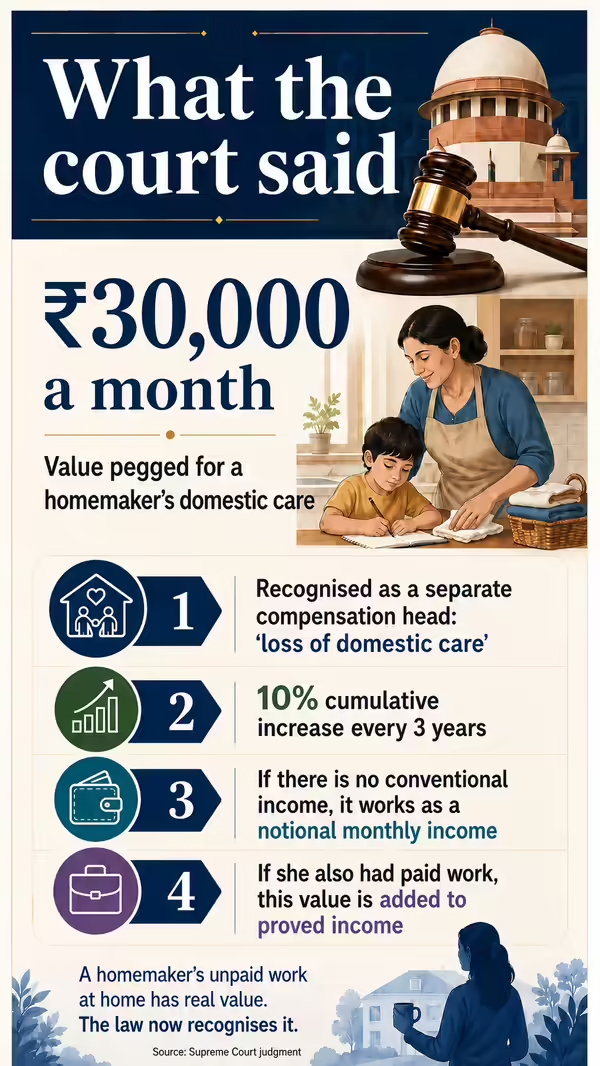
Recently, the Supreme Court of India delivered a landmark judgment by recognizing homemakers as "nation-builders" and directing that their notional monthly income be fixed at ₹30,000 for the purpose of assessing compensation in motor accident cases. A bench comprising Justice Sanjay Karol and Justice N. Kotiswar Singh observed that the role of homemakers in family care, child-rearing, and the shaping of social values should be recognized not merely from an emotional perspective but also from an economic standpoint. This judgment is a significant development in Indian jurisprudence because it:
-
-
- Grants dignity and legal recognition to long-invisible and unpaid domestic labour.
- Affirms that household work, childcare, elderly care, and emotional support should be regarded as economically valuable contributions.
- Recognizes "Loss of Domestic Care" as a separate category for compensation.
- Establishes ₹30,000 per month as the minimum value of a homemaker's contribution in motor accident compensation claims.
- Grants dignity and legal recognition to long-invisible and unpaid domestic labour.
-
Observations of the Supreme Court:
-
-
- The Supreme Court stated in its judgment that the contribution of homemakers is invaluable and cannot be underestimated merely because it is unpaid. The Court remarked that homemakers form the foundation of society and play a central role in shaping future generations. Therefore, describing them as "nation-builders" is not an exaggeration but an acknowledgment of social reality.
- Until now, the income of homemakers in motor accident claims was often assessed at very low amounts, resulting in inadequate compensation for their families. By fixing a notional income of ₹30,000 per month, the Court has attempted to address this inconsistency.
- The Supreme Court stated in its judgment that the contribution of homemakers is invaluable and cannot be underestimated merely because it is unpaid. The Court remarked that homemakers form the foundation of society and play a central role in shaping future generations. Therefore, describing them as "nation-builders" is not an exaggeration but an acknowledgment of social reality.
-
Domestic Work: The Invisible Foundation of the Care Economy
-
-
- In India, as in most parts of the world, household work has traditionally been considered a natural responsibility of women. Activities such as cooking, childcare, elderly care, household cleaning, managing family affairs, and attending to the emotional needs of family members receive no direct financial remuneration. Consequently, such work is excluded from formal calculations of national income and productive labour.
- However, if the market value of these services were assessed, it would become evident that homemakers perform multiple professional roles simultaneously. They act as cooks, teachers, caregivers, managers, counsellors, and nurturers. Without their labour, the economic and social structure of families and society could not function effectively.
- According to the Time Use Survey conducted by India's National Statistical Office (NSO):
- Women aged 15–59 spend an average of 315 minutes (approximately 5.25 hours) per day on unpaid domestic services.
- In contrast, men spend only 88 minutes (approximately 1.5 hours) per day on such activities.
- Women aged 15–59 spend an average of 315 minutes (approximately 5.25 hours) per day on unpaid domestic services.
- This demonstrates that women in India spend nearly 3.5 times more time on domestic work than men.
- In India, as in most parts of the world, household work has traditionally been considered a natural responsibility of women. Activities such as cooking, childcare, elderly care, household cleaning, managing family affairs, and attending to the emotional needs of family members receive no direct financial remuneration. Consequently, such work is excluded from formal calculations of national income and productive labour.
-
Changes in Compensation Assessment:
-
-
- Under the Motor Vehicles Act, compensation awarded to accident victims is generally based on the income of the deceased or injured person. While assessing the income of salaried individuals or businesspersons is relatively straightforward, determining the value of a homemaker's contribution has remained a challenge.
- Following this judgment, tribunals will be required to acknowledge that the services provided by homemakers possess real economic value. This will make compensation assessments more just and realistic. The judgment is not merely a technical legal adjustment but a significant step toward social justice.
- Under the Motor Vehicles Act, compensation awarded to accident victims is generally based on the income of the deceased or injured person. While assessing the income of salaried individuals or businesspersons is relatively straightforward, determining the value of a homemaker's contribution has remained a challenge.
-
Unpaid Care Work and Gender Inequality:
-
-
- Several reports by the United Nations and the International Labour Organization (ILO) indicate that women spend significantly more time on unpaid care work than men. According to UN Women, women globally spend 2.5 times more time on unpaid care work than men.
- Despite this, such labour remains invisible in economic statistics. As a result, women's productivity is often undervalued, and their contributions receive insufficient recognition in policymaking. The Supreme Court's judgment challenges this invisibility and reflects the judiciary's sensitivity toward gender equality.
- Several reports by the United Nations and the International Labour Organization (ILO) indicate that women spend significantly more time on unpaid care work than men. According to UN Women, women globally spend 2.5 times more time on unpaid care work than men.
-
International Perspective:
-
-
- Globally, there has been increasing emphasis on the need to recognize and value domestic labour. The United Nations Development Programme (UNDP) and various international forums focused on women's empowerment have identified the care economy as a fundamental pillar of sustainable development.
- Several countries have attempted to provide indirect economic security to women engaged in domestic work through social security schemes, pension systems, and care services. In India as well, debates regarding the economic valuation of domestic labour and social security measures for homemakers have periodically emerged.
- Globally, there has been increasing emphasis on the need to recognize and value domestic labour. The United Nations Development Programme (UNDP) and various international forums focused on women's empowerment have identified the care economy as a fundamental pillar of sustainable development.
-
Broader Significance of the Judgment:
-
-
- This judgment is important on multiple levels. It acknowledges the dignity of women's unpaid labour. For a long time, there has been a prevailing perception that only income-generating work is productive. The Court has challenged this narrow viewpoint.
- The judgment also makes compensation jurisprudence more humane and sensitive. Families affected by accidents will now be able to receive more realistic financial assistance.
- Furthermore, it may encourage policymakers to pay greater attention to the care economy. It could initiate fresh discussions on issues such as social security, pensions, insurance, and the formal recognition of domestic labour for women.
- The decision also challenges entrenched gender stereotypes by conveying that labour performed within the home is just as important as paid work performed outside it.
- This judgment is important on multiple levels. It acknowledges the dignity of women's unpaid labour. For a long time, there has been a prevailing perception that only income-generating work is productive. The Court has challenged this narrow viewpoint.
-
Challenges:
-
-
- Although this judgment is historic, certain challenges remain. The actual economic value of a homemaker's labour may vary according to social and geographical circumstances. The nature and cost of domestic work differ between rural and urban areas. Therefore, more scientific and standardized methods of valuation may be required in the future.
- Moreover, judicial recognition alone is not sufficient. It is equally important that care work receives adequate attention within the policymaking process. Regular time-use surveys, expansion of social security schemes, and measures promoting women's economic participation can play a crucial role in this regard.
- Although this judgment is historic, certain challenges remain. The actual economic value of a homemaker's labour may vary according to social and geographical circumstances. The nature and cost of domestic work differ between rural and urban areas. Therefore, more scientific and standardized methods of valuation may be required in the future.
-
Conclusion:
The Supreme Court's judgment signals a transformative shift in societal attitudes toward the role of homemakers in India. It recognizes that nation-building does not occur solely in offices, factories, and markets; it also takes place within homes, where women devote their labour, time, and care to nurturing families and shaping future generations. Recognizing homemakers as "nation-builders" is not merely a judicial observation but a call for social consciousness. It reminds us that the true foundation of economic development rests upon the invisible hands whose contributions have long been overlooked. This judgment marks a historic step toward ensuring dignity, recognition, and justice for homemakers in Indian society.



