
Context:
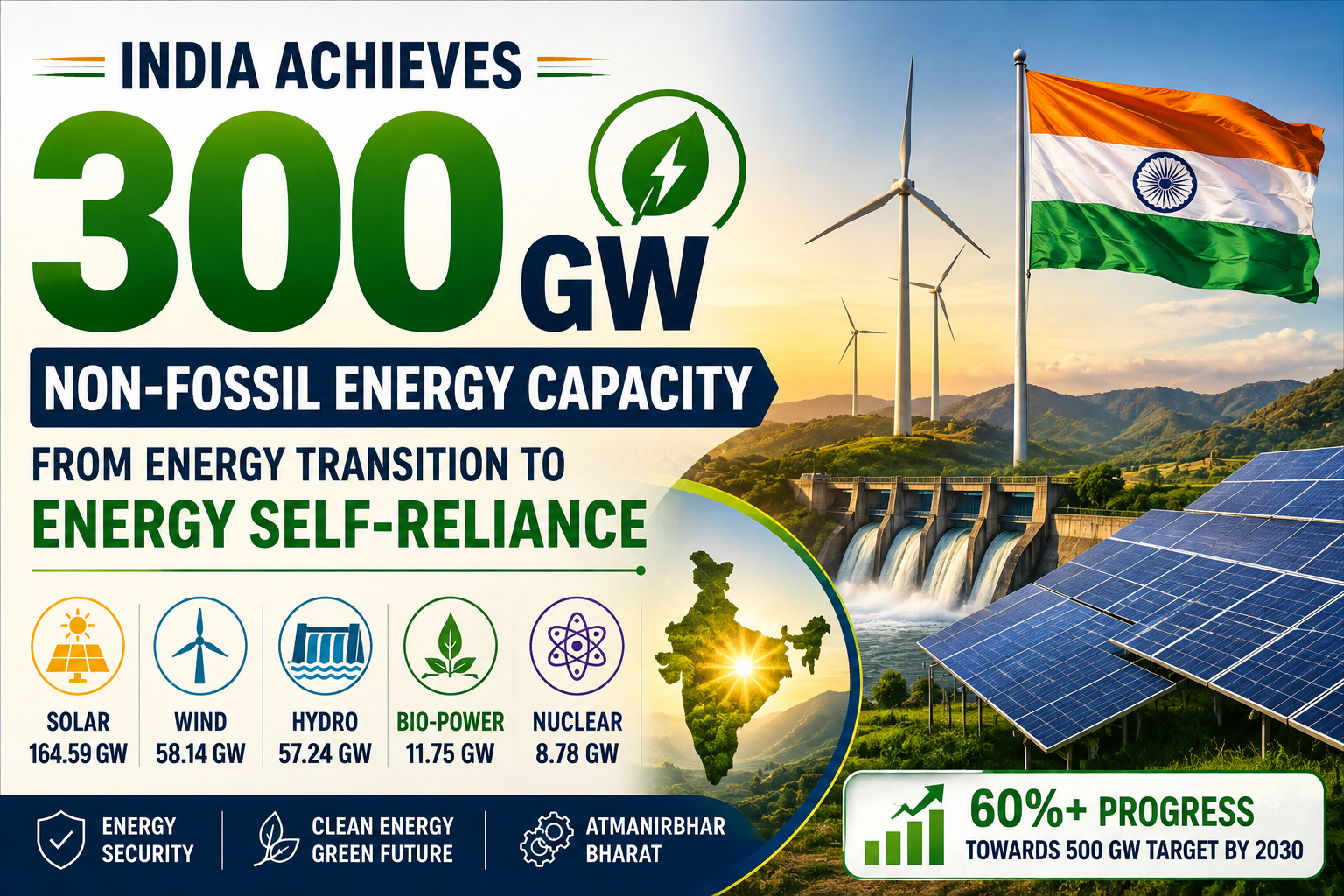
As of July 31, 2026, India has achieved a significant milestone by establishing 300.50 GW of non-fossil fuel-based power capacity. This includes 164.59 GW of solar power, 58.14 GW of wind power, 57.24 GW of hydropower, 11.75 GW of bio-power, and 8.78 GW of nuclear energy. This accounts for more than 54% of the country’s total installed power capacity of approximately 552 GW. The achievement represents more than 60% progress towards India’s target of achieving 500 GW of non-fossil energy capacity by 2030.
Wider Significance of the Achievement:
India’s energy journey has historically been dependent on coal and other fossil fuels. With rapid industrialisation, urbanisation, and population growth, electricity demand is naturally expected to rise significantly in the coming decades. Therefore, balancing economic development with environmental sustainability is a major policy challenge for India.
The achievement of 300 GW of non-fossil capacity is significant in this context because it indicates that India is viewing energy security not merely as the generation of more electricity, but as the creation of a clean, diversified, and long-term energy system.
The expansion of solar energy has been particularly remarkable. India’s installed solar capacity, which was around 2.8 GW in 2014, increased to 164.59 GW by July 2026. During the same period, wind power capacity increased from around 21 GW to 58.14 GW. In FY 2025–26 alone, 55.29 GW of non-fossil capacity was added, including 44.6 GW of solar and around 6 GW of wind capacity.
Progress Towards Climate Commitments:
At COP26, India announced its ‘Panchamrit’ commitments, including a target of achieving 500 GW of non-fossil fuel-based electricity capacity by 2030 and reaching net-zero emissions by 2070.
In June 2025, India had already achieved 50% of its cumulative installed electricity capacity from non-fossil sources, around five years ahead of the 2030 target under the Paris Agreement.
This demonstrates that India has adopted climate goals not merely as international commitments but as an integral part of its development strategy. However, increasing installed capacity alone is not sufficient. The real challenge lies in converting this capacity into a regular and reliable electricity supply.
Capacity Alone Is Not Enough: Reliable Energy Is Essential
The biggest challenge associated with solar and wind energy is their intermittency. The sun is not available throughout the day, while wind speeds are also not constant. Therefore, along with the large-scale expansion of renewable energy, energy storage and grid management are becoming increasingly important.
India is therefore focusing on Pumped Storage Projects (PSPs), battery energy storage systems, and smart-grid infrastructure. As of February 2026, 10 pumped storage projects with a combined capacity of 11,870 MW were under construction.
Thus, the next phase of India’s energy transition must move beyond the question of ‘how much electricity can be generated’ to the more important question of ‘when and how electricity can be made available.’
Energy Security and Import Dependence
India remains dependent on imported oil, gas, and, to some extent, coal to meet a significant share of its energy requirements. Fluctuations in global oil prices, geopolitical tensions, and disruptions in supply chains can adversely affect the Indian economy.
Renewable energy provides an opportunity to reduce this dependence. Sunlight and wind are domestic resources available within India. Therefore, the expansion of solar and wind capacity connects energy security with national security.
Moreover, if India expands domestic production of solar modules, cells, batteries, electrolyzers, and other clean-energy equipment, renewable energy will not merely become an alternative to imported fossil fuels but will also serve as a foundation for domestic manufacturing and employment generation.
Challenge of Self-Reliance and Manufacturing:
India has rapidly expanded its renewable energy capacity, but dependence on global supply chains for solar modules, high-efficiency cells, batteries, and critical minerals remains a concern.
Therefore, it is essential to transform the energy transition into an ‘energy transition based on self-reliance.’ This requires equal attention to Production-Linked Incentives (PLI), domestic manufacturing capacity, research and development, skill development, and securing supplies of critical minerals.
India has an opportunity to move beyond being merely a large renewable-energy market and emerge as a global manufacturing hub for solar equipment, batteries, green hydrogen, and energy-storage technologies.
Decentralised Energy and Inclusive Development:
An important component of India’s energy transition should be decentralised renewable energy. Along with large solar parks, rooftop solar, solar pumps, mini-grids, and rural energy systems can improve access to electricity in remote areas.
Schemes such as PM-KUSUM can promote solar energy in agriculture, reduce irrigation costs for farmers, and decrease dependence on diesel. Similarly, the PM Surya Ghar scheme is promoting rooftop solar at the household level.
This can gradually transform an ‘energy consumer’ into an ‘energy producer’ or ‘prosumer’. Such a transformation would represent an important step towards the democratisation of energy.
Major Challenges:
· The achievement of 300 GW is significant, but several challenges must be addressed to reach the 500 GW target by 2030.
· Land acquisition and environmental clearances need to be streamlined while protecting the interests of local communities.
· Transmission networks must be expanded adequately to connect renewable energy projects with the national grid.
· The cost of energy storage needs to be reduced.
· The financial health of distribution companies (DISCOMs) must be improved, as financially weak distribution companies can affect both investment in the power sector and the procurement of renewable energy.
· The impacts of large-scale solar and wind projects on biodiversity, land use, and local livelihoods must be addressed through scientific and sustainable approaches.
Way Forward:
India must now move from ‘capacity creation’ to ‘restructuring the energy system.’ Five key dimensions deserve particular attention:
1. Renewable Energy and Storage: Develop large-scale battery storage and pumped storage projects alongside solar and wind power to make electricity supply more stable and reliable.
2. Green Grid: Strengthen and modernise inter-state transmission networks to ensure the efficient and uninterrupted distribution of renewable electricity.
3. Domestic Manufacturing: Develop a complete domestic supply chain for solar cells, modules, batteries, and other clean-energy equipment to reduce import dependence and strengthen self-reliance.
4. Green Hydrogen: Promote the use of clean energy in hard-to-decarbonise sectors such as steel, fertilisers, and heavy transport. The National Green Hydrogen Mission is an important initiative in this direction.
5. Just Transition: Ensure alternative employment opportunities and skill development for workers and communities dependent on coal-based economies so that the energy transition remains inclusive and socially balanced.
Conclusion:
India’s achievement of 300 GW of non-fossil electricity capacity is not merely a statistical milestone; it represents a structural transformation taking place in the country’s development strategy. The rapid growth of solar energy, expansion of wind power, and continued contribution of hydropower and nuclear energy are making India’s energy mix more diversified and cleaner.
Nevertheless, 300 GW is not the destination but an important milestone on the way to the 500 GW target. The real success of India’s energy transition will be measured by its ability to provide affordable, reliable, clean, and accessible energy to all, while simultaneously strengthening its domestic manufacturing base and energy security.
Therefore, the central objective of India’s energy transition should not merely be ‘greater renewable energy capacity’, but the creation of a ‘green, reliable, and self-reliant energy system.’ This is the pathway towards achieving a sustainable balance between energy security, economic development, and climate justice.



