
Context:
Nuclear energy is emerging as an important pillar of India’s energy transition. The government has set a target of achieving around 100 GW of nuclear power capacity by 2047. India’s current nuclear capacity is approximately 8.8 GW, and there are plans to increase it to around 22 GW by 2031–32. At the heart of this long-term expansion lies not merely the installation of more nuclear reactors, but also ensuring the long-term availability of nuclear fuel and developing indigenous technological capabilities.
Recently, a parliamentary committee suggested that the Central Government should formulate a policy framework to ensure the participation of Mine Developer-cum-Operator (MDO) entities in uranium mining. This brings the significance of India’s three-stage nuclear power programme and its uranium-thorium strategy into focus.
Why is Uranium Important?
Uranium is one of the most important fuels used in nuclear power generation. Naturally occurring uranium mainly consists of two isotopes- Uranium-238 and Uranium-235. Among these, Uranium-235 is fissile, whereas Uranium-238 is primarily a fertile material.
India has adopted Pressurised Heavy Water Reactors (PHWRs) in the first stage of its nuclear programme. A key feature of these reactors is that they can use natural uranium. Therefore, during the first stage, India has relatively lower dependence on expensive uranium enrichment.
However, the challenge is that India has limited uranium availability compared to thorium. This resource-related reality has shaped the entire structure of India’s nuclear programme.
India’s Three-Stage Nuclear Programme
The most distinctive feature of India’s nuclear programme is its long-term vision. Dr. Homi Jehangir Bhabha envisioned a system in which India would maximise the utilisation of its limited uranium resources and gradually move towards a nuclear energy system based on its abundant thorium resources.
First Stage: PHWRs and Natural Uranium
In the first stage, natural uranium is used in Pressurised Heavy Water Reactors (PHWRs).
This stage produces two important outcomes:
1. Generation of electricity.
2. Production of plutonium from spent nuclear fuel.
This plutonium becomes an important resource for the second stage.
Thus, the first stage is not limited to electricity generation; it also lays the foundation for the subsequent nuclear fuel cycle.
Second Stage: Fast Breeder Reactors
The centrepiece of the second stage is the Fast Breeder Reactor (FBR).
It uses plutonium-based fuel. Its objective is not merely to obtain energy from the available fuel, but also to produce new fissile material.
This is why FBR technology is of strategic importance to India. Through this technology, India seeks to develop the capability to convert fertile materials such as Uranium-238 into more useful fissile materials.
In 2026, significant progress associated with the Prototype Fast Breeder Reactor (PFBR) has been regarded as an important achievement towards the second stage of India’s three-stage nuclear programme. This strengthens the pathway for more efficient utilisation of nuclear fuel and, in the future, large-scale utilisation of thorium.
Third Stage: Transition Towards Thorium
The ultimate objective of India’s nuclear programme is to develop a thorium-based energy system.
India possesses a significant share of the world’s thorium resources. However, thorium itself is not directly a fissile fuel.
Thorium-232 is a fertile material that can be converted into Uranium-233 after absorbing neutrons. Through the process of neutron absorption in a reactor, Thorium-232 can be converted into Uranium-233. Uranium-233 is a fissile material and can be used for nuclear power generation.
With this objective, India has been working on technologies such as the Advanced Heavy Water Reactor (AHWR).
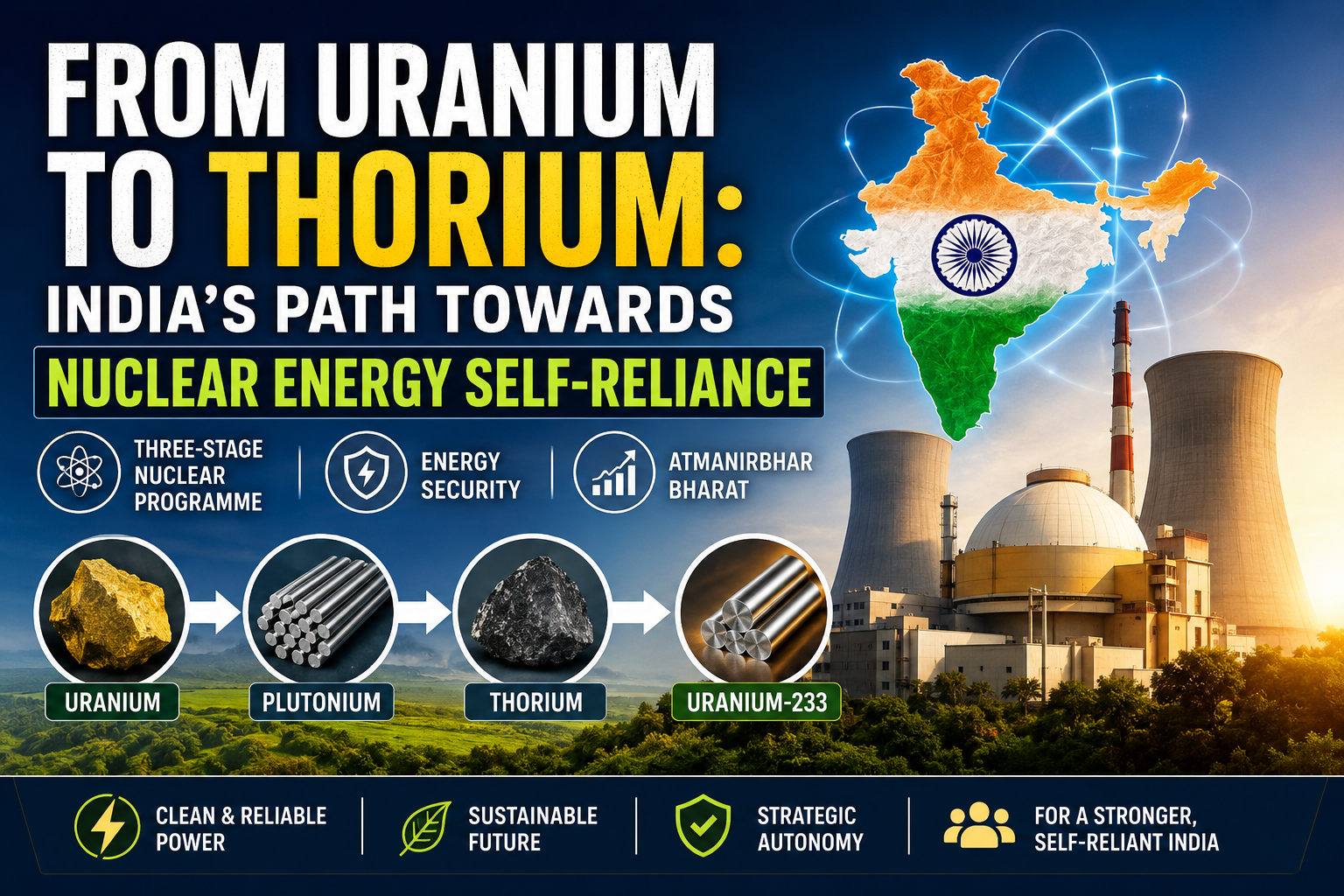
Thus, India’s nuclear journey can be understood simply as:
Uranium → Plutonium → Thorium → Uranium-233
This is the core philosophy of India’s three-stage nuclear strategy.
Then Why is Uranium Still Needed?
This is the most important paradox in India’s nuclear strategy. Despite having abundant thorium resources, India cannot immediately establish a thorium-based nuclear economy. This requires specialised reactors, a sophisticated nuclear fuel cycle, reprocessing technologies, and complex technological capabilities associated with Uranium-233.
Therefore, India’s requirement for uranium will continue in the coming years.
This is why, along with increasing domestic uranium production, India is entering into long-term supply agreements with various countries. The civil nuclear cooperation agreement with Australia in July 2026 is also part of this broader energy security strategy, under which the pathway for the long-term supply of Australian uranium for peaceful purposes has been strengthened.
Major Challenges:
High Initial Costs
The establishment of nuclear power plants requires massive capital investment. Delays in projects can further increase costs.
Nuclear Safety
Safety must remain the highest priority in nuclear energy. Reactor design, emergency response mechanisms, radioactive material management, and independent regulation will need to be continuously strengthened.
Radioactive Waste
The safe and long-term management of radioactive waste remains an important technological and social challenge.
Human Resources
Achieving a capacity of 100 GW will require a large number of scientists, engineers, technicians, and trained regulatory personnel.
Social Acceptance
It is essential to gain the trust of local communities for nuclear projects. Transparency, the quality of environmental impact assessments, and rehabilitation measures will determine this trust.
Way Forward
India needs to adopt an integrated nuclear strategy for expanding nuclear energy:
- Domestic uranium mining and exploration must be accelerated.
- Self-reliance in the nuclear fuel cycle must be enhanced.
- Along with PHWRs, new technologies such as FBRs and Small Modular Reactors (SMRs) should be developed in parallel.
- Research on the third stage based on thorium should receive continuous financial and institutional support.
- Nuclear energy should be integrated with solar, wind, hydropower, battery storage, and green hydrogen as part of an integrated energy strategy.
- Nuclear safety and regulatory independence must be given the highest priority.
Conclusion
India’s nuclear programme is not merely a project for electricity generation; it is a long-term project aimed at energy self-reliance and strategic autonomy.
India faces limited uranium resources on one hand and substantial thorium potential on the other. The three-stage nuclear programme seeks to transform this contradiction into an opportunity. The transition from uranium in the first stage, to plutonium in the second stage, and finally to the thorium-based Uranium-233 fuel cycle in the third stage is intended to take India towards long-term fuel self-reliance.
The target of achieving 100 GW of nuclear capacity by 2047 will succeed only if India can simultaneously address fuel security, technological self-reliance, safe reactor technologies, economic viability, and social acceptance.



