
Context:
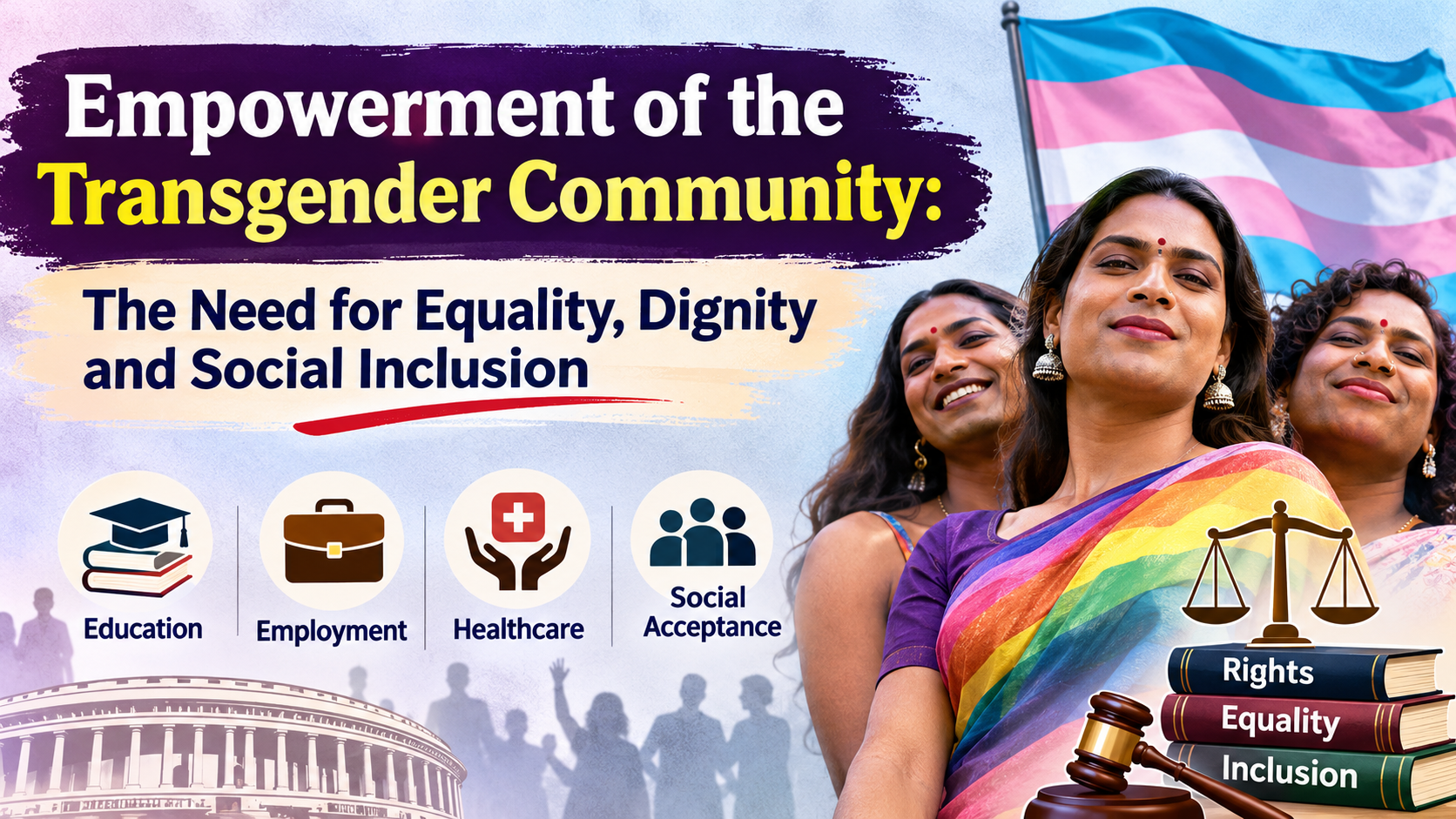
The progress of any democratic society cannot be assessed solely on the basis of its economic prosperity, technological development or infrastructure. It is equally important to examine whether the most vulnerable and marginalised sections of society have access to equal opportunities and dignity. In Indian society, the transgender community has long faced social neglect, discrimination, economic insecurity and institutional barriers. Their participation in fundamental areas such as education, employment, healthcare and family life continues to be affected by several challenges.
In this context, the Delhi Government's decision to provide health coverage of up to ₹10 lakh annually to eligible transgender persons and their families under the Ayushman Bharat–Pradhan Mantri Jan Arogya Yojana (PM-JAY) is significant. Under this initiative, approved on 17 November 2026, health coverage of ₹5 lakh will be provided by the Central Government, with an additional ₹5 lakh contributed by the Delhi Government. This initiative is not merely an expansion of healthcare facilities but also an important step towards social inclusion and equal citizenship rights.
Social Status of the Transgender Community:
The transgender community comprises individuals whose gender identity may differ from the sex assigned to them at birth. It includes individuals with diverse gender identities, such as trans men, trans women, intersex and genderqueer persons. In Indian society, various socio-cultural identities such as Kinnar, Hijra, Aravani and Jogta are also prevalent.
The position of this community in India has remained contradictory. On the one hand, the Kinnar community finds references in Indian traditions and history, while on the other hand, its members continue to struggle for social acceptance and equal opportunities in modern society. In the 2011 Census, approximately 4.87 lakh individuals were recorded under the 'Other' category, apart from male and female categories, for the first time. However, this figure does not fully represent the actual population of the community.
Health Security: An Important Foundation of Social Inclusion
Healthcare is not merely about treating illnesses; it is the foundation of a dignified and quality life. Health security becomes even more important for the transgender community because, apart from general health problems, its members also have specific healthcare needs related to their gender identity.
Due to economic vulnerability and social discrimination, many individuals are unable to access timely medical treatment. Expensive treatment in private hospitals and the lack of sensitive healthcare services in government hospitals further aggravate their problems.
In this context, the Delhi Government's decision to provide health coverage of up to ₹10 lakh is significant. Under this initiative, eligible transgender persons and their families will receive cashless treatment at empanelled hospitals. The initiative includes 1,961 treatment packages across 27 medical specialities. The Delhi Government is estimated to incur an additional annual expenditure of approximately ₹1.19 crore for this purpose.
This initiative seeks to make healthcare services financially accessible while integrating the transgender community into the mainstream welfare system. However, its actual impact will depend on how effectively information about the scheme, registration and treatment facilities reach eligible beneficiaries.
Major Challenges of Social Exclusion and Discrimination:
The problems faced by the transgender community are not limited to individual identity but are also linked to social structures, family systems and institutional behaviour.
1. Family Rejection and Social Exclusion: In Indian society, the family is a major source of social security for an individual. However, due to their gender identity, many transgender persons face family rejection, mental harassment and circumstances that force them to leave their homes. This adversely affects their emotional and social development.
2. Challenges in the Field of Education: Discrimination, ridicule, unsafe environments and a lack of essential facilities in schools and higher educational institutions force many transgender students to discontinue their education. Consequently, their opportunities for employment and economic self-reliance become limited.
3. Employment and Economic Insecurity: Social prejudices and discrimination in both private and public sectors make it difficult for members of this community to secure employment. Despite possessing adequate skills and qualifications, they are often denied equal opportunities. As a result, many individuals are compelled to depend on informal employment and live under conditions of economic insecurity.
4. Limited Access to Healthcare Services: Transgender persons face several challenges, including discriminatory behaviour in hospitals, a shortage of trained medical professionals, a lack of sensitivity towards gender identity and limited availability of specialised healthcare services. Essential services such as hormone therapy and gender-affirmation surgeries are also not easily accessible to everyone.
5. Violence and Insecurity: Due to social prejudices, transgender persons are more vulnerable to physical violence, sexual harassment, mental abuse and discrimination in public spaces. In many cases, complaints regarding incidents against them are also not properly registered.
Constitutional and Legal Protection:
1. National Legal Services Authority vs. Union of India, 2014 (NALSA Case): In this landmark judgment, the Supreme Court recognised transgender persons as a third gender. The Court clarified that they are also entitled to the fundamental rights guaranteed under the Constitution.
In addition, the Transgender Persons (Protection of Rights) Act, 2019 provides for the prohibition of discrimination in education, employment, healthcare services and public facilities. Section 15 of the Act specifically emphasises measures related to healthcare facilities, medical care, counselling and health insurance.
2. Transgender Persons (Protection of Rights) Act, 2019 and Its 2026 Amendment:
Following the NALSA judgment, Parliament enacted the Transgender Persons (Protection of Rights) Act, 2019, to safeguard the rights of the transgender community.
The primary objective of this Act was to eliminate discrimination against transgender persons and provide them with equal access to education, employment, healthcare services and public facilities.
The major provisions of the Act included:
- Recognition of the legal identity of transgender persons.
- Prohibition of discrimination in education, employment, healthcare services and housing.
- Establishment of a mechanism for obtaining identity certificates.
- Defining the responsibilities of the government towards the welfare of transgender persons.
- Establishment of the National Council for Transgender Persons.
However, amendments to this Act in 2026 introduced significant changes to the process of legal recognition of gender identity. Under the amendment, greater importance was assigned to the role of the District Magistrate and the prescribed medical board in issuing identity certificates. Changes were also made to the definition of transgender persons and the procedures applicable to their identification.
However, greater dependence on medical and administrative certification may weaken an individual's right to self-determination. This could potentially affect the personal freedom and dignity of transgender persons.
Government Initiatives for the Welfare of the Transgender Community:
SMILE Scheme: Implemented by the Ministry of Social Justice and Empowerment, this scheme aims to rehabilitate and empower marginalised individuals. It provides facilities related to skill development, livelihood, healthcare and rehabilitation for the transgender community.
Garima Greh: These shelter homes have been established to provide safe accommodation, food, medical care and skill development facilities to transgender persons who have become homeless due to rejection by their families and society.
Ayushman Bharat–Transgender Health Scheme: Through coordination with PM-JAY, provisions have been made to provide eligible transgender persons with health insurance and essential medical facilities related to their gender identity.
National Portal for Transgender Persons: It has made the process of obtaining transgender identity certificates and identity cards digital and more convenient.
National Council for Transgender Persons: Its objective is to monitor the effective implementation of policies, schemes and legal protections related to the transgender community.
Measures Required for Building an Inclusive Society:
The following measures are necessary to ensure the empowerment of the transgender community:
1. Inclusivity in Education: Developing a discrimination-free environment in educational institutions and promoting awareness about gender diversity.
2. Employment Opportunities: Promoting skill development, vocational training and self-employment to ensure economic self-reliance.
3. Expansion of Healthcare Services: Providing accessible and sensitive healthcare services and imparting specialised training to healthcare professionals.
4. Social Awareness: Developing a positive attitude towards gender diversity through families, media and social institutions.
5. Effective Grievance Redressal: Establishing an accessible and effective mechanism for addressing complaints related to discrimination, violence and harassment.
6. Collection of Reliable Data: Formulating targeted policies based on updated data related to education, employment and healthcare.
Conclusion:
The empowerment of the transgender community is not merely a welfare issue but a question linked to the Indian democracy's commitment to equality, liberty and human dignity. The Delhi Government's initiative to provide health coverage of up to ₹10 lakh under PM-JAY is an important step in this direction. However, genuine social transformation will be possible only when education, employment, housing, social acceptance and equal opportunities are ensured alongside health security.
Therefore, it is essential to recognise the transgender community not merely as a beneficiary group receiving assistance but as equal citizens possessing the same rights. The true meaning of an inclusive society will be realised only when every individual gets an equal opportunity to live with dignity, develop and contribute to nation-building while retaining their identity.



