
Context:
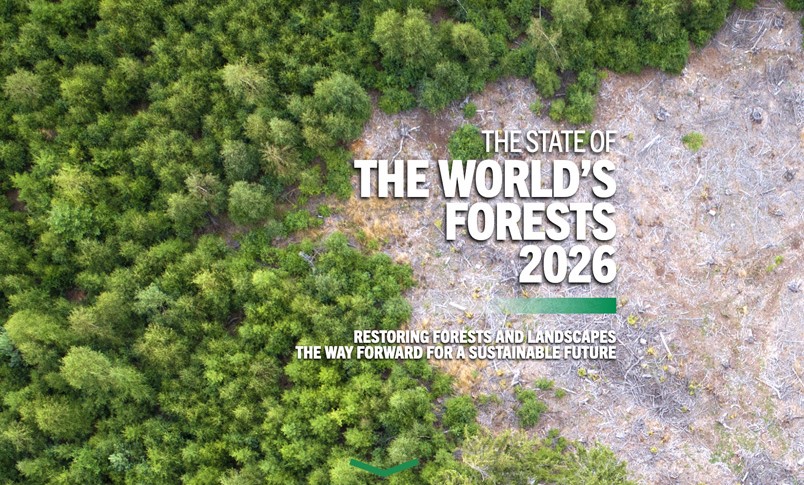
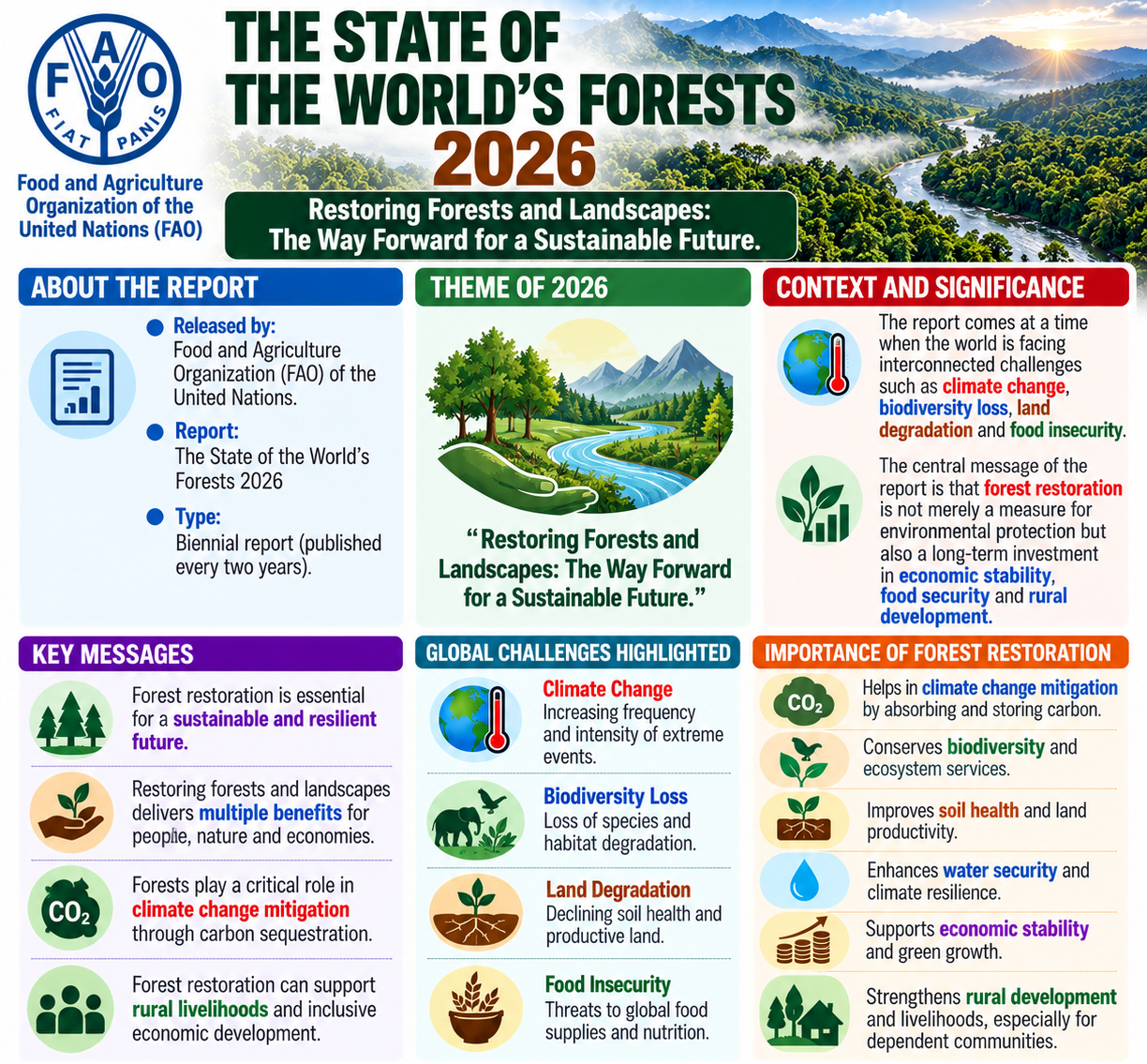
Recently, the Food and Agriculture Organization (FAO) of the United Nations released its biennial report, The State of the World’s Forests 2026. The theme of this year’s report is “Restoring Forests and Landscapes: The Way Forward for a Sustainable Future.” The report comes at a time when the world is facing interconnected challenges such as climate change, biodiversity loss, land degradation, and food insecurity. The central message of the report is that forest restoration is not merely a measure for environmental protection but also a long-term investment in economic stability, food security, and rural development.
Status of Global Forest Resources:
-
-
- The FAO’s State of the World’s Forests Report 2026 highlights the gap between the current status of global forest resources and the progress made in forest restoration. The major findings of the report are as follows:
- Global Forest Area: The world has approximately 4.14 billion hectares of forest area, accounting for about 32% of the Earth’s total land area.
- Carbon Storage: The world’s forests store approximately 714 gigatonnes of carbon, playing a significant role in mitigating climate change.
- Biodiversity Conservation: Forests provide habitats for a large proportion of terrestrial biodiversity and help maintain ecological balance.
- Forest Restoration: According to the report, approximately 206.5 million hectares of forest area are under restoration.
- Forest Loss: Since 1990, more than 489 million hectares of forest area have been lost worldwide.
- Restoration Commitments: Various global initiatives have made commitments to restore more than one billion hectares of land, but significant challenges remain in their effective implementation.
- Global Forest Area: The world has approximately 4.14 billion hectares of forest area, accounting for about 32% of the Earth’s total land area.
- These figures clearly indicate that international commitments alone are insufficient for forest conservation and restoration. Greater attention must be given to effective implementation, adequate financing, local community participation, and scientific monitoring.
- The FAO’s State of the World’s Forests Report 2026 highlights the gap between the current status of global forest resources and the progress made in forest restoration. The major findings of the report are as follows:
-

Need for Forest Restoration:
-
-
- Mitigation of Climate Change: Forests act as natural carbon sinks. They absorb carbon dioxide from the atmosphere and help limit the rise in global temperatures. Healthy forest ecosystems also regulate rainfall patterns, local temperatures, and water balance. However, considering tree planting alone as a climate solution is insufficient. The conservation of natural forests, restoration of degraded ecosystems, and long-term forest management are more important.
- Biodiversity Conservation: Forests are natural habitats for countless plant species, animals, and microorganisms. Forest fragmentation affects the movement, reproduction, and genetic diversity of species. Forest restoration can help maintain the continuity of wildlife corridors, preserve ecological balance, and promote the conservation of endangered species.
- Food and Water Security: Forests play an important role in maintaining soil fertility, groundwater recharge, and the conservation of watersheds. Promoting agroforestry, native tree species, and sustainable land management can make food production more resilient to climate-related risks. Thus, forest conservation and agricultural development are not conflicting objectives but complementary goals.
- Rural Economy and Livelihoods: Forest-based livelihoods are particularly important for tribal and rural communities. Minor forest produce, medicinal plants, honey, bamboo, and other forest products provide income and employment. Community-based restoration can generate environmental benefits while also promoting local economic empowerment.
- Mitigation of Climate Change: Forests act as natural carbon sinks. They absorb carbon dioxide from the atmosphere and help limit the rise in global temperatures. Healthy forest ecosystems also regulate rainfall patterns, local temperatures, and water balance. However, considering tree planting alone as a climate solution is insufficient. The conservation of natural forests, restoration of degraded ecosystems, and long-term forest management are more important.
-
Economic Significance of Forest Restoration:
-
-
- According to the Food and Agriculture Organization (FAO), restoring more than one billion hectares of degraded land could generate benefits worth approximately US$1.8 trillion annually. Under favourable conditions, every dollar invested in restoration could generate returns of up to US$30.
- This indicates that environmental protection should be viewed as an investment in natural capital rather than a burden on economic development. However, these are potential benefits, and actual outcomes will depend on local conditions, financing, and effective management.
- According to the Food and Agriculture Organization (FAO), restoring more than one billion hectares of degraded land could generate benefits worth approximately US$1.8 trillion annually. Under favourable conditions, every dollar invested in restoration could generate returns of up to US$30.
-
Relevance for India:
-
-
- In India, forest conservation is linked not only to environmental security but also to livelihoods, tribal rights, and climate commitments.
- According to the India State of Forest Report 2023 published by the Forest Survey of India, the country’s total forest and tree cover is approximately 25.17%. However, an increase in forest cover alone cannot be considered complete evidence of ecological improvement. The quality of natural forests, species diversity, and ecosystem services must also be evaluated.
- India has promoted forest conservation through initiatives such as the Green India Mission, CAMPA, Joint Forest Management, and agroforestry. In addition, the Forest Rights Act, 2006, provides an important framework for recognising traditional rights over forest resources and promoting community participation.
- Nevertheless, developmental projects, mining, forest fires, and land-use changes continue to exert significant pressure on the Himalayas, the Western Ghats, central Indian forest regions, and arid ecosystems.
- In India, forest conservation is linked not only to environmental security but also to livelihoods, tribal rights, and climate commitments.
-
Major Challenges to Forest Restoration:
-
-
- Lack of Financial Resources: Restoration projects require long-term investment, whereas many programmes remain focused on short-term budgets and tree-planting targets.
- Neglect of Ecological Quality: Plantations of a single species may increase green cover, but they do not necessarily develop biodiversity comparable to that of natural forests.
- Limited Participation of Local Communities: Unclear land rights and the exclusion of communities from decision-making processes affect the long-term sustainability of restoration projects.
- Conflict Between Development and Conservation: Infrastructure development, industrialisation, and mining projects can increase the fragmentation of natural habitats.
- Weak Monitoring Mechanisms: Instead of measuring only the number of trees planted, it is necessary to assess their survival rates, carbon storage, and the restoration of biodiversity.
- Lack of Financial Resources: Restoration projects require long-term investment, whereas many programmes remain focused on short-term budgets and tree-planting targets.
-
Way Forward:
-
-
- The FAO report presents four complementary strategies for implementing forest restoration on a large scale:
- Empowerment of Communities: The rights, traditional knowledge, and participation of tribal and local communities in decision-making must be ensured.
- Landscape-Based Restoration: Forests, agricultural land, water resources, and biodiversity should be restored through an integrated approach.
- Long-Term Green Financing: The use of public investment, private capital, payments for ecosystem services, and responsible carbon finance should be expanded.
- Policy and Institutional Coordination: Coordination among policies related to forests, agriculture, water, rural development, and climate change should be strengthened.
- Empowerment of Communities: The rights, traditional knowledge, and participation of tribal and local communities in decision-making must be ensured.
- India should develop region-specific restoration plans in line with these strategies. In addition, priority must be given to satellite-based monitoring, scientific assessment, and the participation of Gram Sabhas.
- The FAO report presents four complementary strategies for implementing forest restoration on a large scale:
-
Conclusion:
-
-
- The State of the World’s Forests Report 2026 makes it clear that human development and environmental protection cannot be treated as separate objectives. Forest restoration offers a common opportunity to address climate change, strengthen food security, and make rural economies more sustainable.
- For India and other countries, the priority should no longer be limited to increasing tree-planting figures. Instead, the focus must be on developing healthy ecosystems that are rich in biodiversity and beneficial to local communities. True sustainable development is one in which forest conservation, economic prosperity, and social justice complement one another.
- The State of the World’s Forests Report 2026 makes it clear that human development and environmental protection cannot be treated as separate objectives. Forest restoration offers a common opportunity to address climate change, strengthen food security, and make rural economies more sustainable.
-



