
Context:
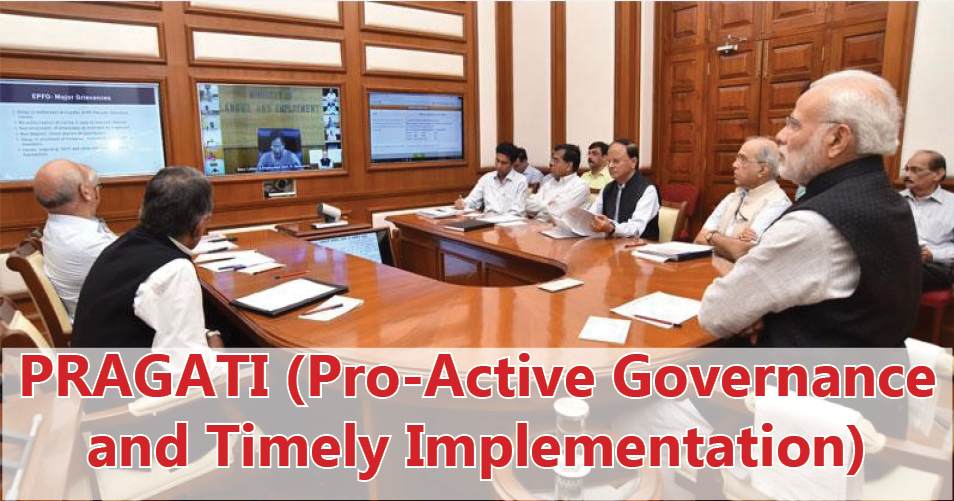
In India, the biggest challenge to development has often not been policy formulation, but its timely and effective implementation. Recently, on December 31, 2025, the 50th meeting of India's flagship governance initiative, PRAGATI (Pro-Active Governance and Timely Implementation), was held, marking a symbolic milestone in the Indian government's commitment to effective, technology-driven governance.
-
-
-
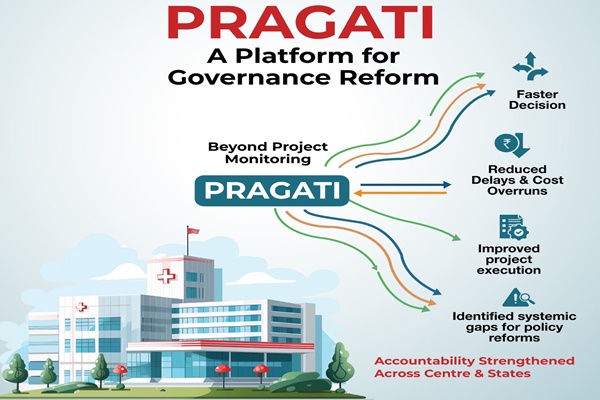
- The emergence of a platform like PRAGATI signifies a decisive shift in the Indian governance landscape. By integrating technology, leadership, and accountability, PRAGATI has demonstrated that proactive monitoring and coordination can accelerate even long-pending projects. In a country where bureaucratic delays have historically hampered development, PRAGATI's decade-long journey represents a conscious shift towards proactive monitoring and results-oriented governance.
- The emergence of a platform like PRAGATI signifies a decisive shift in the Indian governance landscape. By integrating technology, leadership, and accountability, PRAGATI has demonstrated that proactive monitoring and coordination can accelerate even long-pending projects. In a country where bureaucratic delays have historically hampered development, PRAGATI's decade-long journey represents a conscious shift towards proactive monitoring and results-oriented governance.
-
-
|
PRAGATI PRAGATI (Pro-Active Governance And Timely Implementation) is an Information and Communication Technology (ICT) platform launched by the Prime Minister's Office (PMO) with the aim of reviewing and ensuring the timely completion of major projects and addressing grievances of the central and state governments, thereby establishing proactive governance and improved coordination. This platform utilizes technologies such as video conferencing, geospatial mapping, and data management, allowing the Prime Minister to directly connect with officials to resolve issues and expedite projects. Key Objectives: • Proactive Governance: Addressing problems before they arise. • Timely Implementation: Identifying and immediately resolving the reasons for project delays. • Coordination: Fostering better coordination between central and state government departments. · Accountability: Ensuring accountability by monitoring project progress in real-time. |
From Concept to Institutional Practice:
-
-
-
- Large-scale infrastructure and social projects in India have historically suffered from cost overruns, delays, and bureaucratic inertia. The Prime Minister conceptualised PRAGATI to address these challenges by creating an integrated, interactive platform that enables real-time monitoring and inter-governmental coordination.
- PRAGATI integrates three key technologies:
- Digital data management for centralized information and progress tracking
- Video conferencing for direct interaction between the Prime Minister, Central Ministries, and State Governments
- Geo-spatial technology for visual project monitoring and decision-making
- Digital data management for centralized information and progress tracking
- Through these tools, PRAGATI ensures that project-related information, including field-level evidence, is accessible, enabling data-driven, timely decisions. The platform also institutionalizes structured follow-up, ensuring accountability across Ministries and States.
- The conceptual roots of PRAGATI lie in SWAGAT (State Wide Attention on Grievances by Application of Technology), launched by Narendra Modi as Chief Minister of Gujarat in 2003. SWAGAT allowed citizens to submit grievances online, track their progress, and interact with officials via video conferencing. By scaling this idea nationally, PRAGATI evolved from grievance redressal to holistic project management, encompassing infrastructure, social schemes, and public services.
- Large-scale infrastructure and social projects in India have historically suffered from cost overruns, delays, and bureaucratic inertia. The Prime Minister conceptualised PRAGATI to address these challenges by creating an integrated, interactive platform that enables real-time monitoring and inter-governmental coordination.
-
-
Operational Structure:
PRAGATI functions through a three-tier mechanism:
-
-
- Apex-level review: The Prime Minister chairs PRAGATI meetings with Chief Secretaries of States and Secretaries of Central Ministries to address critical issues across projects and schemes.
- Follow-up mechanism: Decisions from meetings are monitored by the Cabinet Secretariat for projects, while Ministries oversee schemes and grievances under continuous PMO supervision.
- Issue escalation: Routine issues are resolved at the Ministry level; complex or high-priority issues are escalated to PRAGATI for direct Prime Ministerial intervention.
- Apex-level review: The Prime Minister chairs PRAGATI meetings with Chief Secretaries of States and Secretaries of Central Ministries to address critical issues across projects and schemes.
-
The platform integrates other initiatives, including PM GatiShakti, PARIVESH, and the PM Ref Portal, ensuring that infrastructure, environmental, and sector-specific data inform decision-making.
Significance of the 50th Meeting:
The milestone meeting was not merely ceremonial. It underscored several defining features of India’s contemporary governance trajectory:
-
-
- Expansion of Scope: While PRAGATI’s early years focused predominantly on infrastructure delays, its scope has widened to include social welfare schemes, evident in the review of the Pradhan Mantri Matru Vandana Yojana (PMMVY) a maternity benefit programme. The emphasis on biometric Aadhaar integration to enhance transparency and delivery efficiency highlights the platform’s adaptability to citizen-centric objectives.
- Adoption of Technology: Prime Minister Narendra Modi’s directive to embed technology at every stage of project life cycles reflects the imperative of digital governance as a multiplier of administrative efficiency. From dashboards to real-time alerts, the platform’s tech DNA has reconfigured accountability norms.
- Cooperative Federalism: PRAGATI's objective of bringing the central government, states, and central ministries onto a single integrated platform is a powerful example of cooperative federalism. By facilitating direct dialogue among diverse administrative actors, PRAGATI helps resolve land, environmental clearances, and coordination bottlenecks that traditionally slow project execution.
- Expansion of Scope: While PRAGATI’s early years focused predominantly on infrastructure delays, its scope has widened to include social welfare schemes, evident in the review of the Pradhan Mantri Matru Vandana Yojana (PMMVY) a maternity benefit programme. The emphasis on biometric Aadhaar integration to enhance transparency and delivery efficiency highlights the platform’s adaptability to citizen-centric objectives.
-
Achievements:
In quantifiable terms, PRAGATI’s impact over the decade is notable. Government figures suggest that more than ₹85 lakh crore worth of investment-linked projects have been accelerated via its ecosystem, spanning sectors such as roads, power, railways, water resources, and social welfare initiatives.
Moreover, independent assessments — including academic studies — highlight PRAGATI’s role in fast-tracking critical developmental projects and infusing a culture of accountability within public administration.
However, the real measure of achievement lies not just in monetary value but in transformative delivery: long-pending infrastructure finally realised, welfare programmes reaching beneficiaries with greater transparency, and bureaucratic coordination shifting from reactive to anticipatory modes.
PRAGATI has accelerated numerous infrastructure projects by resolving long-standing bottlenecks:
-
-
-
- Bogibeel Rail-Cum-Road Bridge (Assam): Conceptualized in 1997, completed in 2018, improving connectivity and strategic mobility in North-East India.
- Navi Mumbai International Airport: Delayed for 25 years due to land acquisition and multi-agency challenges; Phase I inaugurated in 2025 after PRAGATI intervention.
- Bhilai Steel Plant Modernisation: Approved in 2007, delayed due to contractual and execution challenges; PRAGATI helped complete the project efficiently.
- Super Thermal Power Projects (Chhattisgarh, Madhya Pradesh, Jharkhand, North Karanpura, Nabinagar): Escalated under PRAGATI to resolve land, fuel, and administrative bottlenecks, improving energy security and grid reliability.
- Mumbai Trans Harbour Link: India’s longest sea bridge, benefiting from synchronized approvals and execution oversight under PRAGATI.
- Bogibeel Rail-Cum-Road Bridge (Assam): Conceptualized in 1997, completed in 2018, improving connectivity and strategic mobility in North-East India.
-
-
Other projects include natural gas pipelines (JHBDPL), highway expansions (NH-161, NH-75, NH-344M), and rail connectivity projects (Jammu–Udhampur–Srinagar–Baramulla rail line), all of which benefitted from high-level monitoring and accountability enforcement.
Challenges:
-
-
-
- Despite its successes, Land acquisition and inter-departmental coordination remain persistent constraints in large infrastructure projects. Senior administrators have acknowledged that while the platform elevates monitoring, underlying structural issues such as policy rigidity and procedural delays still require deeper reforms.
- Furthermore, institutionalising local ownership of PRAGATI’s model beyond the Centralised apex demands further strengthening at State and district levels.
- Despite its successes, Land acquisition and inter-departmental coordination remain persistent constraints in large infrastructure projects. Senior administrators have acknowledged that while the platform elevates monitoring, underlying structural issues such as policy rigidity and procedural delays still require deeper reforms.
-
-
Key Lessons from PRAGATI:
1. Technology-Enabled Governance: Digital dashboards, video conferencing, and geospatial tools make governance proactive and data-driven.
2. Time-Bound Accountability: Decisions are tracked with clear timelines, ensuring follow-through across multiple agencies.
3. Cooperative Federalism: Direct engagement between Centre and States reduces inter-governmental friction.
4. Outcome Orientation: Focus shifts from processes to tangible deliverables, improving citizen trust in governance.
5. Replicable Model: PRAGATI sets a global benchmark for project acceleration in large federal democracies.
Conclusion:
PRAGATI’s 50th meeting signals more than continuity; it reflects an administrative ethos in evolution. Over the past decade, it has gradually reshaped expectations from governance from policy pronouncements to measurable delivery. In a polity as diverse and complex as India, governance innovations like PRAGATI offer valuable lessons. Its blend of technology, leadership engagement, and intergovernmental coordination could serve as a template for problem-solving platforms in other federal democracies grappling with similar implementation challenges. As the nation approaches its 2047 vision, PRAGATI’s evolution from a project-tracking tool to a governance institution underscores a broader narrative: India’s progress is not just about drafting good policies, but embedding capable institutions that ensure those policies translate into tangible, timely impact.
| UPSC/PCS Mains Exam Mock Question: More than policy formulation, policy implementation has been India's biggest challenge. In light of this statement, analyze the role of PRAGATI. |



