
Context:
At the recently held 60th DGP–IGP Conference in Raipur (28–30 November 2025), the Prime Minister of India emphasized the urgent need to transform the public perception of the police, particularly among the youth. In a rapidly evolving India, socially, economically and demographically, this message signals that policing can no longer remain anchored in the old paradigms of control and coercion. Instead, it must evolve to meet new expectations of fairness, accessibility, trust, and citizen-centric service.
Importance of Public Perception of the Police:
-
-
- Public perception of the police plays a foundational role in shaping the effectiveness, legitimacy, and moral authority of law enforcement in a democracy.
- When the police are viewed as protectors and partners, they help build trust, cooperation, and a sense of security among citizens. In such an atmosphere, people willingly report crimes, assist in investigations and cooperate with police in maintaining public safety—strengthening the rule of law, social stability, and community cohesion.
- Conversely, if the police are seen with suspicion, fear, or resentment due to bias, misconduct, inefficiency, or lack of accountability, even legitimate policing efforts can be undermined. Citizens may hesitate to report crimes, avoid engagement, or mistrust outcomes. This erodes the credibility of law enforcement and weakens the very foundations of justice and social order.
- Public perception of the police plays a foundational role in shaping the effectiveness, legitimacy, and moral authority of law enforcement in a democracy.
-
What Kind of Change Is Needed?
To transform public perception, reforms must be structural, institutional, cultural, and operational. The 2025 conference highlighted several directions.
Key areas requiring transformation include:
-
-
- Policing as Public Service, Not Mere Enforcement: Police must be redefined as public servants whose primary duty is to protect rights and ensure safety—not merely maintain order or serve those in power. This requires cultivating empathy, fairness, and accountability.
- Modernization and Technology-Driven Policing: The conference called for leveraging modern tools: integrating databases under NATGRID, using Artificial Intelligence (AI), expanding forensic-based investigations—all aimed at improving quality, transparency, and credibility in policing.
- Urban Policing, Youth Outreach, and Citizen-Centric Services: Recognizing the realities of rapidly growing cities and a youthful population, the conference emphasized strengthening urban policing, revitalizing tourist police, and enhancing accessibility and accountability of policing services in alignment with citizen needs.
- Public Awareness and Legal Modernization: It highlighted the need to raise awareness about newly introduced criminal laws (replacing colonial-era legislation) so that citizens understand their rights and responsibilities, and police can adapt their practices accordingly.
- Holistic Role: Security, Rights, Service: Beyond crime control, the police must play a wider role in community safety, women’s security, disaster response, crime prevention, and rehabilitation—thus becoming protectors of citizen welfare.
- Policing as Public Service, Not Mere Enforcement: Police must be redefined as public servants whose primary duty is to protect rights and ensure safety—not merely maintain order or serve those in power. This requires cultivating empathy, fairness, and accountability.
-
Police Reforms in India:
-
-
- Police reforms in India aim to transform values, culture, policies, and practices to create a citizen-centered, professional, and accountable policing system. The overarching goal is to enable police to perform duties aligned with democratic values, human rights, and the rule of law, while strengthening coordination with courts, correctional facilities, and oversight bodies.
- Despite policing being a State subject under the Constitution, most State Police Acts are still influenced by the colonial-era Police Act of 1861 or the Model Police Act of 2006. This colonial legacy left the system bureaucratic and politically influenced. Police officers are often perceived as political instruments, eroding public trust.
- The emergence of new forms of crime, cybercrime, terrorism, extremism, requires technological modernization and specialized training. Further, systemic issues in crime registration, investigation, and agencies such as the CBI demand urgent reform. For India to position itself as a regional “net security provider,” major transformation in policing is crucial.
- Police reforms in India aim to transform values, culture, policies, and practices to create a citizen-centered, professional, and accountable policing system. The overarching goal is to enable police to perform duties aligned with democratic values, human rights, and the rule of law, while strengthening coordination with courts, correctional facilities, and oversight bodies.
-
Key Issues in the Police System:
-
-
- Colonial Legacy: The current system—rooted in the 1861 Act—prioritizes state control over citizen security.
- Political Interference vs. Operational Independence: Political influence over postings, transfers, and promotions promotes bias. The 2nd Administrative Reforms Commission recommended limiting political power to uphold the rule of law.
- Public Perception: Police are often seen as instruments of repression rather than protectors. Recurring cases of custodial deaths and torture undermine credibility.
- Overburdened Force: With only 192 police personnel per lakh population—below the UN recommendation of 222—the force faces long hours, stress, and reduced efficiency.
- Constabulary Challenges: Constables constitute 86% of the force and work in poor conditions with limited promotion opportunities and inadequate training.
- Infrastructure Gaps: Shortages of vehicles, weapons, control rooms, and basic facilities hinder operational efficiency.
- Operational Challenges: Excessive workload, weak forensic/logistical support, non-cooperation from the public, and interference in investigations complicate policing.
- Colonial Legacy: The current system—rooted in the 1861 Act—prioritizes state control over citizen security.
-
Major Recommendations of Police Reform Commissions:
-
-
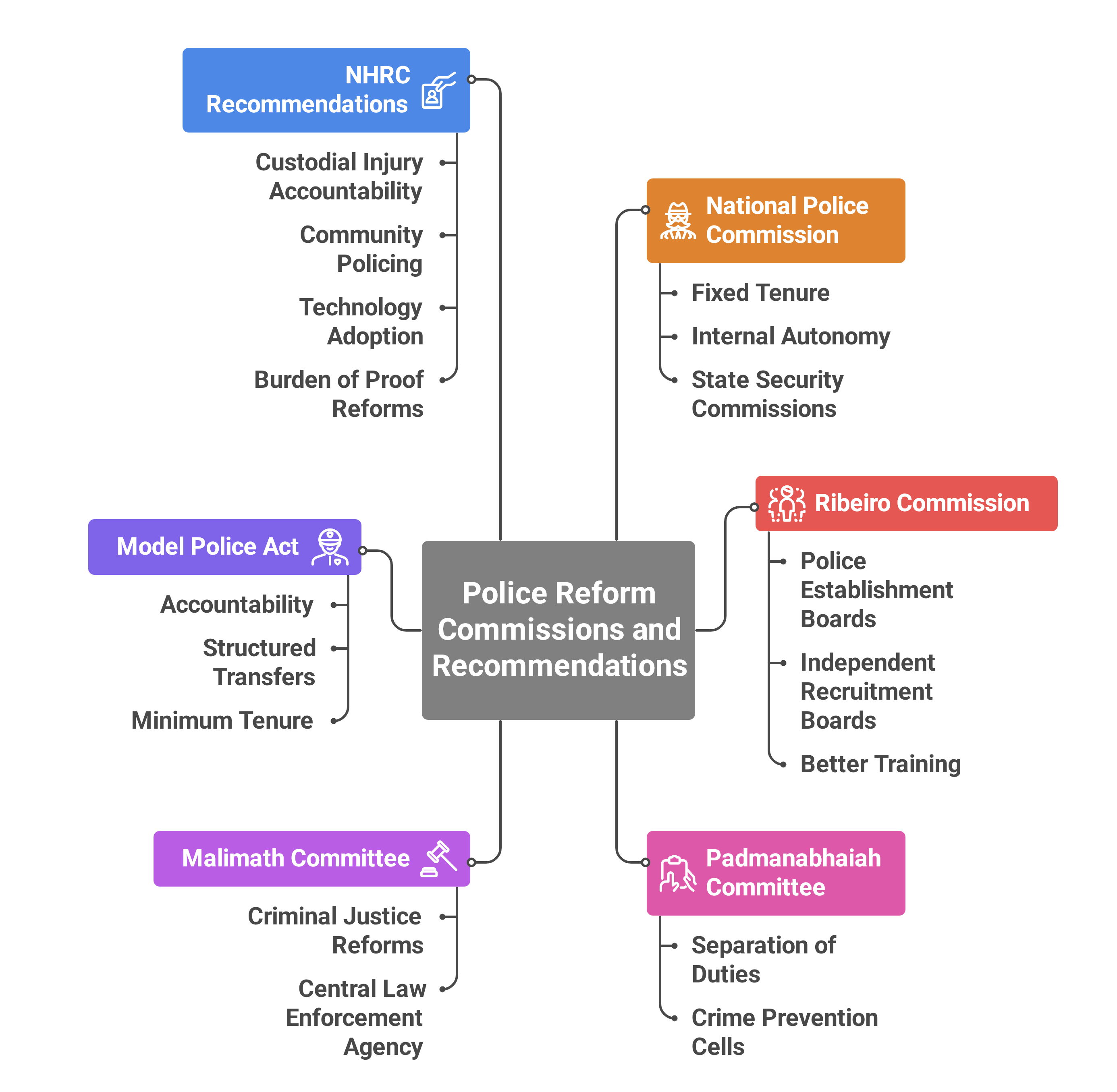
- National Police Commission (1977–81): Fixed tenure for police chiefs, internal management autonomy, State Security Commissions.
- Ribeiro Commission (1998): Police Establishment Boards (PEBs), independent recruitment boards, better training.
- Padmanabhaiah Committee (2000): Separation of law-and-order duties from investigation, creation of crime prevention cells.
- Malimath Committee (2002–03): Reforms across the criminal justice system including a central law enforcement agency.
- Model Police Act (2006): Focused on accountability, structured transfers, minimum tenure, stronger internal management.
- NHRC Recommendations (2021): Accountability in custodial injury cases, community policing, technology adoption, burden of proof reforms.
- National Police Commission (1977–81): Fixed tenure for police chiefs, internal management autonomy, State Security Commissions.
-
Supreme Court Directives: Prakash Singh Case (2006):
A landmark judgment mandated reforms to shield the police from political interference:
-
-
- Fixed tenure for DGPs, SPs, and SHOs
- Establishment of State Police Complaints Authorities (SPCAs)
- Separation of investigation from law-and-order functions
- Creation of State Security Commissions with civil society participation
- Fixed tenure for DGPs, SPs, and SHOs
-
Despite this, full compliance remains poor, with major States like Maharashtra, Tamil Nadu, and Uttar Pradesh lagging.
Importance of Police Reforms
If reforms succeed and public perception becomes positive, the impact will be long-lasting:
-
-
- Greater Legitimacy and Public Trust: Police will be more widely viewed as protectors and helpers, increasing cooperation, crime reporting, and community support.
- Improved Law Enforcement and Justice Delivery: Enhanced training, forensic capacity, technology, and accountability can make investigations more efficient and transparent, raise conviction rates, reduce delays, and strengthen trust in justice.
- Protection of Human Rights and Dignity: A rights-respecting, accountable police force can reduce custodial violence, arbitrary arrest, discrimination, and misuse of power.
- Stronger Public Safety and Social Stability: Reliable policing helps prevent crime, respond to modern threats (cybercrime, organized crime, extremism), manage disasters, and ensure community security.
- Strengthening Democratic Norms and Rule of Law: A professional and citizen-centric police force reinforces respect for the rule of law, protects civil liberties, and strengthens trust in democratic institutions.
- Greater Legitimacy and Public Trust: Police will be more widely viewed as protectors and helpers, increasing cooperation, crime reporting, and community support.
-
For a youthful, urbanizing, and aspirational nation, such transformation is not just desirable but essential for the future.
Conclusion:
Police reforms in India aim to build a professional, accountable, and citizen-oriented police force. By addressing historical legacies, operational inefficiencies, infrastructure deficits, and political interference, these reforms seek to strengthen public trust, uphold human rights, and ensure effective law enforcement. The successful implementation of these reforms is crucial for addressing contemporary security challenges and upholding the rule of law in a democratic society.
| UPSC/PCS Mains Question: |



