
Context:
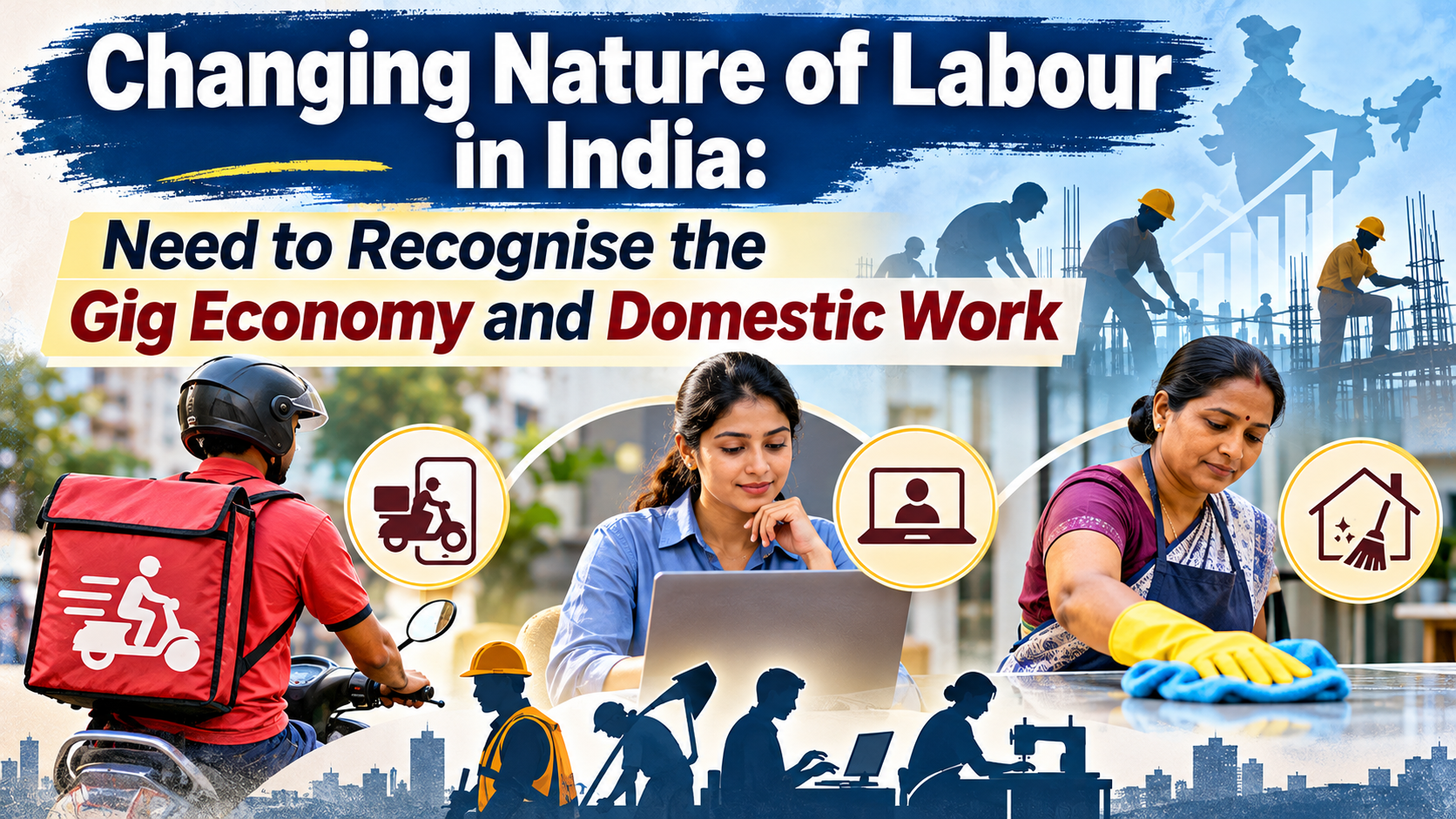
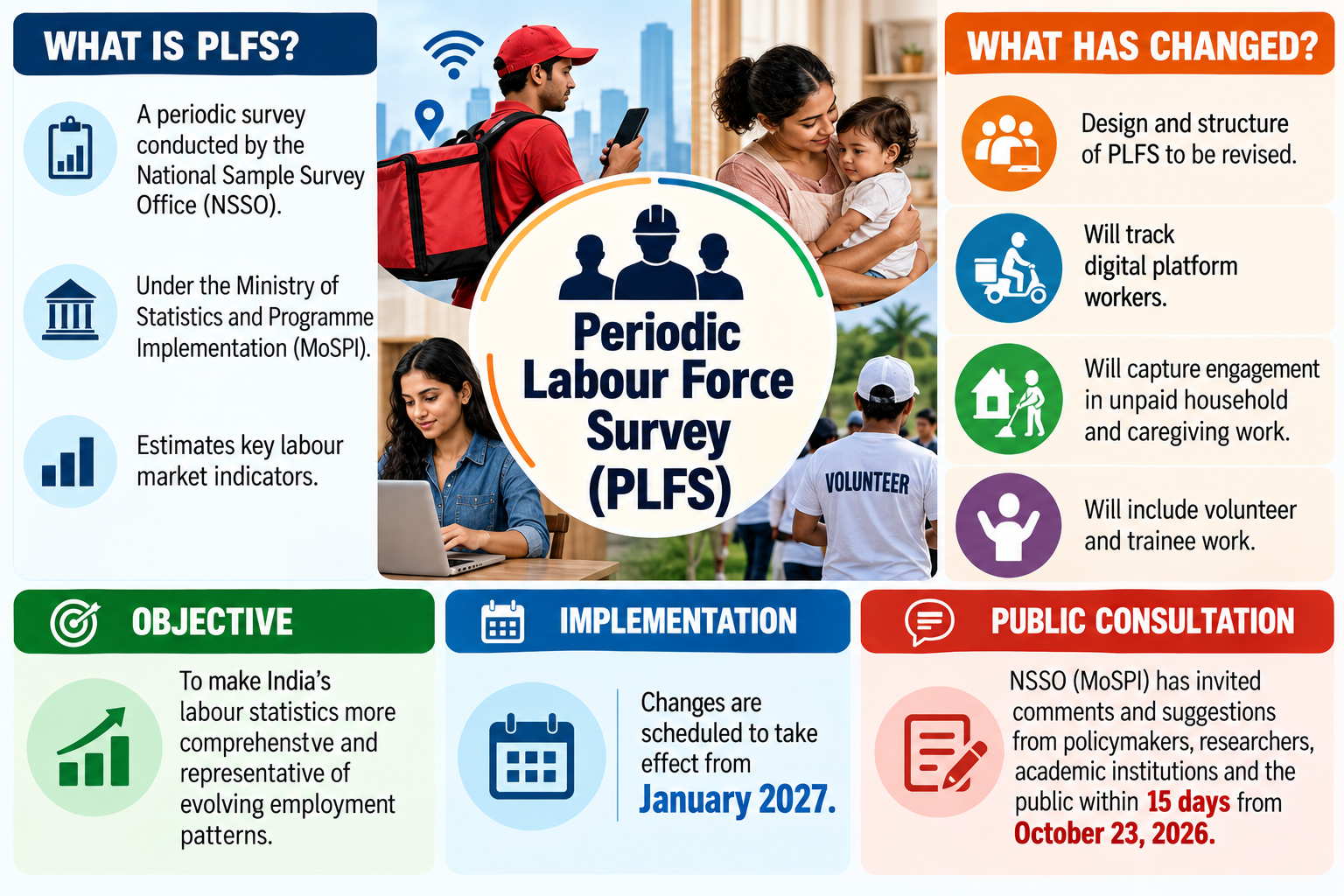
Recently, the Ministry of Statistics and Programme Implementation (MoSPI) has proposed comprehensive changes to the Periodic Labour Force Survey (PLFS). The objective is to better incorporate the rapidly growing gig and platform-based workers, as well as unpaid domestic and care-related work performed by women, into employment statistics. The proposed changes are scheduled to be implemented from January 2027. The Ministry has also invited suggestions from experts, researchers and the general public. This initiative is an important step towards understanding the changing realities of India's labour market and developing a more inclusive definition of employment.
Current Framework for Employment Measurement in India:
-
-
- The economic progress of any country cannot be assessed solely on the basis of Gross Domestic Product (GDP) or industrial development. It is equally important to examine how many people participate in economic activities and the nature of employment available to them. This requires reliable labour-related data.
- In India, the Periodic Labour Force Survey (PLFS) is the primary source of data on employment and unemployment. It was launched in 2017-18 by the National Statistical Office (NSO). Its objective is to assess key indicators such as employment, unemployment, the Labour Force Participation Rate (LFPR) and the Worker Population Ratio (WPR).
- Under the existing framework, employment statistics are primarily based on categories such as regular wage or salaried employment, self-employment and casual labour. However, new forms of employment are emerging in the changing economy. Workers engaged through digital platforms and unpaid activities performed within households have not received adequate representation in traditional employment measurement systems. Consequently, the assessment of the actual labour market situation remains incomplete.
- The economic progress of any country cannot be assessed solely on the basis of Gross Domestic Product (GDP) or industrial development. It is equally important to examine how many people participate in economic activities and the nature of employment available to them. This requires reliable labour-related data.
-
Expansion of the Gig Economy and Emerging Employment Relationships:
-
-
- The expansion of digital technology, the internet and smartphones has rapidly transformed the nature of employment in India. A growing number of people are now providing services through digital platforms rather than working in traditional offices or regular workplaces. This arrangement is known as the gig economy.
- The gig economy includes workers who provide services on the basis of specific tasks, assignments or projects rather than through permanent employment. It includes taxi drivers, food delivery workers, online service providers and independent professionals. Platforms such as Ola, Uber, Zomato, Amazon and Urban Company are prominent examples.
- According to the NITI Aayog report of 2022, India had approximately 7.7 million gig and platform workers during 2020-21. Their number is projected to increase to 23.5 million by 2029-30. This growth highlights the increasing importance of the gig sector in the Indian economy.
- However, accurately estimating the actual number of these workers and assessing their working conditions remain challenging. The primary reason is that gig work is often irregular, and many people undertake it in addition to their primary occupation. Consequently, such workers may remain unidentified in traditional surveys.
- The expansion of digital technology, the internet and smartphones has rapidly transformed the nature of employment in India. A growing number of people are now providing services through digital platforms rather than working in traditional offices or regular workplaces. This arrangement is known as the gig economy.
-
Major Proposed Changes in PLFS:
-
-
- Under the proposed changes, a separate Second Stage Stratum (SSS) will be developed to identify digital platform workers. For this purpose, households in both rural and urban areas will be asked whether any member of the household has worked through a digital platform during the preceding 365 days.
- Additionally, information will be collected from workers regarding the services they provide, whether they work across multiple platforms, their reasons for choosing this form of employment, and the challenges they face while working.
- These challenges include long working hours, adverse weather conditions such as extreme heat and rainfall, uncertain income, lack of protection against accidents and inadequate social security facilities.
- Thus, the proposed changes are not limited to estimating the number of gig workers but will also help in understanding the quality of their employment and their working conditions.
- Under the proposed changes, a separate Second Stage Stratum (SSS) will be developed to identify digital platform workers. For this purpose, households in both rural and urban areas will be asked whether any member of the household has worked through a digital platform during the preceding 365 days.
-
Need to Give Economic Recognition to Unpaid Domestic Work:
-
-
- The second important aspect of the proposed reforms is to better record unpaid domestic and care-related work performed by women.
- In Indian society, activities such as cooking, cleaning, childcare, assisting elderly people and fulfilling the needs of other family members are primarily performed by women. These activities require considerable time and labour, but they do not generate direct monetary payments. Consequently, they are often not recorded as employment in traditional labour surveys.
- According to the Time Use Survey 2024 conducted by the Ministry of Statistics and Programme Implementation, women aged six years and above spent an average of more than four and a half hours per day on unpaid domestic and care-related services. In contrast, men spent only 37 minutes on these activities. This disparity reflects the unequal distribution of domestic responsibilities in Indian society.
- Under the proposed changes, information will be collected from individuals aged 15 years and above regarding the production of goods for self-consumption, unpaid domestic work, care-related activities, voluntary work and unpaid training. This will help identify activities that contribute to the economy but have not received adequate recognition so far.
- The second important aspect of the proposed reforms is to better record unpaid domestic and care-related work performed by women.
-
Economic and Social Significance of the Proposed Reforms:
-
-
- Improved Coverage of Employment Statistics: Better recording of gig workers and unpaid activities will provide a more realistic picture of the labour market. It will also help distinguish between traditional and emerging forms of employment.
- Women's Empowerment: Assessing women's contribution to domestic work will help in understanding gender inequality, the unequal distribution of time and issues related to women's economic participation.
- Expansion of Social Security: Reliable data on the number, working conditions and challenges of gig workers will help make insurance, pensions, healthcare facilities and other social security measures more effective.
- Inclusive Development: Identifying diverse forms of employment in rural and urban areas will help the government formulate policies according to region-specific requirements.
- Improvement in Policy Decisions: Reliable labour statistics can make policies related to skill development, employment generation, women's labour force participation and labour reforms more effective.
- Improved Coverage of Employment Statistics: Better recording of gig workers and unpaid activities will provide a more realistic picture of the labour market. It will also help distinguish between traditional and emerging forms of employment.
-
Major Challenges Facing the Reforms:
-
-
- The foremost challenge is the accurate identification of gig workers. Many workers operate across multiple platforms simultaneously or undertake gig work in addition to their regular employment. Consequently, their work may be missed during surveys.
- It may not be easy for every individual to accurately recall irregular work undertaken during the preceding 365 days. This may lead to errors in survey responses.
- The economic valuation of unpaid domestic work is also a challenge. It is not sufficient to know whether an individual performs domestic work; it is equally important to understand how much time they spend on these activities. Better coordination between the Time Use Survey and PLFS is therefore essential.
- Changes in survey methodology and employment categories may make direct comparisons between old and new data difficult. Therefore, clear information regarding comparable statistics and the revised methodology must be made available.
- Furthermore, the changing working conditions of gig workers, accountability of platform companies and social security rights of workers must also receive adequate attention in policymaking.
- The foremost challenge is the accurate identification of gig workers. Many workers operate across multiple platforms simultaneously or undertake gig work in addition to their regular employment. Consequently, their work may be missed during surveys.
-
Way Forward:
-
-
- India needs to modernise its employment measurement system in accordance with the changing realities of the labour market. First, the proposed changes in PLFS should be implemented in a scientific and practical manner. Along with simplifying the survey questionnaire, survey investigators should also receive appropriate training.
- Coordination among digital platform companies, the Ministry of Labour and the Ministry of Statistics must be strengthened to ensure the reliability of data related to gig workers. Better integration with existing mechanisms such as the e-Shram Portal can help extend the benefits of social security schemes to workers.
- The Time Use Survey should be conducted at regular intervals to assess unpaid domestic work. At the same time, public childcare centres, elderly care services, clean cooking fuel and drinking water facilities should be expanded to reduce women's domestic workload.
- The quality of employment should receive the same importance as the quantity of employment. Effective provisions for minimum income security, accident insurance, health protection and social security must be ensured for gig workers.
- India needs to modernise its employment measurement system in accordance with the changing realities of the labour market. First, the proposed changes in PLFS should be implemented in a scientific and practical manner. Along with simplifying the survey questionnaire, survey investigators should also receive appropriate training.
-
Conclusion:
-
-
- Modernising labour statistics in accordance with the changing nature of employment in India is the need of the hour. The proposal to better record the gig economy and unpaid domestic work is not merely a statistical reform but also an important initiative towards economic and social justice.
- In any economy, only those contributions that are properly recognised and measured can become the basis for effective policymaking. Therefore, India must develop a labour measurement system that recognises not only wage-earning workers but also those engaged in the digital economy and individuals whose unpaid labour contributes to the well-being of families and society. This will serve as the foundation for inclusive, equitable and sustainable development.
- Modernising labour statistics in accordance with the changing nature of employment in India is the need of the hour. The proposal to better record the gig economy and unpaid domestic work is not merely a statistical reform but also an important initiative towards economic and social justice.
-



