
India’s Water Future: Challenges, Governance and Sustainability
Context:
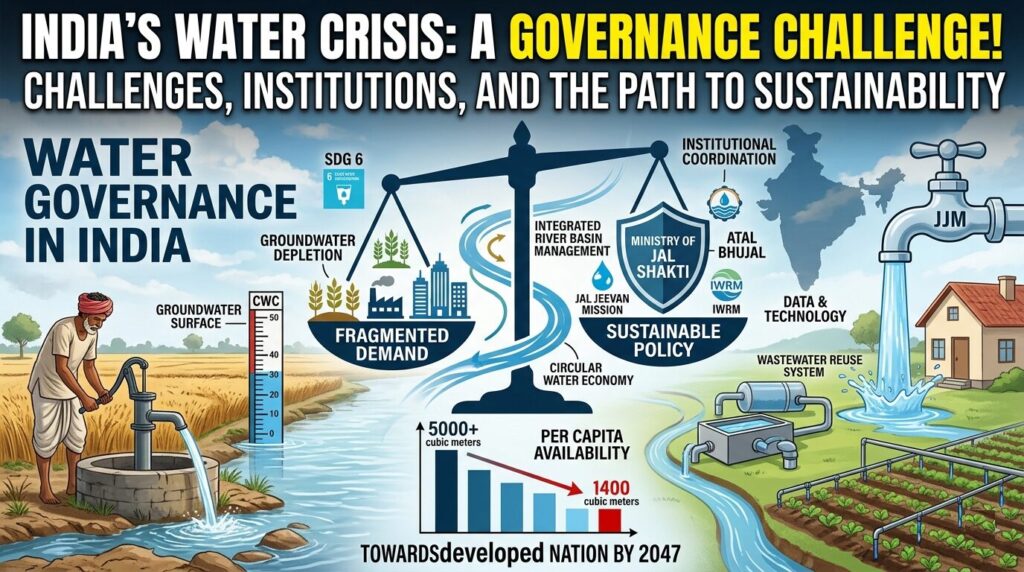
India supports nearly 18% of the world’s population, while possessing only about 4% of global freshwater resources. Rising population, unplanned urbanisation, climate change, excessive groundwater extraction and pollution have pushed the country towards a serious water crisis. This crisis is not merely about “water scarcity”, but also about “water management and governance”. Therefore, the need of the hour is not limited to the construction of new dams and canals, but also to ensure scientific, participatory and sustainable management of water resources.
The Reality of India’s Water Crisis:
India is the world’s largest user of groundwater. A major share of water used in agriculture, industry and domestic consumption depends upon groundwater. After the Green Revolution, tube-well-based irrigation in regions such as Punjab, Haryana and western Uttar Pradesh significantly increased agricultural production, but it also led to a sharp decline in groundwater levels.
According to NITI Aayog’s ‘Composite Water Management Index’ report, several major Indian cities may face a “Day Zero” situation in the future, where tap water could completely run out.
In addition:
-
-
- Nearly 70% of surface water is polluted in one form or another.
- Many rivers in the country are affected by industrial waste and sewage.
- Climate change is increasing the frequency of irregular monsoons, droughts and floods.
- Per capita water availability is continuously declining, indicating a situation of water stress.
- It is evident that India’s water crisis is multidimensional and structural in nature.
- Nearly 70% of surface water is polluted in one form or another.
-
Water Governance:
-
-
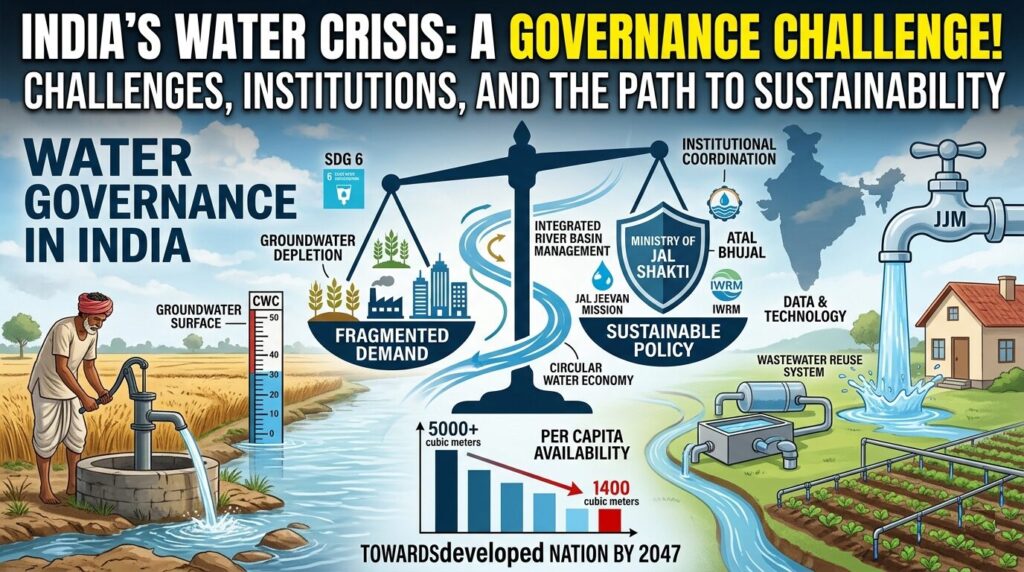
- Water governance is not merely an administrative framework for water distribution. It includes aspects such as policy formulation, institutional coordination, community participation, water conservation, water quality, equitable distribution and ecological balance.
- In India, water is a subject under the State List of the Constitution, but the Union government also plays an important role in matters related to inter-state rivers, dams and national water policy. This often creates conflicts of authority and a lack of coordination in water management.
- River disputes such as Cauvery, Krishna and the Sutlej-Yamuna Link (SYL) demonstrate that water has become not only a natural resource issue, but also a political and federal challenge.
- Water governance is not merely an administrative framework for water distribution. It includes aspects such as policy formulation, institutional coordination, community participation, water conservation, water quality, equitable distribution and ecological balance.
-
Limitations of the Traditional Model:
After Independence, India adopted a model based on large dams, canals and centralised water projects. These were considered the foundation of development and food security. Projects such as Bhakra-Nangal, Hirakud and Sardar Sarovar contributed significantly to agriculture and power generation.
However, over time, several challenges emerged from this model:
-
-
- Large dams led to displacement and environmental degradation.
- Regional inequalities in water distribution increased.
- Groundwater management was neglected.
- Traditional water conservation systems weakened.
- Large dams led to displacement and environmental degradation.
-
At present, there is a growing understanding that engineering-based solutions alone are insufficient. The solution to the water crisis lies in the integration of social, economic and ecological approaches.
New Initiatives for Water Governance in India:
-
-
- Formation of the Ministry of Jal Shakti: In 2019, the Union Government merged various water-related departments to form the Ministry of Jal Shakti. Its objective was to develop coordination and an integrated approach towards water management.
- Jal Jeevan Mission: The objective of this mission is to provide tap water connections to every rural household. It has improved access to drinking water and reduced the burden of labour on women.
- Atal Bhujal Yojana: This scheme promotes groundwater conservation and water budgeting through community participation. It seeks to increase awareness regarding water usage at the local level.
- Catch the Rain Campaign: This campaign was launched to promote rainwater harvesting with the principle: “Where it rains, when it rains.”
- Digital Water Data and Technological Interventions: Technologies such as remote sensing, GIS-based water mapping and smart metering are important steps towards making water management more scientific.
- Formation of the Ministry of Jal Shakti: In 2019, the Union Government merged various water-related departments to form the Ministry of Jal Shakti. Its objective was to develop coordination and an integrated approach towards water management.
-
Major Challenges in Water Governance:
-
-
- Excessive Water Use in Agriculture: Nearly 80% of freshwater in India is used in agriculture. Water-intensive crops such as paddy and sugarcane are being cultivated in regions already facing water scarcity. Policies such as free electricity and Minimum Support Price (MSP) also encourage excessive groundwater extraction.
- Urban Water Crisis: Rapidly expanding cities suffer from weak water supply and sewage management systems. Many cities are excessively dependent on groundwater, leading to a rapid decline in water levels.
- Water Pollution: Industrial waste, agricultural chemicals and untreated sewage are polluting rivers and lakes. This is adversely affecting both drinking water quality and public health.
- Institutional Fragmentation: Several departments associated with water management function separately, resulting in a lack of coordination in policy formulation and implementation.
- Climate Change: Irregular rainfall, melting glaciers and extreme weather events may further increase uncertainty in water availability in the future.
- Excessive Water Use in Agriculture: Nearly 80% of freshwater in India is used in agriculture. Water-intensive crops such as paddy and sugarcane are being cultivated in regions already facing water scarcity. Policies such as free electricity and Minimum Support Price (MSP) also encourage excessive groundwater extraction.
-
Way Forward:
To address the water crisis, India must move beyond a “supply-based” approach and adopt a “demand management” based policy.
-
-
- Integrated Water Resources Management (IWRM): Policies must view rivers, groundwater, rainwater and ecology as a single integrated unit.
- Crop Diversification: There is a need to promote crops requiring less water instead of water-intensive crops such as paddy and sugarcane.
- Community Participation: Traditional systems such as Rajasthan’s johads, Maharashtra’s Pani Panchayats and South India’s tank systems demonstrate that local communities can play an important role in water conservation.
- Recycling and Reuse of Water: Urban areas must promote the treatment and reuse of wastewater.
- Viewing Water as a “Public Trust”: Water should not be viewed merely as an economic commodity, but as a shared natural resource and a human right.
- Integrated Water Resources Management (IWRM): Policies must view rivers, groundwater, rainwater and ecology as a single integrated unit.
-
Conclusion:
India’s future will depend upon the sustainable management of its water resources. The water crisis is not merely an environmental issue, but a national concern linked with economic development, food security, public health and social stability. If India aims to achieve the goal of becoming a “Developed India”, it must prioritise structural reforms in water governance, scientific policy-making and community participation. Today, there is a need to view water not as an unlimited resource, but as a limited and shared natural heritage, because in the coming years, “water security” will become the true foundation of national security.



