

Context:
Recently, India successfully concluded the 20th session of the Intergovernmental Committee for the Safeguarding of the Intangible Cultural Heritage (ICH) of UNESCO at the historic Red Fort, New Delhi. The six-day meeting marked the first time India hosted this important UNESCO committee, reinforcing its growing leadership in cultural diplomacy and global heritage governance.
-
-
-
- The session witnessed the inscription of Deepavali (Diwali) on UNESCO’s Representative List of the Intangible Cultural Heritage of Humanity, making it the 16th ICH element from India. The event highlighted the convergence of India’s tangible and intangible heritage and showcased its civilisational depth on a global platform.
- The session witnessed the inscription of Deepavali (Diwali) on UNESCO’s Representative List of the Intangible Cultural Heritage of Humanity, making it the 16th ICH element from India. The event highlighted the convergence of India’s tangible and intangible heritage and showcased its civilisational depth on a global platform.
-
-
Why It Matters?
-
-
-
- Intangible Cultural Heritage (ICH) encompasses traditions, performing arts, rituals, crafts, languages, festivals, and other non-tangible expressions that communities recognise as part of their cultural heritage.
- The Committee provides a global platform for policy dialogue, listings, monitoring, and capacity-building to safeguard living heritage in a rapidly globalising world.
- This session was particularly noteworthy as India hosted the Committee for the first time, at the historic Red Fort, New Delhi, underscoring its commitment to cultural diplomacy and heritage safeguarding.
- Intangible Cultural Heritage (ICH) encompasses traditions, performing arts, rituals, crafts, languages, festivals, and other non-tangible expressions that communities recognise as part of their cultural heritage.
-
-
Key Outcomes of the 20th Session:
-
-
-
- Major Inscriptions and Recognitions: Deepavali (Diwali), the pan-Indian festival of lights, was officially inscribed on the UNESCO Representative List of the Intangible Cultural Heritage of Humanity, recognising its cultural, social, and symbolic significance globally.
- Volume of Nominations and Listings: The session examined a substantial number of heritage nominations from multiple countries and inscribed several new elements onto UNESCO’s lists, reflecting the diversity of living traditions worldwide.
- Decisions on Future Sessions: The Committee decided that the 21st session will be held in Xiamen, China (30 November–5 December 2026), demonstrating continued global rotation and participation.
- Major Inscriptions and Recognitions: Deepavali (Diwali), the pan-Indian festival of lights, was officially inscribed on the UNESCO Representative List of the Intangible Cultural Heritage of Humanity, recognising its cultural, social, and symbolic significance globally.
-
-
Historical Background:
-
-
-
- Recognising the growing threat to living cultural traditions due to globalisation, rapid social change, urbanisation, and limited resources, UNESCO adopted the Convention for the Safeguarding of the Intangible Cultural Heritage on 17 October 2003 during its 32nd General Conference in Paris.
- The Convention acknowledged that oral traditions, performing arts, rituals, social customs, craftsmanship, and traditional knowledge systems form the backbone of cultural identity but remain vulnerable without institutional support. A key feature of the Convention was its community-centric approach, placing indigenous communities, groups, and individual practitioners at the heart of safeguarding efforts.
- It underscored:
- The interdependence of tangible and intangible heritage
- The need for international cooperation and assistance
- The importance of intergenerational transmission, especially among youth
- The interdependence of tangible and intangible heritage
- The Convention laid the foundation for:
- UNESCO’s Intangible Cultural Heritage Lists
- The work of the Intergovernmental Committee for the Safeguarding of the Intangible Cultural Heritage
- UNESCO’s Intangible Cultural Heritage Lists
- Recognising the growing threat to living cultural traditions due to globalisation, rapid social change, urbanisation, and limited resources, UNESCO adopted the Convention for the Safeguarding of the Intangible Cultural Heritage on 17 October 2003 during its 32nd General Conference in Paris.
-
-
Objectives of the 2003 Convention:
The Convention seeks to:
-
-
-
- Safeguard intangible cultural heritage
- Ensure respect for the heritage of communities, groups, and individuals
- Raise awareness at local, national, and international levels
- Promote global cooperation and mutual assistance
- Safeguard intangible cultural heritage
-
-
Functions of the Intergovernmental Committee:
The Intergovernmental Committee for the Safeguarding of ICH plays a central role in implementing the Convention by:
-
-
-
- Monitoring and promoting Convention objectives
- Recommending best practices for safeguarding ICH
- Preparing plans for the utilisation of the ICH Fund
- Mobilising additional financial resources
- Drafting and updating Operational Directives
- Examining periodic reports from States Parties
- Deciding on:
- Inscription of elements on UNESCO’s ICH Lists
- Granting of international assistance
- Inscription of elements on UNESCO’s ICH Lists
- Monitoring and promoting Convention objectives
-
-
India’s Intangible Cultural Heritage: A National & Global Asset:
India’s intangible cultural heritage is a living resource, contributing far beyond cultural symbolism.
-
-
-
- Social & Cultural Identity: ICH preserves linguistic, regional, tribal, religious, and community identities, strengthening social cohesion and pluralism in a diverse society.
- Livelihoods & Crafts Economy: Traditional crafts, folk arts, rituals, and cultural tourism sustain millions of artisans and performers, particularly in rural and marginalised regions. Safeguarding ICH supports inclusive and sustainable development.
- Education & Knowledge Transmission: ICH embodies traditional ecological wisdom, oral histories, craftsmanship techniques, and indigenous knowledge systems, enriching education and ensuring intergenerational continuity.
- Cultural Diplomacy & Soft Power: Festivals, dances, crafts, and rituals reflect India’s values and diversity, enhancing soft power, people-to-people connections, and international cultural influence. Hosting the UNESCO session amplified this impact.
- Global Heritage Leadership: India’s active role strengthens equitable and community-sensitive global heritage governance, positioning it as a key voice among developing nations.
- Social & Cultural Identity: ICH preserves linguistic, regional, tribal, religious, and community identities, strengthening social cohesion and pluralism in a diverse society.
-
-
India’s Contributions to Safeguarding ICH:
To systematise preservation efforts, the Ministry of Culture launched the “Scheme for Safeguarding the Intangible Heritage and Diverse Cultural Traditions of India.”
Key features:
Revitalisation of practitioners, institutions, scholars, and communities
• Support for documentation, ICH inventories, workshops, performances, and training
• Assistance in preparing UNESCO nomination dossiers
• Promotion of education–culture integration
• Skill development support under the NVEQF framework
Additionally, the Sangeet Natak Akademi (SNA) conducts capacity-building programmes, training practitioners and spreading awareness of ICH values.
India’s Intangible Cultural Heritage Inscribed by UNESCO:
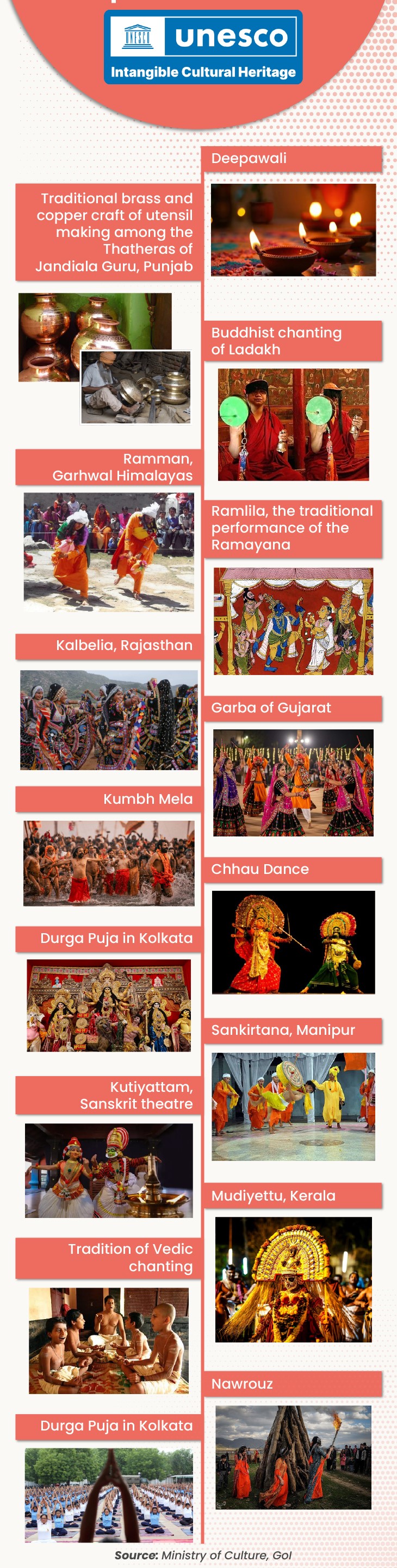
India is a State Party to the 2003 Convention and now has 16 elements on UNESCO’s ICH List, with Deepavali (2025) being the latest.
Snapshot of India’s Inscribed Elements
Festivals & Rituals
• Ramlila (2008)
• Ramman (2009)
• Kumbh Mela (2017)
• Durga Puja (2021)
• Garba (2023)
• Deepavali (2025)
Performing Arts
• Kutiyattam (2008)
• Chhau Dance (2010)
• Kalbelia (2010)
• Mudiyettu (2010)
• Sankirtana (2013)
Traditions & Knowledge
• Vedic Chanting (2008)
• Buddhist Chanting of Ladakh (2012)
• Yoga (2016)
Crafts
• Thatheras’ brass and copper craft (2014)
Multinational
• Nowruz / Nawrouz (2016)
Implications of the UNESCO Meet:
-
-
-
- Cultural Diplomacy & Soft Power: India’s leadership in cultural governance strengthens its global image, projecting it as a nation that respects and promotes living heritage. Hosting the meet amplifies India’s soft power and people-to-people diplomacy, particularly among developing countries.
- International Cooperation & Policy Influence: The meet provided India with a platform to influence UNESCO policy, advocate community-sensitive heritage preservation, and share best practices for safeguarding intangible traditions globally.
- Boost to Heritage Tourism & Economy: Recognition of Deepavali and other cultural practices encourages heritage tourism, supporting artisans, performers, and local communities, and generating economic and social benefits.
- Strengthening Domestic Heritage Governance: The event highlighted the importance of structured national initiatives such as the ICH Scheme and Sangeet Natak Akademi programmes, encouraging documentation, capacity-building, and education–culture integration at scale.
- Community Empowerment: By placing communities at the centre of heritage protection, the meet reinforced participatory preservation, ensuring safeguarding efforts remain inclusive and sustainable.
- Cultural Diplomacy & Soft Power: India’s leadership in cultural governance strengthens its global image, projecting it as a nation that respects and promotes living heritage. Hosting the meet amplifies India’s soft power and people-to-people diplomacy, particularly among developing countries.
-
-
Conclusion:
The successful hosting of the UNESCO ICH Committee meeting in India reflects the country’s evolving leadership in cultural governance, its commitment to community-based heritage preservation, and its strategic use of culture as a tool of soft power and diplomacy. By bridging tradition with modern governance frameworks, India has reaffirmed that safeguarding living heritage is essential not only for cultural continuity but also for sustainable and inclusive development in a globalised world.
|
UPSC/PCS Main Question: Discuss the challenges of preserving intangible cultural heritage in the era of globalization. Evaluate the relevance of the 2003 UNESCO Convention in addressing these challenges. |



