
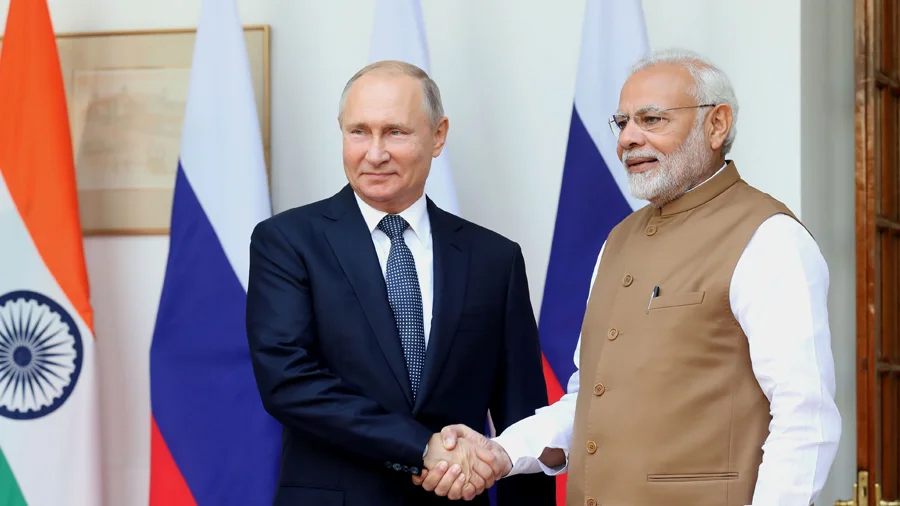
Introduction:
Russian President Vladimir Putin was recently on a two-day state visit to India on December 4–5. The visit concluded with the 23rd India–Russia Annual Summit, which reaffirmed the special and privileged strategic partnership between the two countries. The summit made it clear that the bilateral relationship, based on decades of strategic, economic, and cultural cooperation, remains resilient and robust despite rapid global geopolitical changes.
Historical Background of India–Russia Relations:
1. Foundations and Cold War Context:
-
-
- Post-independence, India adopted a policy of non-alignment, seeking to avoid entanglement in Cold War blocs. However, in practice, India cultivated strong ties with the Soviet Union, largely due to strategic imperatives. The USSR became a crucial partner for India in defence supplies, particularly during conflicts with Pakistan (1965, 1971) when Western countries either imposed arms embargoes or were reluctant to provide support. Beyond material assistance, the Soviet Union offered diplomatic backing in multilateral forums, including the United Nations, reinforcing India’s international standing. Cultural and intellectual exchanges further cemented this bond.
- Post-independence, India adopted a policy of non-alignment, seeking to avoid entanglement in Cold War blocs. However, in practice, India cultivated strong ties with the Soviet Union, largely due to strategic imperatives. The USSR became a crucial partner for India in defence supplies, particularly during conflicts with Pakistan (1965, 1971) when Western countries either imposed arms embargoes or were reluctant to provide support. Beyond material assistance, the Soviet Union offered diplomatic backing in multilateral forums, including the United Nations, reinforcing India’s international standing. Cultural and intellectual exchanges further cemented this bond.
-
2. The Strategic Partnership:
-
-
- The modern India–Russia partnership took formal shape during Putin’s first visit to India as Russian President in October 2000, when the two countries institutionalized their Strategic Partnership. This framework created mechanisms for annual summits, inter-ministerial committees, and working groups, facilitating regular and structured engagement across multiple sectors. Over time, the partnership evolved into a “Special and Privileged Strategic Partnership”, reflecting the depth and breadth of collaboration.
- This elevated partnership encompassed defence cooperation, diplomatic consultation, energy collaboration, science and technology exchange, and people-to-people ties, making it one of India’s most stable bilateral relationships. It has endured despite fluctuations in global geopolitics, including the post-Cold War shift and the Russia–Ukraine conflict.
- The modern India–Russia partnership took formal shape during Putin’s first visit to India as Russian President in October 2000, when the two countries institutionalized their Strategic Partnership. This framework created mechanisms for annual summits, inter-ministerial committees, and working groups, facilitating regular and structured engagement across multiple sectors. Over time, the partnership evolved into a “Special and Privileged Strategic Partnership”, reflecting the depth and breadth of collaboration.
-
3. Defence and Technological Collaboration:
-
-
- Russia has been India’s primary defence supplier for decades, providing fighter aircraft, tanks, submarines, and missile systems. Beyond procurement, the partnership has included technology transfers and co-production projects, enabling India to develop domestic capabilities. For instance, the co-production of the T-90 tanks and the Su-30MKI fighter aircraft exemplifies a collaborative approach to defence modernisation.
- The relationship has also extended to space cooperation, including astronaut training, satellite launches, and joint rocket engine projects. These collaborations reflect deep strategic interdependence, reinforcing India’s security and technological ambitions.
- Russia has been India’s primary defence supplier for decades, providing fighter aircraft, tanks, submarines, and missile systems. Beyond procurement, the partnership has included technology transfers and co-production projects, enabling India to develop domestic capabilities. For instance, the co-production of the T-90 tanks and the Su-30MKI fighter aircraft exemplifies a collaborative approach to defence modernisation.
-
4. Energy and Economic Links:
-
-
- Energy has been another pillar of India–Russia relations. Russia has supplied crude oil, petroleum products, natural gas, and coal to India, with discounted oil deliveries increasing significantly after 2022 amid Western sanctions. Such energy partnerships have helped India ensure energy security while diversifying sources away from conventional suppliers.
- However, bilateral trade exhibits a persistent imbalance, with India’s imports from Russia heavily skewed toward energy, while Indian exports remain limited. This imbalance has been a point of discussion in successive summits, with both sides acknowledging the need to broaden trade beyond traditional sectors.
- Energy has been another pillar of India–Russia relations. Russia has supplied crude oil, petroleum products, natural gas, and coal to India, with discounted oil deliveries increasing significantly after 2022 amid Western sanctions. Such energy partnerships have helped India ensure energy security while diversifying sources away from conventional suppliers.
-

Strategic significance of the 23rd India–Russia Annual Summit:
The 23rd India–Russia Annual Summit (December 4–5, 2025) is strategically significant as it:
-
-
- Marked 25 years of the Declaration on Strategic Partnership (2000), reaffirming the longevity and trust-based nature of bilateral ties.
- Reiterated the commitment to the “Special and Privileged Strategic Partnership”, underscoring mutual respect for core national interests and strategic convergence.
- Positioned India–Russia relations as an anchor of global peace and stability, grounded in the principle of equal and indivisible security.
- The Joint Statement highlights that despite a complex and uncertain geopolitical environment, bilateral ties have shown resilience, adaptability and continuity. It emphasizes India–Russia relations as a shared foreign policy priority, aiming to unlock the full potential of cooperation across political, security, economic, technological and humanitarian domains.
- The opening of Indian Consulates in Kazan and Yekaterinburg reflects growing emphasis on inter-regional engagement, trade facilitation and people-to-people ties, moving beyond capital-centric diplomacy.
- Marked 25 years of the Declaration on Strategic Partnership (2000), reaffirming the longevity and trust-based nature of bilateral ties.
-
Key Outcomes of the 2025 Summit:
1. Economic Roadmap to 2030:
-
-
- A major highlight of the summit was the announcement of the Vision 2030 Economic Cooperation Programme, aimed at raising bilateral trade to US$100 billion by 2030. This roadmap seeks to diversify trade beyond energy, reduce non-tariff barriers, facilitate smoother logistics, and enhance business interactions. The programme also emphasizes the use of national currencies (rupee and ruble) and the development of alternative payment mechanisms, insulating trade from potential external pressures and ensuring continuity even amidst global uncertainties.
- A major highlight of the summit was the announcement of the Vision 2030 Economic Cooperation Programme, aimed at raising bilateral trade to US$100 billion by 2030. This roadmap seeks to diversify trade beyond energy, reduce non-tariff barriers, facilitate smoother logistics, and enhance business interactions. The programme also emphasizes the use of national currencies (rupee and ruble) and the development of alternative payment mechanisms, insulating trade from potential external pressures and ensuring continuity even amidst global uncertainties.
-
2. Energy and Supply Assurance:
-
-
- Russia reaffirmed uninterrupted energy supplies to India, ensuring stability in fuel and petroleum products. This commitment is especially significant given global energy competition and the pressures on Russian energy exports due to sanctions. Reliable energy supplies help India meet its growing domestic demand and maintain industrial continuity.
- Russia reaffirmed uninterrupted energy supplies to India, ensuring stability in fuel and petroleum products. This commitment is especially significant given global energy competition and the pressures on Russian energy exports due to sanctions. Reliable energy supplies help India meet its growing domestic demand and maintain industrial continuity.
-
3. Defence and Technology Cooperation:
-
-
- The summit also focused on modernizing defence and technological ties, including potential co-production of advanced systems such as Su-57 fighter aircraft and air defence systems. Discussions extended to space cooperation, technology transfers, and defence research, signaling a forward-looking approach to military-technical collaboration that goes beyond traditional procurement.
- The summit also focused on modernizing defence and technological ties, including potential co-production of advanced systems such as Su-57 fighter aircraft and air defence systems. Discussions extended to space cooperation, technology transfers, and defence research, signaling a forward-looking approach to military-technical collaboration that goes beyond traditional procurement.
-
4. Multilateralism & Global Governance:
The Joint Statement reflects strong convergence on:
-
-
- UN-centric multilateralism and respect for international law.
- UNSC reform, with Russia reiterating support for India’s permanent membership.
- Strengthening cooperation in G20, BRICS and SCO, especially:
- Global South priorities
- Reform of Multilateral Development Banks
- Supply chain resilience and critical minerals
- Global South priorities
- Shared commitment to a multipolar world order, both globally and in Asia.
- UN-centric multilateralism and respect for international law.
-
5. Counter-Terrorism
-
-
- Zero-tolerance approach to terrorism.
- Joint condemnation of attacks in Pahalgam (2025) and Moscow (2024).
- Zero-tolerance approach to terrorism.
-
Support for:
-
-
-
- Early adoption of the Comprehensive Convention on International Terrorism (CCIT)
- Implementation of the Delhi Declaration on misuse of emerging technologies by terrorists.
- Early adoption of the Comprehensive Convention on International Terrorism (CCIT)
- Emphasis on state responsibility and rejection of double standards.
- Overall, the Joint Statement reinforces India–Russia alignment on strategic autonomy, reformed multilateralism, counter-terrorism and global stability.
-
-
Strategic and Geopolitical Implications:
For India:
-
-
- Strategic Autonomy: The visit reinforced India’s ability to engage with Russia deeply while maintaining strong ties with Western nations. This balancing act exemplifies India’s multipolar foreign policy.
- Economic Diversification: Efforts to correct the trade imbalance and expand Indian exports to Russia indicate a shift toward more equitable economic engagement, ensuring that trade becomes a tool for strategic leverage as well as growth.
- Strategic Autonomy: The visit reinforced India’s ability to engage with Russia deeply while maintaining strong ties with Western nations. This balancing act exemplifies India’s multipolar foreign policy.
-
For Russia:
-
-
- For Moscow, India remains an indispensable strategic partner in Asia, helping Russia mitigate the impact of Western sanctions. The visit allowed Russia to reaffirm ties with a major Asian power, diversify its strategic engagements, and demonstrate that it retains influence in critical global partnerships despite geopolitical pressures.
- For Moscow, India remains an indispensable strategic partner in Asia, helping Russia mitigate the impact of Western sanctions. The visit allowed Russia to reaffirm ties with a major Asian power, diversify its strategic engagements, and demonstrate that it retains influence in critical global partnerships despite geopolitical pressures.
-
Global Repercussions:
-
-
- The summit signaled a broader commitment to multipolar cooperation, resisting attempts to polarize global alignments into binary blocs. The visit drew reactions from neighboring powers and global players alike, highlighting the importance of India–Russia engagement in Eurasian geopolitics. China’s measured response emphasized that regional strategic alignments are dynamic, and India continues to play a central role in shaping global South diplomacy.
- The summit signaled a broader commitment to multipolar cooperation, resisting attempts to polarize global alignments into binary blocs. The visit drew reactions from neighboring powers and global players alike, highlighting the importance of India–Russia engagement in Eurasian geopolitics. China’s measured response emphasized that regional strategic alignments are dynamic, and India continues to play a central role in shaping global South diplomacy.
-
Conclusion:
Vladimir Putin’s 2025 state visit to India was far more than ceremonial. It reaffirmed a multi-dimensional partnership rooted in historical trust while evolving to address contemporary strategic, economic, and geopolitical challenges. The visit underscored India’s nuanced diplomacy, balancing strategic autonomy with engagement across global powers, while Russia leveraged the partnership to sustain relevance and resilience amid international isolation. Looking forward, the Vision 2030 roadmap, diversification of economic ties, expansion of defence and technological collaboration, and strengthened energy cooperation position India–Russia relations as a cornerstone of strategic stability in a rapidly changing world, demonstrating that enduring partnerships are not only a product of history but also of deliberate, forward-looking diplomacy. The 23rd India–Russia Annual Summit reaffirmed the partnership as a time-tested, trust-based and forward-looking relationship, combining strategic depth with economic pragmatism and a shared vision for a multipolar world.
| UPSC/PCS Mains Question: |



