

Context:
Over the past decade, the Indo-Pacific region has decisively emerged as the focal point of global geopolitics. Within this evolving maritime strategic landscape, India’s position is not only geographically central but also extremely sensitive from a security perspective. In the changing security architecture of the Indian Ocean Region (IOR), the Indian Navy is recalibrating its traditional capabilities in line with the most advanced contemporary standards. In this context, Project-75I (P-75I) stands out as the most significant and ambitious pillar of India’s long-term naval capability development. With an estimated cost of nearly USD 8 billion (over ₹60,000 crore), this project is not merely a means of expanding the naval fleet, but represents a comprehensive strategic response to China’s “String of Pearls” strategy and Pakistan’s growing naval assertiveness.
-
-
-
- In this context, defence and security cooperation emerged as a key issue during the recent visit of German Chancellor Friedrich Merz to India. Both countries signed a joint declaration aimed at strengthening bilateral defence-industrial cooperation, reflecting their commitment to deeper strategic ties. In recent years, Germany has modified its defence export norms, simplifying the approval process for Indian procurement. Long-pending applications are now being processed more swiftly, creating a more conducive environment for defence trade.
- In this context, defence and security cooperation emerged as a key issue during the recent visit of German Chancellor Friedrich Merz to India. Both countries signed a joint declaration aimed at strengthening bilateral defence-industrial cooperation, reflecting their commitment to deeper strategic ties. In recent years, Germany has modified its defence export norms, simplifying the approval process for Indian procurement. Long-pending applications are now being processed more swiftly, creating a more conducive environment for defence trade.
-
-

Project-75I and the AIP System:
-
-
-
- Under Project-75I, six state-of-the-art conventional submarines are to be constructed. The most critical technological component of this project is the Air-Independent Propulsion (AIP) system.
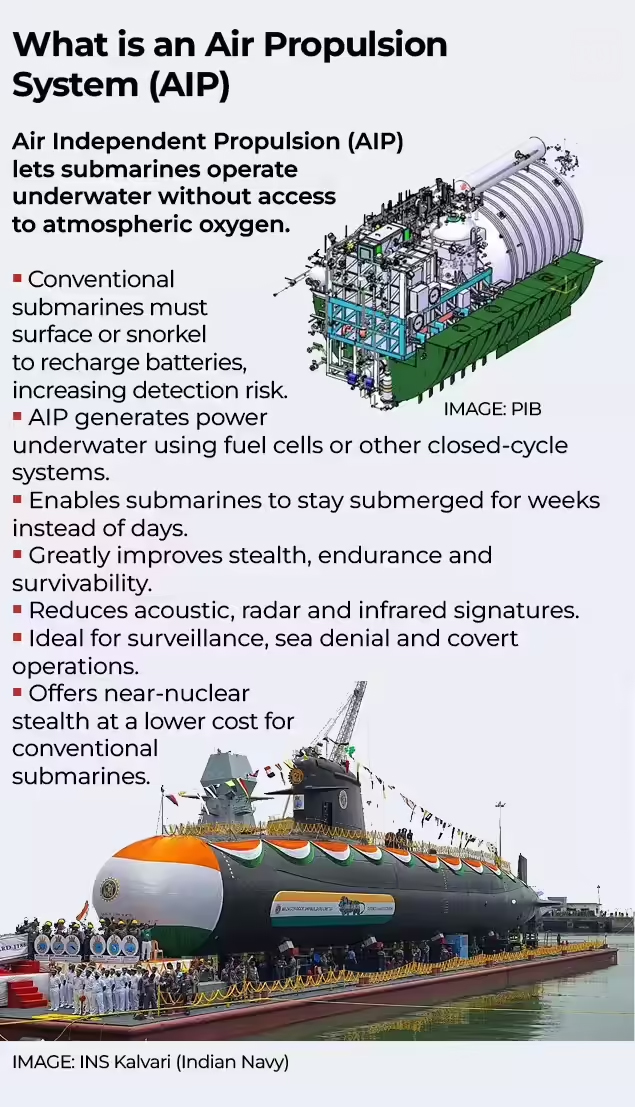
- The principal limitation of conventional diesel-electric submarines lies in the constraints on their stealth capabilities. To recharge their batteries, they must frequently surface or snorkel, making them vulnerable to detection by radar and satellites. Once equipped with AIP technology, submarines can remain submerged continuously for two to three weeks. This capability brings them closer to nuclear-powered submarines in operational terms; however, owing to their lower noise levels, they are quieter and potentially more lethal. For India, this technology is particularly significant because in the shallow waters of the Arabian Sea and the Bay of Bengal, such submarines can pose an invisible threat to adversary aircraft carrier groups.
- Under Project-75I, six state-of-the-art conventional submarines are to be constructed. The most critical technological component of this project is the Air-Independent Propulsion (AIP) system.
-
-
|
Project-75I Submarine Programme Project-75I is the successor initiative to India’s earlier Project-75, under which six Scorpène-class submarines were constructed at Mazagon Dock Shipbuilders Limited (MDL). Unlike Project-75, where advanced technologies were envisaged largely through later retrofitting, Project-75I mandates the integration of cutting-edge AIP technology at the construction stage itself. Key features of Project-75I:
Strategic significance of Project-75I:
Air-Independent Propulsion (AIP) Traditional submarines primarily rely on batteries, which require periodic surfacing or snorkelling for recharging, thereby increasing the risk of detection. AIP technology fundamentally alters this equation. Strategic advantages of AIP-equipped submarines:
For India, AIP bridges the operational gap between conventional and nuclear submarines, without escalating costs or political risks. The programme sends a clear message: India will not relinquish underwater dominance in its primary maritime domain. |
Regional Balance of Power:
-
-
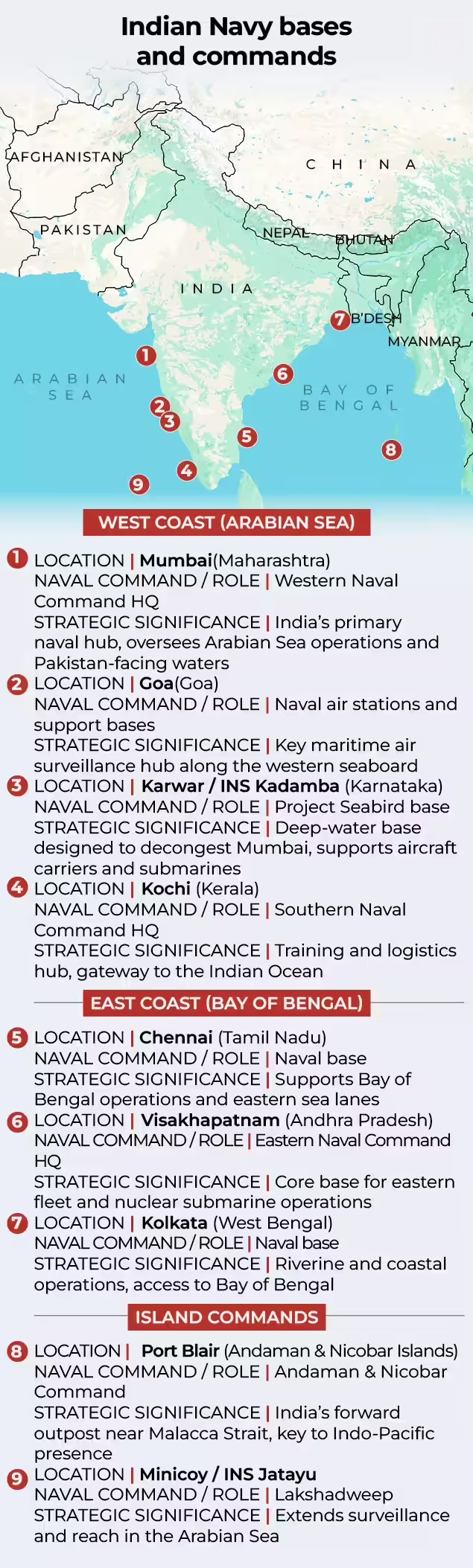
- India’s defence planners increasingly confront a “two-front war” scenario that is taking shape in the maritime domain as well.
- China’s influence: The People’s Liberation Army Navy (PLAN) has become the world’s largest navy. Through its base in Djibouti and investments in ports such as Gwadar, China is institutionalising its presence in the Indian Ocean.
- Pakistan’s modernisation: Pakistan has signed an agreement with China to acquire eight Hangor-class (Type-039B) submarines equipped with AIP technology.
- China’s influence: The People’s Liberation Army Navy (PLAN) has become the world’s largest navy. Through its base in Djibouti and investments in ports such as Gwadar, China is institutionalising its presence in the Indian Ocean.
- If India does not modernise its fleet in a timely manner, a situation could emerge where Pakistan’s submarine strike capability equals or even surpasses that of India. Project-75I seeks to bridge this technological gap. It ensures that India possesses not only regional defence capabilities but also the power projection required to disrupt adversary SLOCs.
- India’s defence planners increasingly confront a “two-front war” scenario that is taking shape in the maritime domain as well.
-
Strategic Partnership Model and Atmanirbhar Bharat:
-
-
-
- Project-75I is the first major defence programme under India’s Strategic Partnership (SP) model. This model aims to involve the private sector in defence production and establish long-term collaboration with foreign Original Equipment Manufacturers (OEMs).
- The growing cooperation between Germany’s ThyssenKrupp Marine Systems (TKMS) and India’s Mazagon Dock Shipbuilders Limited (MDL) has injected new momentum into the project. The central issue here is Transfer of Technology (ToT). India no longer seeks to remain merely a buyer; the very conditions of the project mandate construction in Indian shipyards with a high percentage of indigenous content. In the long run, this approach has the potential to establish India as a global submarine-building hub.
- Project-75I is the first major defence programme under India’s Strategic Partnership (SP) model. This model aims to involve the private sector in defence production and establish long-term collaboration with foreign Original Equipment Manufacturers (OEMs).
-
-
Economic and Industrial Impact:
The USD 8-billion investment is not confined to military capability alone. Large defence projects generate significant multiplier effects:
-
-
-
- MSME ecosystem: Thousands of small and medium enterprises across the country gain opportunities to supply components, sensors and sub-systems.
- Skill development: Indian engineers and technicians attain global standards in high-technology welding, stealth materials science and advanced electronics.
- Research and Development (R&D): Plans to integrate the indigenously developed AIP module by DRDO will test and strengthen India’s domestic scientific capabilities.
- MSME ecosystem: Thousands of small and medium enterprises across the country gain opportunities to supply components, sensors and sub-systems.
-
-
Challenges:
The most serious challenge facing Project-75I is prolonged delay. Even after more than a decade since the original conceptualisation, construction has yet to commence. Complex tendering procedures, stringent technical requirements and reluctance among foreign firms to share critical technologies have slowed progress. Meanwhile, the retirement of older submarines is creating a capability gap within the Indian Navy. The government must therefore pursue the project in a mission-mode approach; otherwise, by the time these submarines enter service, prevailing maritime technology standards may have already evolved further.
Conclusion:
Project-75I represents the future of India’s maritime sovereignty. A powerful and modern submarine fleet ensures the maintenance of balance of power in the Indian Ocean. The successful implementation of Project-75I is indispensable for the realisation of India’s SAGAR (Security and Growth for All in the Region) vision. If completed in a timely manner, the project will not only strengthen India’s position in South Asia but also reinforce its claim to being an emerging great power in the global defence domain.
| UPSC/PCS Mains Practice Question: In the context of the evolving geopolitical landscape of the Indo-Pacific region, examine how Project-75I redefines India’s maritime strategy. |



