
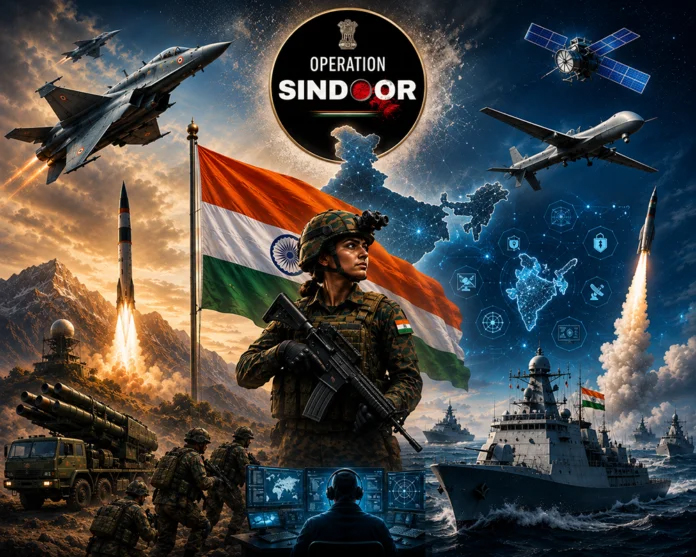
India’s New War Doctrine: Technological Power, Deterrence and Strategic Dominance
Context:
In the changing security landscape of the twenty-first century, India’s military policy has remained continuously evolving. For a long time, India followed a policy of “Strategic Restraint”, under which it attempted to avoid large-scale military retaliation despite cross-border terrorism. However, the Uri Surgical Strike (2016), the Balakot Air Strike (2019), and ultimately Operation Sindoor (2025) indicated a decisive transformation in India’s military thinking.
-
-
- Recently, on 7 May, Operation Sindoor completed one year. It was not merely a military operation, but emerged as a symbol of India’s new strategic mindset. The operation made it clear that India would no longer remain only defensive against terrorism and cross-border proxy warfare, but would be prepared to undertake precise, swift, and punitive action whenever necessary.
- Recently, on 7 May, Operation Sindoor completed one year. It was not merely a military operation, but emerged as a symbol of India’s new strategic mindset. The operation made it clear that India would no longer remain only defensive against terrorism and cross-border proxy warfare, but would be prepared to undertake precise, swift, and punitive action whenever necessary.
-
Operation Sindoor: Background
-
-
- Following the Pahalgam terrorist attack in April 2025, in which 26 civilians were killed, India carried out targeted strikes against terrorist infrastructure located in Pakistan and Pakistan-occupied Kashmir. The operation witnessed extensive use of Rafale fighter aircraft, SCALP missiles, HAMMER bombs, drones, and electronic warfare systems.
- The most significant aspect of this operation was that India, through precision-strike based action within a limited timeframe, delivered a clear military and political message that terrorism could not be protected under the cover of “nuclear blackmail.”
- Following the Pahalgam terrorist attack in April 2025, in which 26 civilians were killed, India carried out targeted strikes against terrorist infrastructure located in Pakistan and Pakistan-occupied Kashmir. The operation witnessed extensive use of Rafale fighter aircraft, SCALP missiles, HAMMER bombs, drones, and electronic warfare systems.
-
Major Changes in India’s Military Policy:
-
-
- From “Strategic Restraint” to “Punitive Deterrence”
- Earlier, India’s policy was primarily based on restraint and diplomatic pressure. However, after Operation Sindoor, India signaled that responses to terrorist attacks would no longer remain confined to condemnation or diplomatic protest alone.
- India’s strategy now appears to be based on Punitive Deterrence, under which punitive costs are imposed upon the adversary in order to prevent future aggression.
- This transformation establishes a “New Normal” in India’s security thinking.
- Earlier, India’s policy was primarily based on restraint and diplomatic pressure. However, after Operation Sindoor, India signaled that responses to terrorist attacks would no longer remain confined to condemnation or diplomatic protest alone.
- The Concept of Escalation Dominance
- Escalation Dominance refers to the capability of a country to escalate, limit, or control a conflict on its own terms while maintaining continuous strategic superiority over the adversary. For example, during Operation Sindoor, India demonstrated the capability of “Escalation Dominance” through limited military action.
- This implies that India seeks to reach a position where it can initiate, control, and terminate conflicts on its own terms. This becomes especially significant because India faces two nuclear-armed neighbours, China and Pakistan.
- This policy challenges Pakistan’s traditional strategy of promoting cross-border terrorism under the shield of nuclear weapons.
- Escalation Dominance refers to the capability of a country to escalate, limit, or control a conflict on its own terms while maintaining continuous strategic superiority over the adversary. For example, during Operation Sindoor, India demonstrated the capability of “Escalation Dominance” through limited military action.
- Rise of Non-Contact Warfare and Technological Warfare
- Operation Sindoor has also been described as South Asia’s first “Non-Contact War”, in which action was carried out through drones, missiles, cyber, and electronic warfare instead of direct ground invasion.
- The following technologies are becoming decisive in modern warfare:
- Drones and Loitering Munitions
- Artificial Intelligence-based surveillance
- Cyber warfare
- Satellite-based ISR (Intelligence, Surveillance & Reconnaissance)
- Electronic warfare systems
- Long-range precision missiles
- Drones and Loitering Munitions
- Through this operation, India demonstrated that future wars would not be determined merely by the number of soldiers, but by technological superiority.
- Operation Sindoor has also been described as South Asia’s first “Non-Contact War”, in which action was carried out through drones, missiles, cyber, and electronic warfare instead of direct ground invasion.
- Emphasis on Joint Military Operations (Jointness)
- Operation Sindoor witnessed a high degree of coordination among the Army, Air Force, and Navy. This further highlighted the necessity of theatre commands and an integrated military structure.
- India is now rapidly moving towards Integrated Theatre Commands, which are expected to improve resource optimization and response time among the three armed services.
- Operation Sindoor witnessed a high degree of coordination among the Army, Air Force, and Navy. This further highlighted the necessity of theatre commands and an integrated military structure.
- Promotion of Self-Reliant Defence Production
- Operation Sindoor also highlighted that defence self-reliance is critically important for national security.
- The effective use of BrahMos missiles, Akash air defence systems, indigenous radars, drones, and electronic warfare systems strengthened the credibility of India’s “Atmanirbhar Bharat” defence policy.
- India is now moving from being a defence importer towards becoming a defence exporter. India’s defence exports stood at ₹23,622 crore in 2024-25, which increased to a record ₹38,424 crore in 2025-26, reflecting a growth of nearly 62.66% in a single year. According to the Ministry of Defence, India is now exporting defence equipment to more than 80 countries. These exports include BrahMos missiles, Akash air defence systems, radars, ammunition, armoured vehicles, electronic warfare systems, drones, and naval platforms.
- Operation Sindoor also highlighted that defence self-reliance is critically important for national security.
- From “Strategic Restraint” to “Punitive Deterrence”
-
Broader Implications of India’s New Strategic Posture:
-
-
- Changes in South Asia’s Security Structure: After Operation Sindoor, visible changes can be observed in South Asia’s balance-of-power politics. India conveyed the message that it seeks to emerge not merely as a reactive power, but as an active Net Security Provider.
- Significance in the Context of the China-Pakistan Axis: India’s new military policy is not solely Pakistan-centric. Following the experiences of the Eastern Ladakh crisis, India is pursuing military modernization while taking into account the possibility of a two-front challenge.
- Information Warfare and Narrative Control: Modern conflicts are no longer confined to the battlefield. Social media, cyber propaganda, and disinformation have also become integral parts of warfare. During Operation Sindoor, India actively participated in information warfare and countered Pakistan’s disinformation campaigns.
- Changes in South Asia’s Security Structure: After Operation Sindoor, visible changes can be observed in South Asia’s balance-of-power politics. India conveyed the message that it seeks to emerge not merely as a reactive power, but as an active Net Security Provider.
-
Challenges and Limitations:
-
-
- Nuclear Risks: Although India is developing the capability of Escalation Dominance, South Asia’s nuclear environment remains extremely sensitive. Even limited conflicts carry the risk of uncontrolled escalation.
- Economic Burden: High-technology military modernization is extremely expensive. Continuous increases in defence expenditure may affect social and developmental spending.
- Cyber Security Challenges: With the expansion of digital warfare, India’s critical infrastructure is becoming increasingly vulnerable to cyber attacks. Therefore, investment in cyber security and data protection has become essential.
- Complexity of Theatre Command Reforms: Implementing a joint military command structure is challenging from administrative, organizational, and inter-service coordination perspectives.
- Nuclear Risks: Although India is developing the capability of Escalation Dominance, South Asia’s nuclear environment remains extremely sensitive. Even limited conflicts carry the risk of uncontrolled escalation.
-
Way Forward:
-
-
- To effectively address future complex security challenges, India must comprehensively modernize its military and strategic capabilities. This would include expanding Artificial Intelligence (AI), cyber warfare, and electronic warfare capabilities, as modern warfare is increasingly becoming technology-driven. Simultaneously, the process of establishing Integrated Theatre Commands must be completed at the earliest to ensure better coordination among the three armed forces.
- India must also encourage indigenous research and defence technology development in order to strengthen self-reliance in the defence sector, reduce foreign dependence, and enhance strategic autonomy. Furthermore, special emphasis must be placed on developing space-based surveillance and intelligence systems, as satellite-based information and monitoring will play a decisive role in future warfare.
- To strengthen its strategic position at regional and global levels, India must further deepen Quad and Indo-Pacific partnerships. At the same time, it is essential to enhance technological coordination in border management, counter-terrorism mechanisms, and internal security in order to develop a more capable and rapid response system against multidimensional security challenges.
- To effectively address future complex security challenges, India must comprehensively modernize its military and strategic capabilities. This would include expanding Artificial Intelligence (AI), cyber warfare, and electronic warfare capabilities, as modern warfare is increasingly becoming technology-driven. Simultaneously, the process of establishing Integrated Theatre Commands must be completed at the earliest to ensure better coordination among the three armed forces.
-
Conclusion:
Operation Sindoor represents a decisive turning point in India’s military and strategic thinking. It has made it clear that India no longer wishes to remain confined to the policy of “Strategic Restraint”, but seeks to establish deterrence through precise, technology-driven, and controlled military power. India’s new military doctrine appears to be based on “Punitive Deterrence”, “Technological Superiority”, “Joint Military Operations”, and “Self-Reliant Defence”. Although this transformation is accompanied by challenges such as nuclear risks, economic burdens, and cyber threats, it nevertheless positions India as a more capable, confident, and decisive regional power.



