

Context:
During the national ceremony held on the occasion of World AIDS Day, the Union Minister of Health and Family Welfare highlighted significant achievements related to India’s HIV/AIDS response. The country has witnessed a remarkable reduction of 32 percent in new HIV infections and 69 percent in AIDS-related deaths. This progress has been made possible through better diagnostic services, affordable medicines and the expansion of Antiretroviral Therapy (ART) centres across the country. Under the Test and Treat policy, every infected individual receives lifelong and free treatment, resulting in a sharp decline in mortality rates. India continues to strengthen nationwide awareness through extensive campaigns, community participation and initiatives led by the National AIDS Control Organisation (NACO).
-
- Initiated by the World Health Organization in 1988, World AIDS Day is observed every year on 1 December with the aim of raising global awareness about HIV/AIDS, paying tribute to those who lost their lives to AIDS, and promoting sensitivity and support for people living with HIV.
- Initiated by the World Health Organization in 1988, World AIDS Day is observed every year on 1 December with the aim of raising global awareness about HIV/AIDS, paying tribute to those who lost their lives to AIDS, and promoting sensitivity and support for people living with HIV.
India’s AIDS Control Programme:
-
- India’s AIDS control programme is recognised globally as a successful public health model. From identifying early HIV cases to building a decentralised, community-driven programme, India has made remarkable progress over the past four decades.
- Between 1985 and 1991, India focused on case detection, safe blood transfusion and targeted awareness campaigns. With the establishment of the National AIDS Control Organisation (NACO) and the National AIDS Control Programme (NACP) in 1992, India adopted a structured, multisectoral strategy involving health, education, women and child development, labour, and several social sectors.
- Over time, the NACP transitioned from a centralised policy approach to a community-based and decentralised model, prioritising the involvement of NGOs and networks of people living with HIV (PLHIV).
- India’s achievements are not merely policy-driven; they are also evident in practical outcomes. The decline from 1.73 lakh annual deaths in 2010 to 32,200 in 2024, amounting to an 81 percent reduction, reflects the nation’s strong commitment. Universal and free access to Antiretroviral Therapy (ART), 94 percent ART retention and 97 percent viral suppression have positioned India as a global leader.
- India’s contribution to global AIDS deaths in 2024 is only 5 percent, compared to the global figure of 6.3 lakh. This reflects India's significant role in international health due to its affordable generic drug production, which supplies about 70 percent of global ART. India’s progress aligns with the UNAIDS 95-95-95 targets, reinforcing the goal of ending AIDS as a public health threat by 2030.
- India’s AIDS control programme is recognised globally as a successful public health model. From identifying early HIV cases to building a decentralised, community-driven programme, India has made remarkable progress over the past four decades.
|
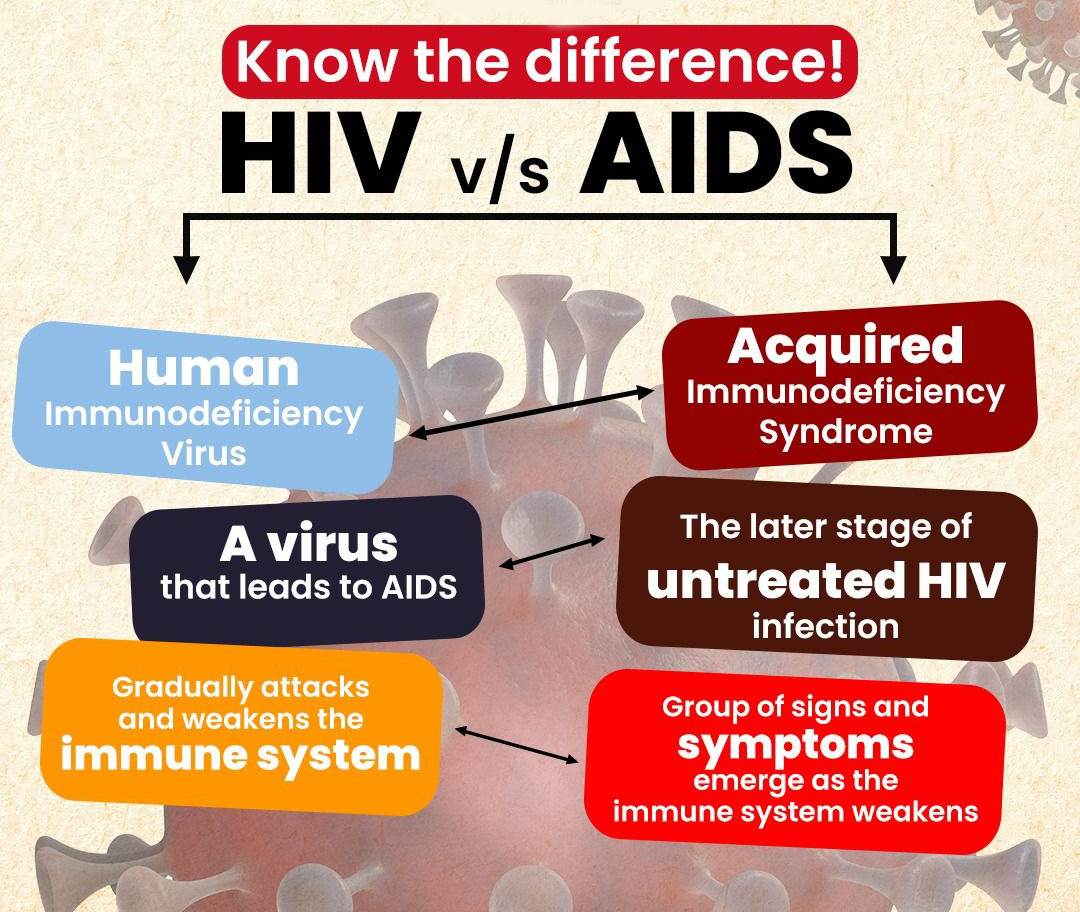
HIV and AIDS The Human Immunodeficiency Virus (HIV) is a retrovirus that targets and progressively weakens the human immune system. It primarily attacks CD4+ T-lymphocytes, the core cells of the immune defence system, and gradually reduces their count. As CD4+ cells decline, the body’s natural resistance weakens. If HIV infection is not detected early and treated appropriately, it progresses to its advanced stage, known as Acquired Immunodeficiency Syndrome (AIDS). AIDS is a condition where the immune system becomes so severely compromised that the patient is unable to combat common infections, opportunistic pathogens or certain forms of cancer. This is the stage at which HIV infection becomes life-threatening. Early diagnosis, regular testing, timely access to ART and viral suppression are considered the most effective strategies to prevent HIV from progressing into AIDS. |
National AIDS Control Programme:
1. NACP-I (1992–1999): Laying the Foundation
The objective of this phase was to slow down the spread of HIV/AIDS and reduce morbidity and overall impact. The focus was on safe blood supply, awareness and basic prevention initiatives.
2. NACP-II (1999–2006): Building Institutional Capacity
• Reducing HIV transmission in India.
• Developing long-term national capacity to respond to HIV/AIDS.
This phase prioritised strengthening health systems, training and behaviour change communication (BCC).
3. NACP-III (2007–2012): Goal of Reversing the Epidemic
Its objective was to bring down the infection rate by 2012.
• Targeted interventions for High-Risk Groups (HRGs)
• Integration of prevention, care, support and treatment services
A key initiative during this period was the establishment of District AIDS Prevention and Control Units (DAPCU), strengthening decentralised monitoring and stigma-reporting systems.
4. NACP-IV (2012–2017)
• Goal: Accelerating the reversal of the epidemic and ensuring an integrated response.
• Objectives:
o 50 percent reduction in new infections (compared to the 2007 baseline).
o Comprehensive care, support and treatment for all PLHIV.
This phase was extended up to 2030 to advance the goal of ending AIDS.
Key initiatives during the extension:
• HIV/AIDS (Prevention and Control) Act, 2017 – prohibits discrimination against PLHIV, ensures confidentiality and mandates informed consent for testing and treatment.
• Mission SAMPARK – aimed at bringing back PLHIV who had discontinued ART.
5. NACP-V (2021–2026)
Launched as a central sector scheme with an outlay of ₹15,471.94 crore, this phase aims to build on past achievements and address persisting challenges. It supports SDG 3.3 by strengthening prevention, testing and treatment services to eliminate HIV/AIDS as a public health threat by 2030.
Government Efforts in Awareness and Prevention:
HIV/AIDS awareness in India is based on a multi-layered strategy.
1. Nationwide Awareness Campaigns
NACO uses television, radio, social media, digital platforms and print media to disseminate messages widely, especially targeting youth.
2. Outdoor Outreach and Community Dialogue
Hoardings, bus panels, folk performances and mobile IEC vans help spread awareness across remote regions.
3. Involvement of Grassroots Institutions
Self-help groups, Anganwadi workers, ASHA workers and Panchayati Raj Institutions play an important role in behavioural change, encouraging testing and reducing stigma.
4. Targeted Interventions for High-Risk Groups
By July 2025, 1,619 targeted intervention projects were operational to ensure equitable access to prevention and treatment services.
5. Campaigns Against Stigma and Discrimination
Since discrimination hinders access to treatment, thematic campaigns are conducted in workplaces, schools, hospitals and communities.
6. Appointment of Ombudsmen in States/UTs
Under the HIV/AIDS Act, 2017, the appointment of ombudsmen has strengthened the protection of PLHIV rights.
Challenges and the Road Ahead:
Despite major achievements, several challenges demand policy and health system attention:
1. Hidden Epidemic: Social stigma prevents individuals from getting tested.
2. High infection rates in Northeast India and urban slums – requiring targeted strategies.
3. Vulnerability of women and adolescent girls due to gender-based inequalities.
4. Migrant and mobile populations – difficulty in ensuring continuity of treatment.
5. Digital health literacy gaps – limiting access to new digital platforms.
To achieve the 2030 target, India must strengthen prevention-focused strategies, community partnerships, gender-sensitive health services and stigma eradication efforts.
Conclusion:
India’s HIV/AIDS journey reflects how a nation transformed a crisis into an opportunity by aligning health policy, science, community participation and governance toward a shared goal. This journey extends beyond understanding transmission to establishing a rights-based health ecosystem.
|
UPSC/PCS Mains Question: India’s HIV/AIDS response is considered a successful model of public health management over the past three decades. In line with SDG 3.3, what multi-level strategies should India prioritise to eliminate AIDS as a public health threat by 2030? |



