
Context:
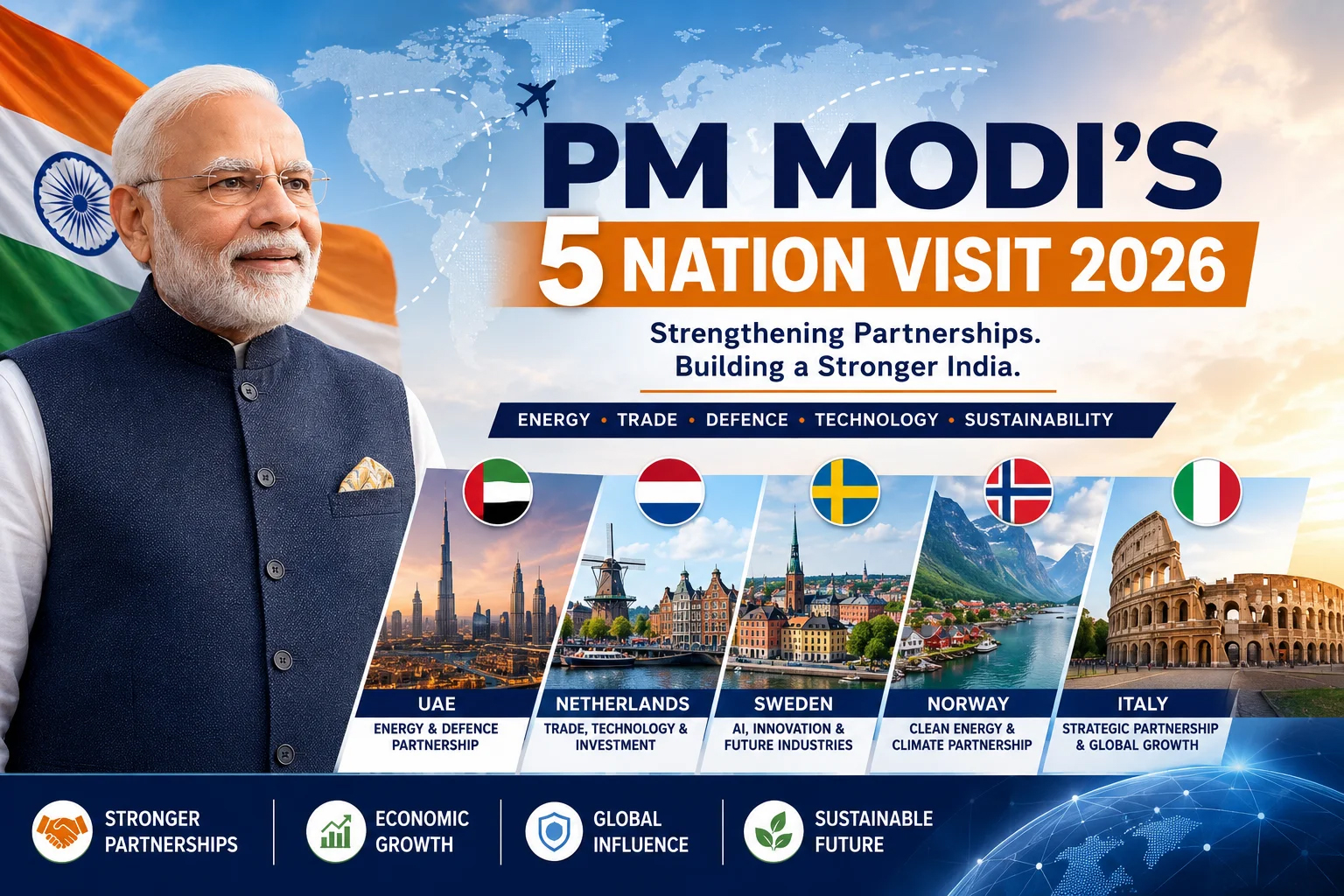
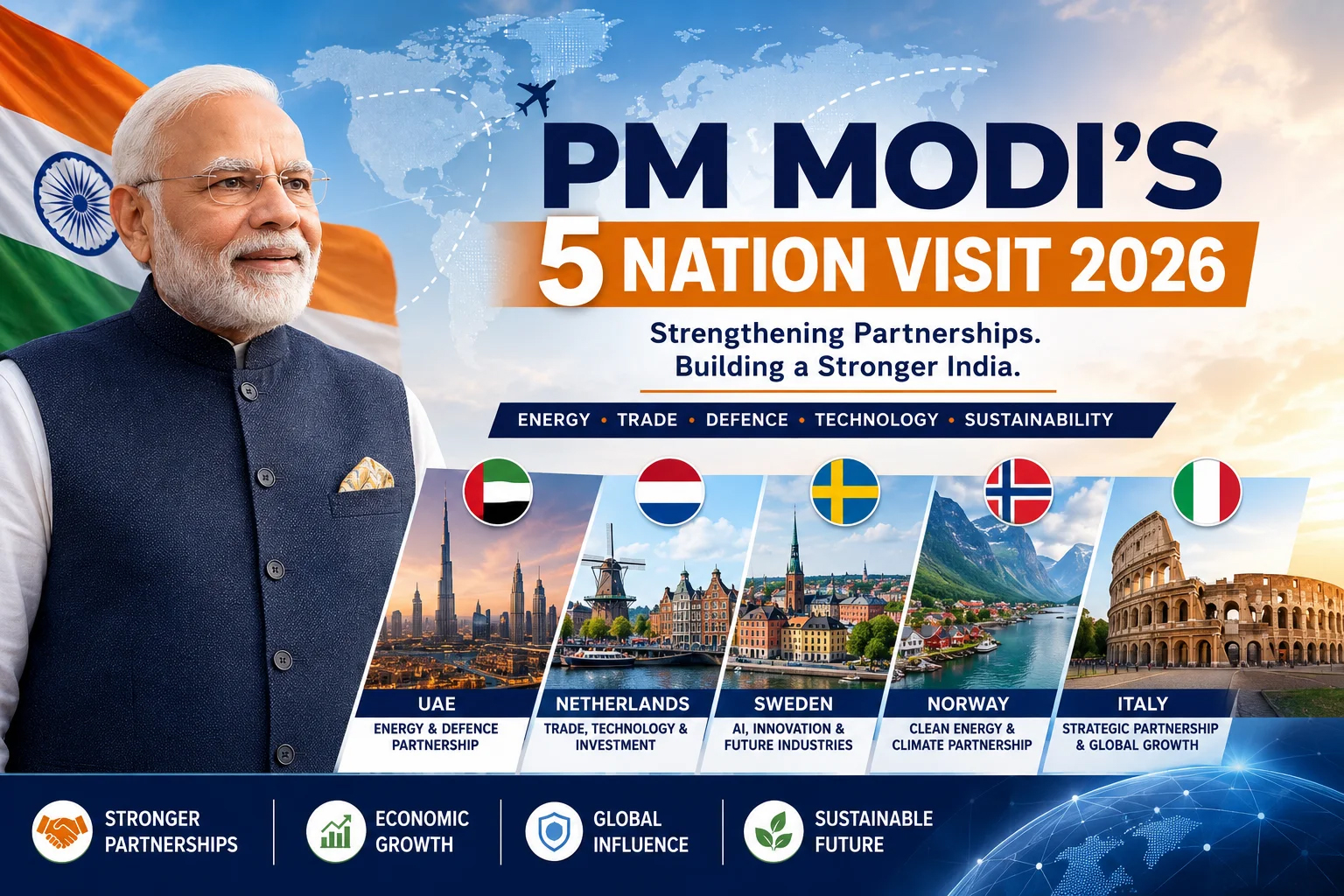
Prime Minister Modi’s recent five-nation visit in May 2026 to the United Arab Emirates, the Netherlands, Sweden, Norway, and Italy has presented India’s foreign policy in a new strategic dimension. The central focus of this tour was to strengthen India’s long-term energy security, green transition, technological self-reliance, and India’s role in global supply chains.
-
-
- India is among the world’s fastest-growing major economies. According to the International Energy Agency (IEA), the largest share of global energy demand growth in the coming decade is expected to come from India. At present, India imports nearly 85 percent of its crude oil requirement and around 50 percent of its gas requirement. In such a situation, energy security is no longer merely an economic necessity but has become a question of national security and strategic autonomy. Prime Minister Modi’s visit is being viewed as highly significant within this broader geopolitical and economic context. The agreements reached with these countries are expected to strengthen India’s presence in the sectors of clean energy, critical minerals, and sustainable development.
- India is among the world’s fastest-growing major economies. According to the International Energy Agency (IEA), the largest share of global energy demand growth in the coming decade is expected to come from India. At present, India imports nearly 85 percent of its crude oil requirement and around 50 percent of its gas requirement. In such a situation, energy security is no longer merely an economic necessity but has become a question of national security and strategic autonomy. Prime Minister Modi’s visit is being viewed as highly significant within this broader geopolitical and economic context. The agreements reached with these countries are expected to strengthen India’s presence in the sectors of clean energy, critical minerals, and sustainable development.
-
Energy Security: India’s Biggest Strategic Challenge
The Russia-Ukraine war, tensions in West Asia, the Red Sea crisis, and fluctuations in global oil prices have clearly demonstrated that disruptions in energy supply can seriously impact any nation’s economy.
For a developing and energy-dependent country like India, this challenge is even more serious because:
-
-
- India is the world’s third-largest energy consumer.
- Energy demand in the country is rising rapidly.
- Manufacturing, the digital economy, and urbanisation are further increasing energy requirements.
- India is committed to achieving its Net Zero target by 2070.
- India is the world’s third-largest energy consumer.
-
In such a scenario, India must simultaneously balance three objectives:
1. Ensuring affordable energy availability
2. Securing energy supply
3. Transitioning toward green and clean energy
Prime Minister Modi’s five-nation visit is therefore being seen as a strategic initiative aimed at resolving this “Energy Trilemma.”

UAE: The Central Pillar of India’s Energy Diplomacy:
The United Arab Emirates (UAE) has emerged as an extremely important partner in India’s energy strategy. India-UAE relations are no longer limited to oil trade but have expanded into strategic investment, petroleum storage, renewable energy, and food security.
During this visit, both countries emphasized expanding cooperation in the following areas:
-
-
- Long-term oil and gas supply
- Strategic petroleum storage
- Green hydrogen
- Energy infrastructure investment
- Petrochemical cooperation
- Long-term oil and gas supply
-
India is moving beyond a policy focused solely on purchasing oil and is working toward a broader “energy partnership.” The objective now is to encourage foreign energy-producing countries to invest in India’s energy sector as well.
In particular, the participation of Abu Dhabi National Oil Company (ADNOC) in India’s strategic petroleum reserves strengthens India’s energy security. This provides India with the option to ensure supply security during global crises.
Europe and Nordic Countries: Green Energy and Technological Cooperation
The second major dimension of Prime Minister Modi’s visit was technological and green energy cooperation with European and Nordic countries.
1. Netherlands: Semiconductor and Green Technology:
The Netherlands is a major global hub for semiconductor equipment manufacturing and water management technology. India aims to establish itself as an alternative to China-centric global supply chains. Cooperation between India and the Netherlands is significant in the following sectors:
· Semiconductor manufacturing
· Chip design
· Clean energy technology
· Ports and logistics
· Water management
India’s Semiconductor Mission can succeed only if it receives advanced technology and global investment.
2. Sweden and Norway: Models of Green Transition:
Sweden and Norway represent some of the world’s most advanced green economy models. These countries are leaders in clean energy, electric mobility, carbon-neutral technologies, and sustainable industrial development. For India, cooperation with these countries is important in several respects:
· Green hydrogen
· Battery storage technology
· Electric mobility
· Carbon capture technology
· Waste management
· Arctic research
India is now transitioning from a “brown economy” to a “green economy.” For this, not only capital but also advanced technology and research cooperation are essential.
Special Strategic Partnership with Italy:
The elevation of India-Italy relations to a “Special Strategic Partnership” is considered one of the most significant diplomatic achievements of this visit. Italy is a major industrial and manufacturing center in Europe. Cooperation between the two countries is being expanded in the following areas:
-
-
- Defence manufacturing
- Energy transition
- Green industries
- Advanced machinery
- Maritime security
- Critical minerals
- Defence manufacturing
-
Critical minerals are increasingly becoming the new center of global geopolitics. Lithium, cobalt, nickel, and rare earth elements are essential for electric vehicles, batteries, and semiconductor industries.
China’s dominance over these minerals has emerged as a major strategic challenge for the world. India is now working toward developing alternative supply chains.
India’s Broader Strategy Related to Energy Security:
Prime Minister Modi’s visit clearly reflects India’s multi-dimensional energy strategy. India no longer wishes to remain dependent solely on an import-based energy model.
India’s Major Strategies:
-
-
- Diversification of Energy Sources: India is increasing energy imports from multiple regions including Russia, West Asia, the United States, and Africa so that excessive dependence on any one region can be avoided.
- Expansion of Green Energy: India has set a target of achieving 500 GW of non-fossil fuel energy capacity by 2030.
- Green Hydrogen Mission: The National Green Hydrogen Mission is an important step toward transforming India into a clean fuel exporter.
- Strategic Petroleum Reserves: India is expanding its petroleum storage capacity to maintain energy supply during global crises.
- Technological Self-Reliance: Emphasis is being placed on increasing domestic manufacturing in semiconductors, batteries, and clean energy equipment.
- Diversification of Energy Sources: India is increasing energy imports from multiple regions including Russia, West Asia, the United States, and Africa so that excessive dependence on any one region can be avoided.
-
Challenges:
Although India’s strategy is ambitious, several challenges remain:
-
-
- Excessive import dependence
- High cost of clean energy technology
- Dependence on China for critical minerals
- Global geopolitical instability
- Limitations in domestic energy infrastructure
- Excessive import dependence
-
Additionally, during the green energy transition, employment and social impacts associated with the coal-based economy will remain significant challenges.
Conclusion:
Prime Minister Modi’s five-nation visit has made it clear that India’s foreign policy is now based on a “multi-alignment” model. India is advancing its national interests while maintaining balanced relations with the United States, Europe, Russia, and West Asia. India is moving toward becoming an important hub in global energy and trade networks by leveraging its strategic position in the Indian Ocean region. India’s foreign policy is no longer confined merely to diplomatic relations but has become part of a broader strategy encompassing energy security, technological self-reliance, green transition, and the ambition of becoming a global economic power. If India succeeds in establishing a balance between energy security, green development, and technological self-reliance, then in the coming decade it may emerge not only as the world’s most populous country but also as a major center of global economic and strategic power.



