
Context:
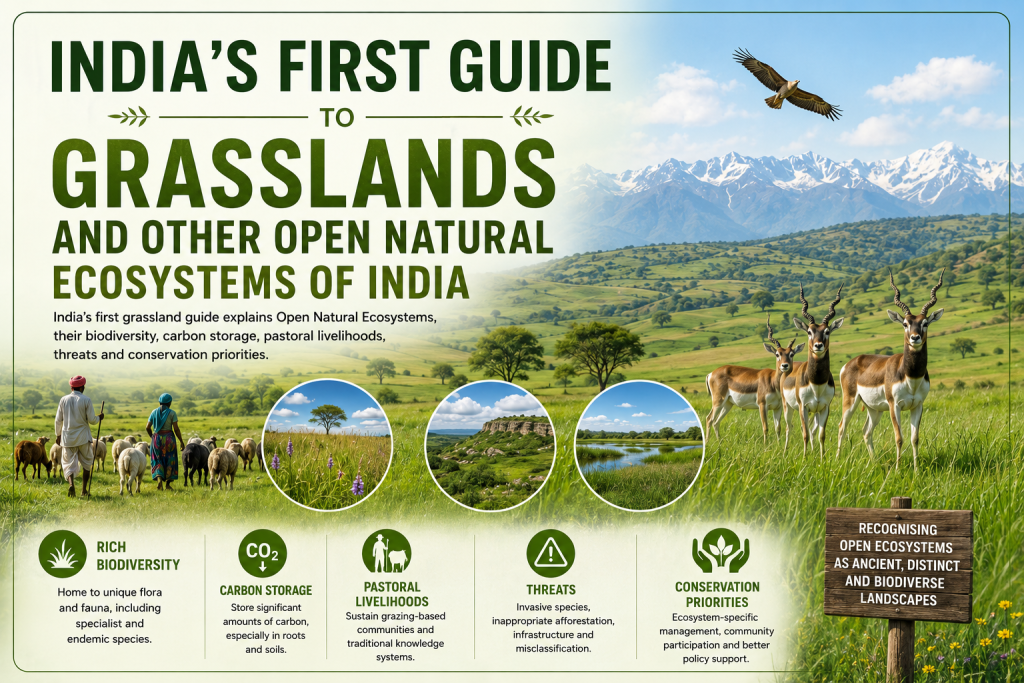
In August 2026, during the 17th Conference of the Parties (COP17) to the United Nations Convention to Combat Desertification (UNCCD), held in Ulaanbaatar, the capital of Mongolia, the Government of India released the country’s first comprehensive Guidelines on India’s Grasslands and Open Natural Ecosystems (ONEs). The document represents a paradigm shift in India’s environmental policy.
-
-
- For decades, policy approaches in India largely treated forests as the primary ecosystems worthy of conservation, while grasslands, savannas, and desert landscapes were often classified as “wastelands”, partly reflecting a colonial legacy. The new guidelines not only provide scientific recognition to these Open Natural Ecosystems (ONEs) but also highlight their social, economic, and ecological significance and present a comprehensive roadmap for their conservation and management.
- For decades, policy approaches in India largely treated forests as the primary ecosystems worthy of conservation, while grasslands, savannas, and desert landscapes were often classified as “wastelands”, partly reflecting a colonial legacy. The new guidelines not only provide scientific recognition to these Open Natural Ecosystems (ONEs) but also highlight their social, economic, and ecological significance and present a comprehensive roadmap for their conservation and management.
-
Open Natural Ecosystems (ONEs) and Distribution in India:
-
-
- Open Natural Ecosystems (ONEs) refer to landscapes where tree density is very low, generally less than 10%, and where grasses, shrubs, and other low-growing vegetation predominate. They are not degraded forests, but distinct ecosystems that are the result of thousands of years of evolutionary adaptation to local climatic and ecological conditions.
- According to the guidelines prepared in collaboration with the Bengaluru-based Ashoka Trust for Research in Ecology and the Environment (ATREE), the Indian Space Research Organisation (ISRO), and the Indian Council of Forestry Research and Education (ICFRE), India’s Open Natural Ecosystems include:
- 24 distinct ecological categories: These ecosystems cover approximately 10% of India’s total geographical area, equivalent to around 3.2 lakh square kilometres.
- Open Natural Ecosystems (ONEs) refer to landscapes where tree density is very low, generally less than 10%, and where grasses, shrubs, and other low-growing vegetation predominate. They are not degraded forests, but distinct ecosystems that are the result of thousands of years of evolutionary adaptation to local climatic and ecological conditions.
-
Major geographical regions include:
-
-
- Cold deserts and alpine grasslands: Found in Ladakh and the high Himalayan regions, including bugyals.
- Terai grasslands: Marshy and grass-dominated landscapes of the Indo-Gangetic plains.
- Banni and Thar savannas: Extremely arid and semi-arid landscapes of Gujarat and Rajasthan.
- Semi-arid scrublands of the Deccan Plateau: Dry interior regions of central and southern India.
- Chambal ravines: Dissected ravine landscapes across Madhya Pradesh and Uttar Pradesh.
- Rocky plateaus and Shola grasslands of the Western Ghats: Unique high-altitude ecosystems with distinctive ecological characteristics.
- Cold deserts and alpine grasslands: Found in Ladakh and the high Himalayan regions, including bugyals.
-
Multifaceted Importance of ONEs:
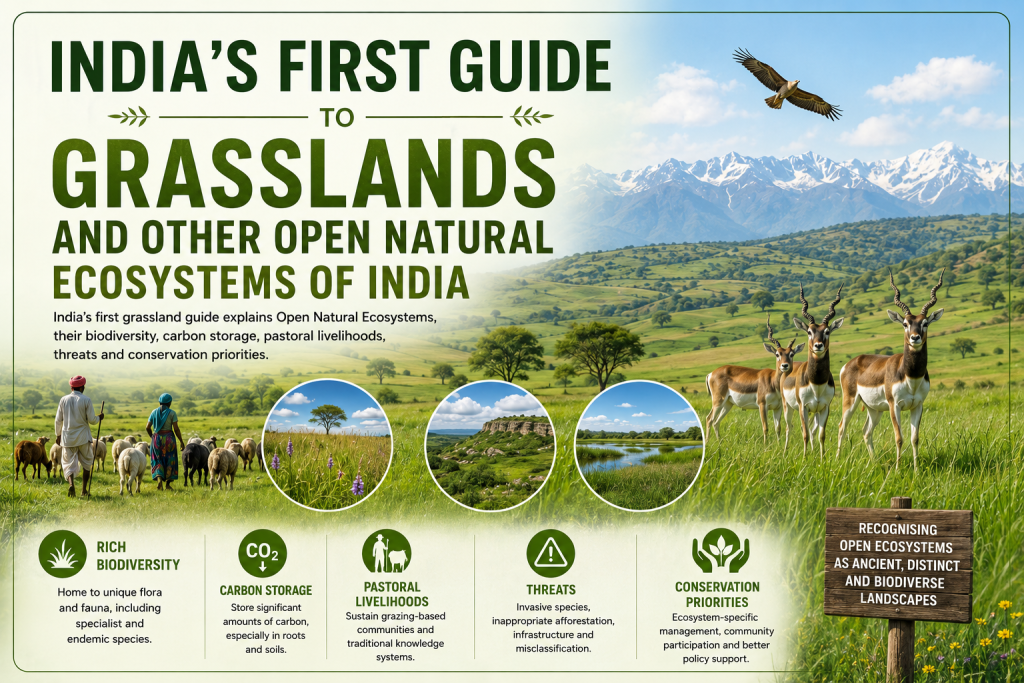
The comprehensive guidelines make it clear that Open Natural Ecosystems are critical to India’s ecological stability and rural economy.
-
-
- Ecological and Biodiversity Significance:
- Habitat for specialised species: ONEs provide habitat for several species that cannot survive in dense forests. These include the critically endangered Great Indian Bustard, Lesser Florican, Indian Wolf, Blackbuck, Chital, and Caracal.
- Role in the hydrological cycle: Extensive root systems in grasslands function like natural sponges. They absorb excess monsoon rainfall, facilitate groundwater recharge, and help prevent soil erosion.
- Habitat for specialised species: ONEs provide habitat for several species that cannot survive in dense forests. These include the critically endangered Great Indian Bustard, Lesser Florican, Indian Wolf, Blackbuck, Chital, and Caracal.
- Climate Change and Carbon Sequestration:
- Underground carbon sinks: Unlike forests, grasslands store a substantial proportion of their carbon below ground, particularly in their extensive root systems and soil organic matter.
- Greater carbon persistence: During wildfires or droughts, a significant amount of above-ground carbon stored in forests can be released into the atmosphere. In grasslands, much of the carbon is stored underground and is therefore relatively protected from fire, making their soil carbon reserves potentially more persistent.
- Underground carbon sinks: Unlike forests, grasslands store a substantial proportion of their carbon below ground, particularly in their extensive root systems and soil organic matter.
- Socio-Economic and Cultural Significance:
- Livestock Rearing and Livelihoods: India has one of the world’s largest livestock populations. Open Natural Ecosystems provide essential grazing and fodder resources for millions of pastoralists, herders, and nomadic communities, including the Rabaris of Rajasthan, Dhangars of Maharashtra, and Kurubas of Karnataka.
- Traditional Conservation Systems: India also has a long cultural tradition of conserving open ecosystems through community-managed and sacred landscapes such as Orans, Gauchars, and Devbanis. These institutions demonstrate that local communities have historically played an important role in maintaining ecological balance and biodiversity.
- Livestock Rearing and Livelihoods: India has one of the world’s largest livestock populations. Open Natural Ecosystems provide essential grazing and fodder resources for millions of pastoralists, herders, and nomadic communities, including the Rabaris of Rajasthan, Dhangars of Maharashtra, and Kurubas of Karnataka.
- Ecological and Biodiversity Significance:
-
Major Challenges Facing ONEs in India:
-
-
- Colonial Classification as “Wastelands”: The colonial-era classification of many open landscapes as wastelands, reinforced by subsequent wasteland mapping and land-use practices, contributed to the perception that these areas were unproductive. As a result, governments have often made them available for industries, solar parks, wind-energy projects, and other infrastructure.
- Misguided Afforestation Policies: Under programmes such as the Green India Mission and compensatory afforestation through CAMPA, tree plantation has sometimes been promoted in grasslands and savannas where naturally low tree cover is an ecological characteristic. The introduction or spread of species such as Prosopis juliflora and, in some contexts, eucalyptus can alter hydrological conditions and adversely affect native biodiversity. This highlights the need to distinguish between forest restoration and grassland restoration.
- Encroachment and Agricultural Expansion: Expansion of irrigation infrastructure and agricultural activities has resulted in the conversion of several dry ONEs into agricultural land. In some regions, irrigation projects such as the Indira Gandhi Canal have significantly altered naturally arid and semi-arid landscapes.
- Climate Change and Desertification: Changing rainfall patterns, rising climatic variability, droughts, and unsustainable grazing pressures can degrade these ecosystems and reduce their carrying capacity. If ecological thresholds are crossed, degradation may accelerate processes associated with desertification.
- Colonial Classification as “Wastelands”: The colonial-era classification of many open landscapes as wastelands, reinforced by subsequent wasteland mapping and land-use practices, contributed to the perception that these areas were unproductive. As a result, governments have often made them available for industries, solar parks, wind-energy projects, and other infrastructure.
-
India’s Global Environmental Commitments:
The release of the guidelines in Ulaanbaatar is also significant from the perspective of India’s global environmental diplomacy.
-
-
- Land Degradation Neutrality: India has committed to restoring 26 million hectares of degraded land by 2030. Scientific identification, restoration, and sustainable management of ONEs can contribute significantly to achieving this target.
- Kunming-Montreal Global Biodiversity Framework: The Kunming-Montreal Global Biodiversity Framework includes the goal of conserving at least 30% of the world’s terrestrial, inland water, coastal, and marine areas by 2030, commonly referred to as the 30×30 target.
- India can strengthen its contribution to this goal by recognising ecologically significant ONEs and, where they meet the relevant criteria, bringing them under appropriate Other Effective Area-Based Conservation Measures (OECMs) and other conservation frameworks.
- Land Degradation Neutrality: India has committed to restoring 26 million hectares of degraded land by 2030. Scientific identification, restoration, and sustainable management of ONEs can contribute significantly to achieving this target.
-
Way Forward:
following corrective measures are required to translate the objectives regarding grasslands and open natural ecosystems into reality:
-
-
- Revise the Wasteland Atlas: India should reconsider the use of the term “wasteland” in land-use classification and replace it with scientifically meaningful ecological categories. This would help prevent naturally open ecosystems from being treated as vacant or unproductive land.
- Promote ecologically appropriate restoration: Restoration should not automatically mean tree planting. Grassland and savanna restoration should prioritise native grasses, shrubs, and other naturally occurring vegetation appropriate to the ecosystem.
- Empower pastoral communities: Traditional grazing communities should be given greater recognition and participation in the management of community landscapes. Where legally applicable, the Forest Rights Act, 2006 and community forest resource provisions should be effectively implemented.
- Regulate renewable-energy infrastructure: Solar and wind-energy projects should avoid ecologically important ONEs wherever possible and instead prioritise genuinely degraded, already disturbed, or industrially unsuitable lands after rigorous ecological assessment.
- Revise the Wasteland Atlas: India should reconsider the use of the term “wasteland” in land-use classification and replace it with scientifically meaningful ecological categories. This would help prevent naturally open ecosystems from being treated as vacant or unproductive land.
-
Conclusion:
The guideline released by India in Mongolia is an acknowledgement that 'Green Cover' does not only mean 'Tree Cover'. Grasslands, savannas and ravines are precious gifts of nature, which not only absorb carbon but also provide sustenance to India's rural economy and wildlife. This document will prove to be a significant step towards making India's environmental agenda more inclusive, scientific, and sustainable.



