

Introduction:
Dairy has long been the backbone of India’s rural economy and nutritional ecosystem. India remains the world’s leading milk producer, contributing nearly one-fourth of global output. Over the last 11 years, the dairy sector has expanded by about 70 percent, contributes around 5 percent to the national economy, and provides direct employment to over 8 crore farmers, as reported by the National Accounts Statistics. Women farmers play a major role in production and collection, making dairy a key driver of inclusive and gender-responsive growth. Yet structural challenges persist: low productivity, fodder shortages, climate-induced stress, and recurring animal diseases continue to limit long-term performance.
-
- National Milk Day, observed on 26 November to mark the birth anniversary of Dr. Verghese Kurien—the “Father of the White Revolution”—honours the millions of farmers whose work sustains India’s leadership in milk production and strengthens the country’s path toward a resilient, inclusive, and nutritionally secure future.
- National Milk Day, observed on 26 November to mark the birth anniversary of Dr. Verghese Kurien—the “Father of the White Revolution”—honours the millions of farmers whose work sustains India’s leadership in milk production and strengthens the country’s path toward a resilient, inclusive, and nutritionally secure future.
India’s Milk Production: Key Trends:
-
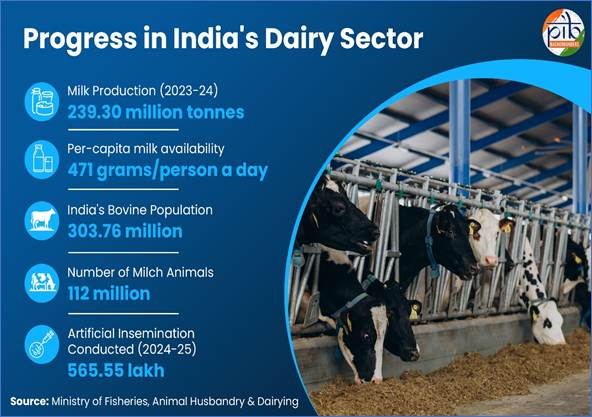
- India’s milk output has maintained a consistent upward trajectory. Production rose from 146.30 million tonnes in 2014–15 to 239.30 million tonnes in 2023–24, reflecting a 63% growth. Per-capita milk availability has climbed to 471 grams/day, far above the global average of 329 grams/day, indicating improved domestic supply and nutritional reach.
- Five states — Uttar Pradesh, Rajasthan, Madhya Pradesh, Gujarat, and Andhra Pradesh — account for over 53% of total production. The livestock base is equally significant: India hosts 303.76 million bovines, with indigenous buffaloes contributing 32% of national milk output and crossbred cattle around 30%. Productivity gaps remain stark — crossbred cattle yield 8.55 kg/day while indigenous cattle average 3.44 kg/day, underlining the need for sustained genetic improvement.
- India’s milk output has maintained a consistent upward trajectory. Production rose from 146.30 million tonnes in 2014–15 to 239.30 million tonnes in 2023–24, reflecting a 63% growth. Per-capita milk availability has climbed to 471 grams/day, far above the global average of 329 grams/day, indicating improved domestic supply and nutritional reach.
Economic and Social Importance of Dairy:
-
- Rural Income Backbone: Dairy contributes nearly 40% of India’s agriculture and allied output, valued at ₹11.16 lakh crore. For around 8 crore farmers, most of them smallholders, milk offers daily and relatively stable cash flow, unlike seasonal crop income.
- Nutritional Security: Milk’s rich nutrient profile — protein, calcium, essential vitamins and micronutrients — supports India’s fight against malnutrition, especially protein deficiency, stunting and anaemia. High per-capita availability allows wider inclusion in household diets.
- Women’s Empowerment: Women make up 70% of India’s dairy workforce. They manage over 48,000 cooperatives and run 16 all-women Milk Producer Organisations (MPOs). Models like the Shreeja MPO in Andhra Pradesh demonstrate how dairy enhances autonomy, income stability and community leadership among rural women.
- Contribution to Sustainable Agriculture: Livestock supplies manure, bio-CNG and organic fertilisers. Programmes such as Gobar-Dhan are turning waste into economic value while reducing chemical fertiliser dependency and improving soil health.
- Rural Income Backbone: Dairy contributes nearly 40% of India’s agriculture and allied output, valued at ₹11.16 lakh crore. For around 8 crore farmers, most of them smallholders, milk offers daily and relatively stable cash flow, unlike seasonal crop income.
Cooperative Structure and Value Chain:
-
- India’s cooperative dairy network is unmatched in scale. It consists of:
- 22 milk federations
- 241 district unions
- 31,908 dairy cooperative societies
- 1.72 crore producers
- 61,677 village testing laboratories
- 22 milk federations
- This framework ensures transparent procurement and fair pricing. However, the organised sector processes only one-third of marketable milk, leaving the unorganised segment dominant. This affects quality consistency, cold-chain efficiency and farmer realisation.
- India’s cooperative dairy network is unmatched in scale. It consists of:
Government Support and Sector Reforms:
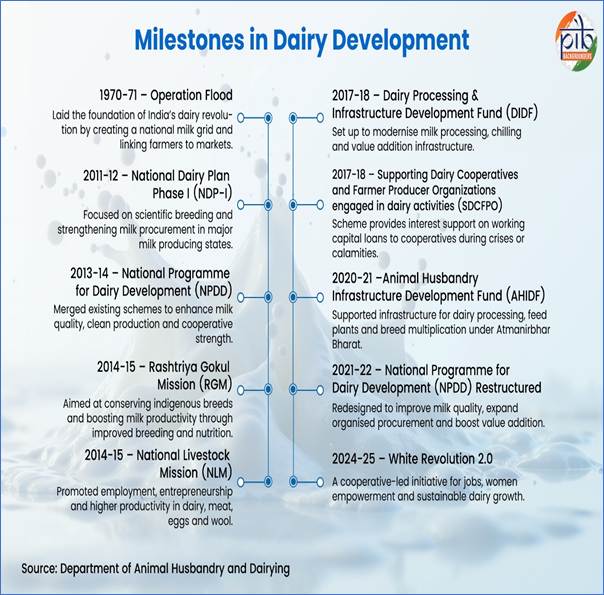
1. White Revolution 2.0:
-
- Launched in 2024–25, this five-year mission aims to modernise the cooperative ecosystem. Its targets include:
- Forming 75,000 new dairy cooperative societies
- Strengthening 46,422 existing societies
- Establishing multi-state cooperatives for feed, biofertilisers and by-product utilisation
- Raising procurement to 1,007 lakh kg/day by 2028–29
- Expanding processing capacity to 100 million litres/day
- Forming 75,000 new dairy cooperative societies
- Large new plants — such as the Sabar Dairy facility in Rohtak — support urban markets like Delhi-NCR and ease supply bottlenecks.
- Launched in 2024–25, this five-year mission aims to modernise the cooperative ecosystem. Its targets include:
2. Rashtriya Gokul Mission (RGM):
-
- Revised in March 2025, RGM aims to enhance breed quality and productivity through scientific breeding. With an outlay of ₹3,400 crore, it has:
- Benefited 92 million animals
- Supported 56 million farmers
- Trained 38,736 MAITRIs
- Enabled 14.12 crore artificial inseminations
- Set up 22 IVF labs
- Produced over 10 million doses of sex-sorted semen
- Benefited 92 million animals
- RGM is central to building a more productive and genetically improved bovine population.
- Revised in March 2025, RGM aims to enhance breed quality and productivity through scientific breeding. With an outlay of ₹3,400 crore, it has:
3. National Programme for Dairy Development (NPDD):
-
- Revised in 2021, NPDD focuses on strengthening procurement and processing systems. Its achievements include:
- Revival of 31,908 cooperatives
- Addition of 17.63 lakh new producers
- Installation of ~6,000 bulk milk coolers
- Upgradation of 279 labs
- Revival of 31,908 cooperatives
- New powder plants, UHT units and greenfield dairies have expanded capacity. For 2025–26, 21,902 new cooperatives are planned with support of over ₹400 crore.
- Revised in 2021, NPDD focuses on strengthening procurement and processing systems. Its achievements include:
4. GST Rationalisation (2025):
-
- The 56th GST Council reduced taxes on key dairy items:
- 0% GST on UHT milk and packaged paneer
- 5% GST on ghee, butter, cheese, condensed milk and dairy beverages
- Ice cream reduced from 18% to 5%
- Milk cans reduced from 12% to 5%
- 0% GST on UHT milk and packaged paneer
- These cuts lower consumer costs, encourage formalisation and improve farmer margins.
- The 56th GST Council reduced taxes on key dairy items:
Challenges in the Dairy and Livestock Sector:
-
- Low Productivity: Average productivity (1,777 kg/year) remains much lower than the global average (2,699 kg/year). Limited AI coverage — only 33% — slows genetic progress.
- Infrastructure Deficits: Shortages of chilling units, testing labs, veterinary services and modern plants lead to post-harvest losses and restrict scaling.
- Climate Stress: Rising temperatures, erratic rainfall and fodder shortages hamper yields. Methane emissions also remain a concern, requiring climate-smart feeding and manure management.
- Animal Diseases: FMD, Brucellosis and Lumpy Skin Disease continue to cause productivity losses. India aims for disease elimination by 2030, but gaps in vaccination logistics persist.
- Fodder Shortage: India faces deficits of 12% green fodder, 23% dry fodder, and 30% concentrate feed, directly affecting animal health and milk output.
- Price Volatility and Low Credit Access: Milk prices fluctuate, and livestock receives only 4% of agricultural credit, limiting investment capacity.
- Slowing Growth: Milk production growth declined from 6.47% (2018–19) to 3.83% (2022–23), signalling deeper structural issues.
- Low Productivity: Average productivity (1,777 kg/year) remains much lower than the global average (2,699 kg/year). Limited AI coverage — only 33% — slows genetic progress.
Way Forward:
-
- Strengthening Cooperatives: Wider cooperative coverage ensures better prices, transparency and formalisation.
- Expanding Scientific Breeding: Greater use of AI, IVF, sexed semen and genomic selection can lift productivity sustainably.
- Modern Infrastructure: Cold-chain expansion, quality testing and efficient processing are essential to reduce wastage and increase value addition.
- Climate-Smart Practices: Bio-CNG units, manure management systems and heat-resilient breeds can mitigate environmental risks.
- Ensuring Fodder Security: High-yield fodder varieties, fodder banks and better irrigation access can reduce chronic shortages.
- More Credit and Insurance: Livestock financing, risk coverage and working capital support will stabilise farmer incomes.
- Promoting Value-Added Products: Cheese, yoghurt, paneer, whey and ice cream offer higher returns than raw milk.
- Supporting Indigenous Breeds: Better conservation and selective breeding can tap their natural resilience and disease tolerance.
- Strengthening Cooperatives: Wider cooperative coverage ensures better prices, transparency and formalisation.
Conclusion:
India’s dairy sector is entering a decisive phase. The rise in production, expansion of cooperatives, stronger breeding programmes and significant policy support have created a promising base. However, productivity gaps, climate pressures, fodder shortages and disease risks remain binding constraints. White Revolution 2.0 aims to bridge these gaps through modern infrastructure and scientific practices, while empowering farmers, especially women at the grassroots. If India sustains reforms, strengthens value chains and adopts climate-smart systems, the dairy sector can not only meet rising domestic demand but also position the country as a competitive global player in the years ahead.
| UPSC/PCS Main Question: The dairy sector contributes significantly to rural incomes, women’s empowerment and nutritional security in India. Analyse how the cooperative model has shaped this growth. How can India strengthen dairy cooperatives to address new challenges such as climate stress and market volatility? |



