
Context:
Recently, on the sidelines of the BRICS Summit held in Delhi, PM Modi and Chinese President Xi Jinping held a separate bilateral meeting. Following the meeting, India stated that the two leaders emphasized the need to address mutual concerns, particularly “structural trade imbalance” and “supply chain-related issues.”
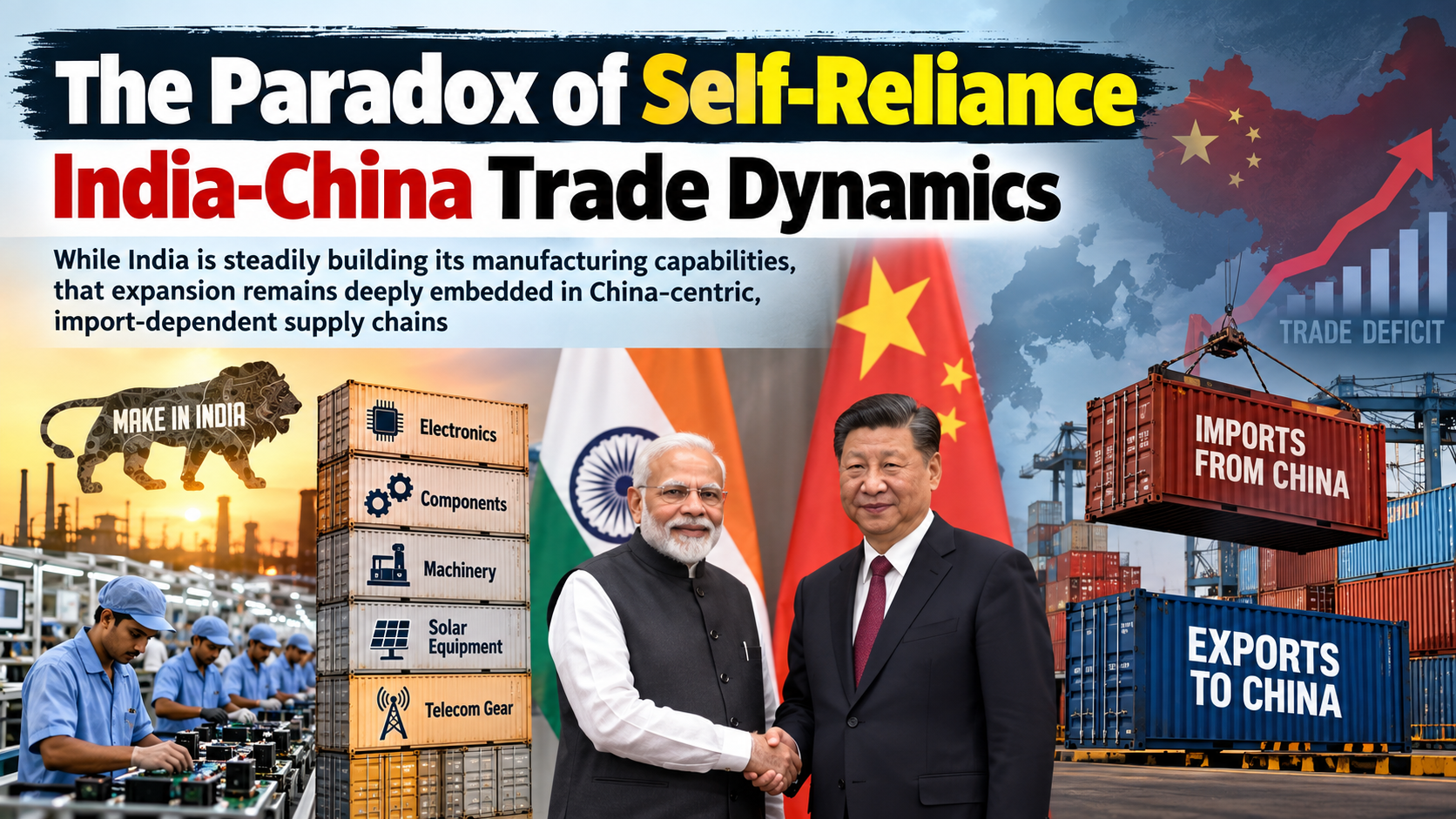
This issue is important for India’s economic strategy because, on the one hand, India is promoting domestic manufacturing through initiatives such as Atmanirbhar Bharat, Make in India, and Production-Linked Incentive (PLI) schemes, while on the other hand, dependence on intermediate goods and components imported from China continues in sectors such as electronics, telecommunications equipment, machinery, solar equipment, and other industrial sectors.
Thus, India faces an important paradox: production in India is increasing, but many of the key inputs required for that production are still being sourced from abroad, particularly from China.
Changing Nature of India-China Trade:
Bilateral trade between India and China has increased significantly in recent years. In 2025, total trade between the two countries stood at approximately $167.6 billion. However, the nature of this trade is highly asymmetric. Between 2021 and 2025, India’s exports to China remained broadly stagnant, while imports from China increased from approximately $87.5 billion to $149.5 billion. This represents an increase of around 71% in imports during this period.
This situation reflects India’s continuously widening trade deficit. Although a trade deficit is not always negative in itself, the problem becomes serious when imports consist primarily of products and technological components whose domestic production has not yet been developed in sufficient quantity and quality. In this context, the India-China trade deficit is not merely a problem of importing consumer goods; rather, it is a broader issue linked to India’s industrial capacity, technological self-reliance, and position in global value chains.
Why Does the Composition of Imports Matter?
Around 70% of India’s imports from China consist of intermediate goods, while approximately 22% are capital goods. Intermediate goods, or supporting materials, are goods that are used in the production of other products. For example, electronic components, machinery parts, chemicals, circuits, and other industrial inputs.
Therefore, imports from China are not limited to the sale of Chinese products in the Indian market. In reality, a part of Indian industry itself operates within a production system dependent on Chinese inputs.
This can be understood as an “assembly trap.” India carries out the final assembly of a product domestically, but imports its critical and high-value components from abroad. As a result, production and export figures may increase, but actual domestic value addition may remain limited.
Electronics Sector: A Key Example of Self-Reliance
India has made significant progress in mobile phone manufacturing and electronics assembly. India is now moving towards becoming an important hub of global electronics manufacturing. However, an important challenge has emerged here. Despite the expansion of mobile phone and other electronic product assembly in India, many critical components required for these products continue to be imported.
According to available data, the share of imported parts and components used in mobile phone manufacturing increased from 3.3% in 2022 to 10.1% in 2025.
This situation indicates that India has rapidly developed assembly capabilities, but it still has a long way to go in building a domestic ecosystem for semiconductors, displays, sensors, precision components, and other high-technology products.
This is why it is important to distinguish between a product “made in India” and a product that is genuinely “manufactured by India.”
Key Challenges for India:
1. High Technological Dependence
India’s domestic capabilities in semiconductors, electronic components, machine tools, and other high-technology sectors are still limited. Greater dependence on China and a few other countries in these sectors can increase risks in the event of supply disruptions.
2. Lack of a Domestic Component Ecosystem
A strong manufacturing economy requires more than just large companies. A broad network of MSMEs, suppliers, design companies, research institutions, logistics networks, and skilled labour is essential around them. In India, the development of such deep supplier networks remains relatively weak in several sectors.
3. Lack of Research and Development
Research, design, and technological innovation are important for high-value manufacturing. If Indian companies continue to depend primarily on foreign technology and designs, domestic value addition will remain limited.
4. Cost Competitiveness
Chinese industry has developed cost competitiveness in several sectors through economies of scale, developed supplier networks, infrastructure, and technological expertise. Achieving a similar level of competitiveness remains a challenge for Indian industry.
Is Restricting Imports the Solution?
Merely imposing import restrictions or high tariffs will not be sufficient to address the India-China trade imbalance. India must recognize that many Chinese imports are themselves essential production inputs for Indian industries. If broad restrictions are suddenly imposed on them, the production costs of Indian companies may increase and their global competitiveness may be affected. Therefore, the objective of policy should not be “stopping imports,” but rather “reducing strategic dependence on imports.”
Where domestic capabilities can be developed, phased and targeted tariffs can provide opportunities for domestic industries. At the same time, in sectors where India does not yet have sufficient capacity, it will be necessary to remain connected to global supply chains.
The Right Meaning of Self-Reliance
Self-reliance does not mean producing in isolation from the rest of the world. In the modern global economy, complete self-reliance is neither practical nor necessary.
The real meaning of self-reliance is that “domestic capabilities should be developed in critical sectors while remaining strategically connected to global markets and supply chains.”
India needs to move its strategy beyond assembly-led manufacturing towards component-led and technology-led manufacturing.
For this, the following steps may be important-
1. Focus on Component Manufacturing: PLI schemes should not be limited only to final products but should also be extended to electronic components, semiconductors, sensors, machine tools, and other critical inputs.
2. Promote R&D and Innovation: Domestic technological capabilities need to be developed by strengthening collaboration among universities, research institutions, and industries.
3. Develop MSME Supplier Networks: It is essential to establish strong local and regional supplier networks around large companies. This will increase both domestic value addition and employment.
4. Deeper Participation in Global Value Chains: India should not depend only on domestic production while reducing its dependence on China. It would be useful to strengthen supply chain cooperation with various partners, including Japan, South Korea, Taiwan, Europe, the United States, and ASEAN countries.
5. Balance in Trade Policy: Tariff policy should protect domestic industries while also preparing them for global competition. Excessive protection can reduce the competitiveness of industries.
Conclusion
The imbalance in India-China trade relations is not merely a question of the trade deficit. It is a broader economic issue connected with India’s manufacturing model, technological capabilities, and position in global supply chains. India has made significant progress in mobile phone assembly, electronics, and other manufacturing sectors, but the next stage should not be merely about increasing production; it should focus on greater domestic value addition.
The real measure of the success of Atmanirbhar Bharat should not be whether the final product was assembled in India, but rather how much India contributes to the design, technology, key components, research, and supply chain of that product. Therefore, instead of distancing itself from China, India should adopt a policy of “strategic diversification away from excessive dependence.” Only by balancing domestic technological capabilities with global integration can India develop a manufacturing economy that is both self-reliant and globally competitive.



