
Context:
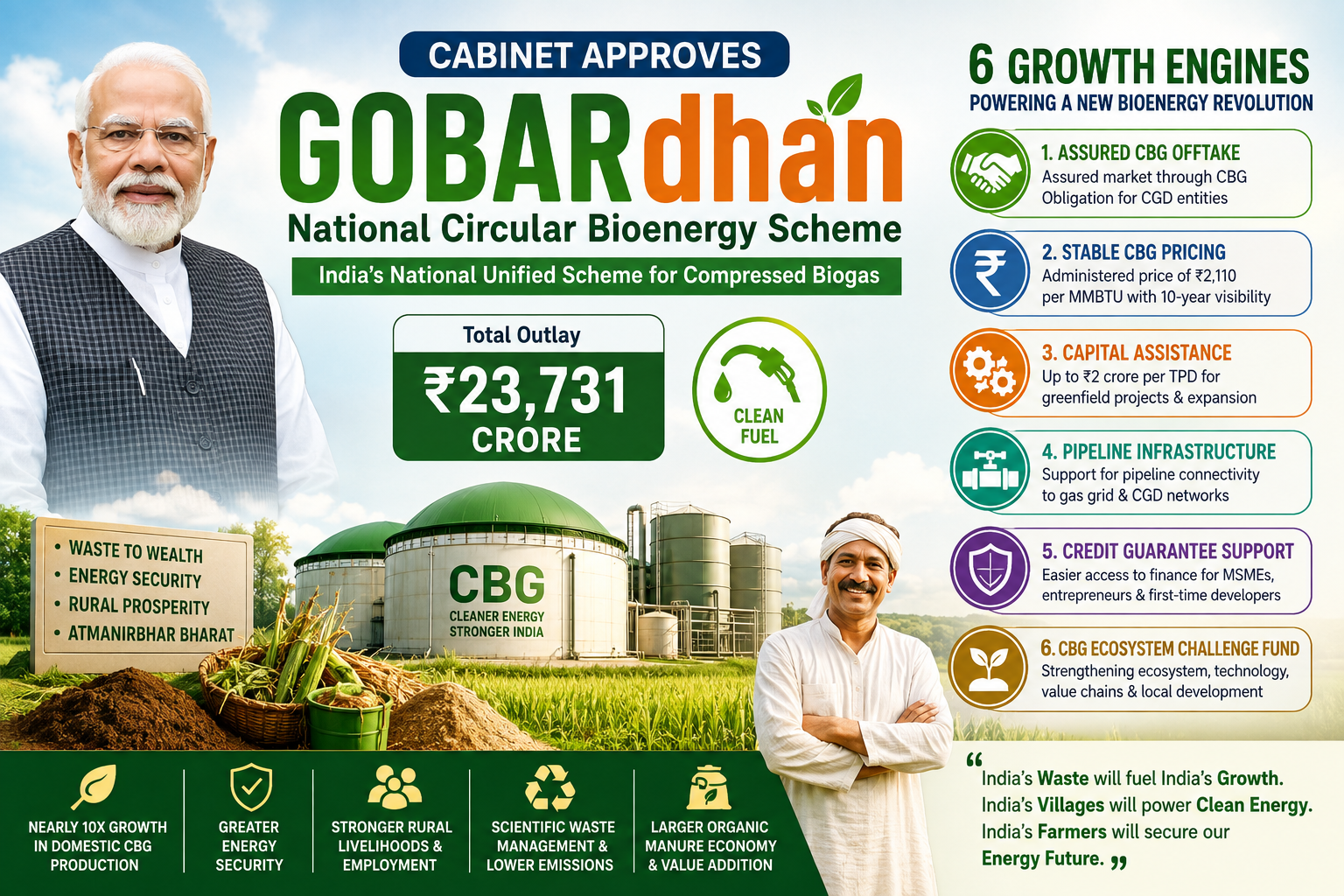
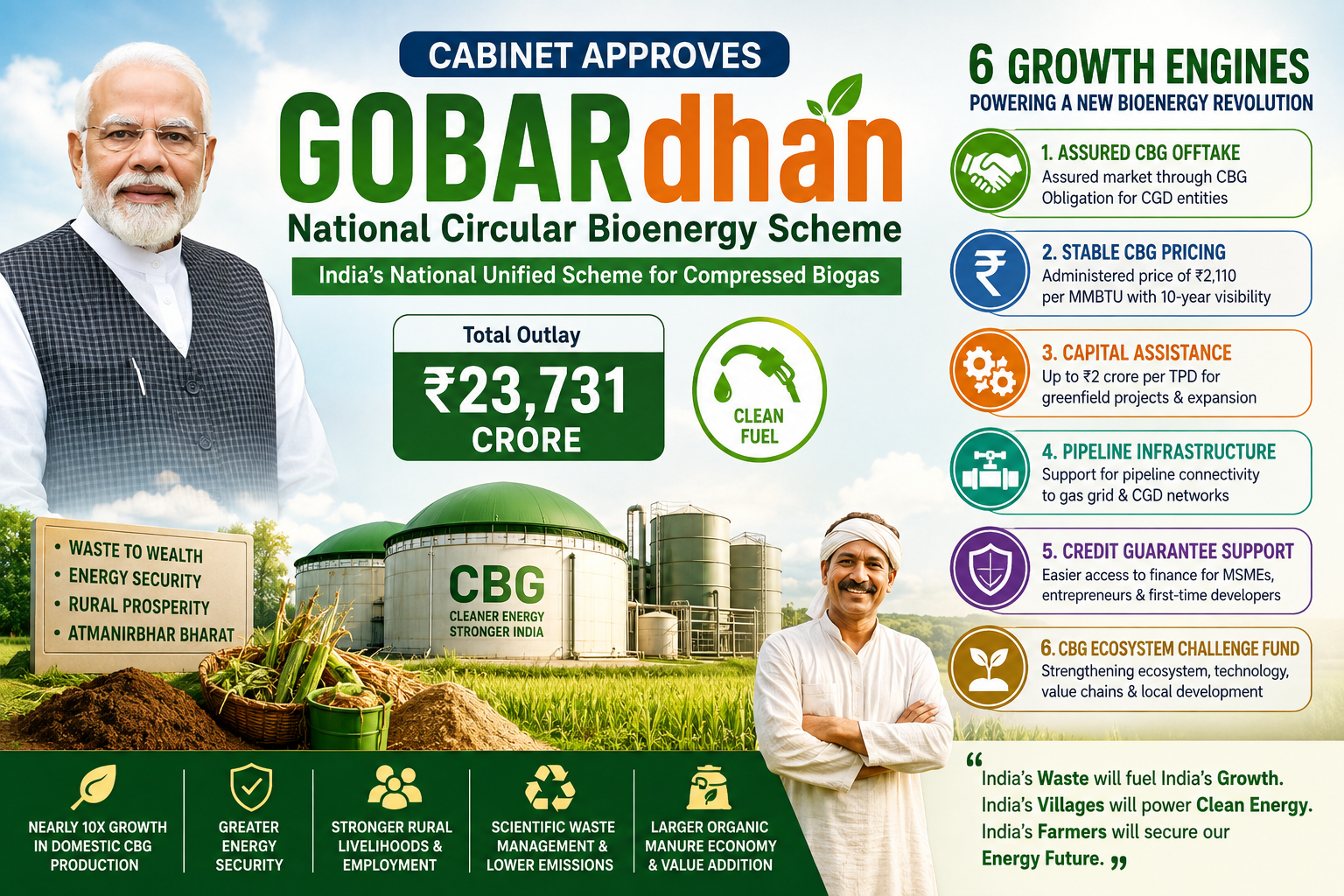
Recently, The Union Cabinet has approved GOBARdhan (Galvanising Organic Bio-Agro Resources Dhan) – the National Circular Bioenergy Scheme, with an outlay of ₹23,731 crore for ten years from FY 2026-27 to FY 2035-36. Implemented by the Ministry of Petroleum and Natural Gas (MoPNG), the scheme aims to increase domestic Compressed Biogas (CBG) production nearly ten-fold and attract large-scale private investment. It seeks to address the major challenges that have restricted the commercial growth of CBG, including uncertain demand, high capital costs, weak feedstock supply chains and inadequate infrastructure.
GOBARdhan: From Waste Management to Energy Security
-
-
- GOBARdhan was originally launched in 2018 as a rural waste-management initiative under the Swachh Bharat Mission (Grameen). Its initial focus was on scientific management of cattle dung and organic waste and converting them into useful products such as biogas and compost.
- Over the years, the programme acquired a much wider significance. Agricultural residues, cattle dung, press mud, food waste and other organic materials came to be viewed not merely as waste but as potential sources of renewable energy and agricultural inputs.
- The latest scheme represents the next stage of this evolution. It seeks to integrate waste management with energy security, rural incomes, clean fuel production and the circular economy.
- GOBARdhan was originally launched in 2018 as a rural waste-management initiative under the Swachh Bharat Mission (Grameen). Its initial focus was on scientific management of cattle dung and organic waste and converting them into useful products such as biogas and compost.
-
What Is Biogas and How Is CBG Different?
-
-
- Biogas is produced when organic matter decomposes in the absence of oxygen. It generally contains around 55-65% methane, along with carbon dioxide and traces of other gases such as hydrogen sulphide, nitrogen and ammonia.
- In its raw form, biogas can be used for cooking, lighting, electricity generation and certain mechanical applications. However, when biogas is purified and upgraded to significantly increase its methane concentration and then compressed at high pressure, it becomes Compressed Biogas (CBG).
- CBG has properties and energy content similar to Compressed Natural Gas (CNG). This makes it suitable for use in transport, industry and commercial applications and allows it to be integrated into existing gas infrastructure. The distinction is therefore important: biogas is the raw product, while CBG is purified and compressed biogas designed for wider commercial fuel applications.
- Biogas is produced when organic matter decomposes in the absence of oxygen. It generally contains around 55-65% methane, along with carbon dioxide and traces of other gases such as hydrogen sulphide, nitrogen and ammonia.
-
How Does a CBG Plant Work?
-
-
- The foundation of a CBG plant is anaerobic digestion, in which microorganisms break down organic matter in a sealed environment without oxygen.
- The process broadly occurs through four stages. Hydrolysis breaks complex organic matter into simpler molecules. During acidogenesis, these molecules are converted into volatile fatty acids. Acetogenesis then produces compounds such as acetic acid, carbon dioxide and hydrogen. Finally, methanogenesis produces methane-rich biogas.
- The raw biogas is subsequently purified to remove impurities and increase methane concentration. It can then be compressed and supplied as CBG.
- The process also produces digestate, which can be processed into Fermented Organic Manure (FOM). Thus, a CBG plant can generate both clean fuel and agricultural nutrients.
- The foundation of a CBG plant is anaerobic digestion, in which microorganisms break down organic matter in a sealed environment without oxygen.
-
Why Is CBG Strategically Important for India?
-
-
- CBG has strategic importance because India remains significantly dependent on imported natural gas.
- Expanding domestic CBG production can help reduce dependence on imported fossil fuels and make the energy system more resilient to international price and supply disruptions.
- CBG also offers a domestic source of renewable gas for transport, households, industry and commercial establishments. Since purified CBG is chemically comparable to natural gas, it can potentially use the country's expanding gas infrastructure.
- Its importance therefore goes beyond climate policy. CBG can contribute simultaneously to energy security, import reduction, waste management and rural economic development.
- CBG has strategic importance because India remains significantly dependent on imported natural gas.
-
Challenge: Making CBG Commercially Viable
India has considerable biomass resources, but the CBG sector has historically faced several commercial bottlenecks.
Feedstock is often scattered across rural areas and may be seasonal. Collecting and transporting crop residues and cattle dung can therefore be expensive. CBG plants also require significant upfront capital, while uncertain offtake has made investors cautious.
The new GOBARdhan framework attempts to address these weaknesses by creating an integrated ecosystem covering feedstock, production, financing, pricing, offtake and infrastructure.
This is a significant shift from treating CBG as a technology or pilot project towards developing it as a bankable energy industry.
The Six Growth Engines of the new Scheme:
To minimize the market and operational risks traditionally associated with bioenergy projects, the GOBARdhan scheme is built upon six interconnected policy engines:
-
-
- Assured CBG Offtake Framework: One of the most significant barriers to commercial CBG production has been market uncertainty. To solve this, the scheme introduces a rigid blending mandate. Starting with a 3% mandatory blending obligation in FY 2026-27, the mandate escalates to 5% by FY 2028-29. This forces natural gas marketing companies to purchase domestic CBG, creating a guaranteed, baseline demand for every molecule of gas produced.
- Stable Administered Pricing: Revenue predictability is crucial for capital-intensive bioenergy plants. The policy institutes a government-backed, long-term administered pricing framework that fixes the price of CBG at ₹2,110 per MMBTU (which equates to roughly ₹105 per kilogram) over a 10-year horizon. This insulates producers from the extreme volatility of global fossil fuel markets and guarantees steady cash flows.
- Targeted Capital Assistance: To lower the high initial cost of setting up these facilities, the government provides extensive direct financial support. Subsidies are scaled up to ₹2 crore per Ton Per Day (TPD) of production capacity. This massive injection of capital assistance directly lowers the equity requirement for entrepreneurs and improves the internal rate of return for projects.
- Infrastructure and Grid Connectivity: The scheme allocates dedicated funds to bridge the physical gap between rural production centers and urban consumption hubs. Financial support is provided to lay pipelines that connect CBG plants directly to existing city gas distribution networks for seamless gas injection. Additionally, a robust credit guarantee mechanism is established to lower interest rates and cushion risks for commercial lenders.
- Feedstock and Biomass Mapping: Recognizing that a bioenergy plant is only as reliable as its supply chain, the policy mandates comprehensive, tech-driven biomass mapping across agricultural zones. A dedicated fund supports the identification, collection, and localized warehousing of crop residues, preventing seasonal shortages and smoothing out raw material pricing.
- Fermented Organic Manure (FOM) Value Addition: The final engine focuses on commercializing the solid and liquid digestate produced alongside the biogas. By funding specialized value-addition facilities, the scheme helps transform raw FOM into standardized, nutrient-rich organic fertilizer. This creates an auxiliary revenue stream for plant operators while advancing sustainable agriculture.
- Assured CBG Offtake Framework: One of the most significant barriers to commercial CBG production has been market uncertainty. To solve this, the scheme introduces a rigid blending mandate. Starting with a 3% mandatory blending obligation in FY 2026-27, the mandate escalates to 5% by FY 2028-29. This forces natural gas marketing companies to purchase domestic CBG, creating a guaranteed, baseline demand for every molecule of gas produced.
-
GOBARdhan and the Circular Economy:
GOBARdhan goes beyond CBG by promoting a circular economy, where organic waste is converted into CBG and Fermented Organic Manure (FOM), generating clean energy and agricultural nutrients. This can reduce landfill pressure, curb crop-residue burning and recycle nutrients back into the soil, linking environmental protection with economic development.
Conclusion:
CBG is part of India's wider waste-to-energy potential. While anaerobic digestion is suitable for biodegradable waste, technologies such as incineration, pyrolysis and gasification can process other waste streams. GOBARdhan also builds on initiatives such as SATAT, Market Development Assistance, Biomass Aggregation Machinery, Development of Pipeline Infrastructure and the National Bioenergy Programme, bringing greater integration and scale to the sector.
Way Forward:
The success of GOBARdhan will depend on effective implementation, including biomass mapping, aggregation, storage, transport, infrastructure and stable pricing. Strong coordination among governments, farmers, cooperatives and industry is essential, while the market for organic manure must develop alongside CBG. Region-specific and decentralised models should also be encouraged. If implemented effectively, GOBARdhan can transform cattle dung, crop residues and organic waste into fuel, fertiliser, employment and income, making waste the starting point of a new circular economic cycle.



