
Context:
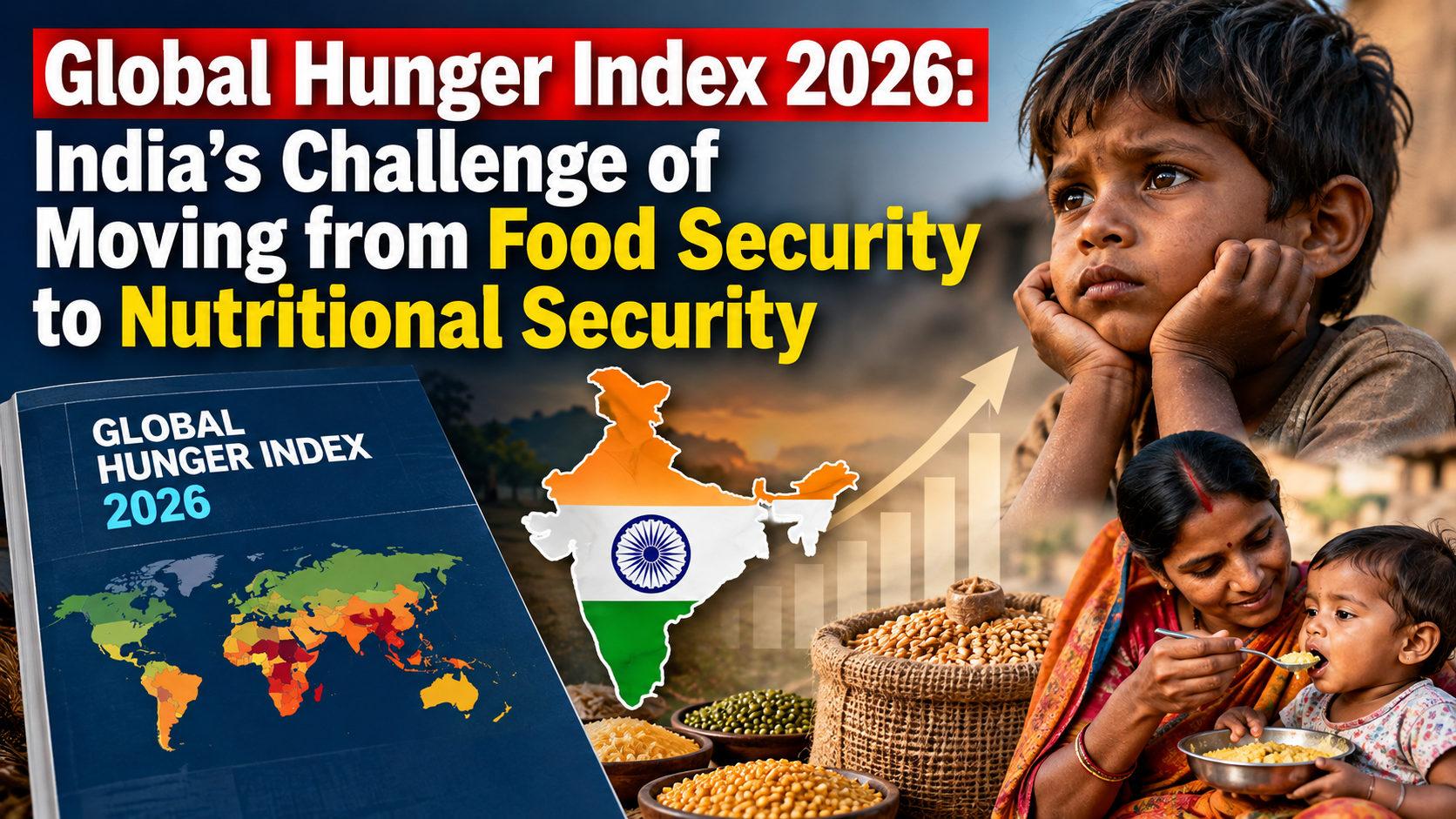
Recently, the Global Hunger Index (GHI), released in October 2026, once again brought the challenge of hunger and malnutrition in India into the spotlight. In this index, India ranks 100th out of 122 countries with a score of 24.1, placing it in the ‘Serious’ category.
This situation has emerged at a time when India is making efforts to ensure food availability through increased food grain production, expansion of the Public Distribution System, and various welfare schemes. The question is not merely whether the country has sufficient food grains, but also whether every citizen has access to adequate, nutritious, and balanced food.
Global Hunger Index 2026: Key Findings
The Global Hunger Index (GHI) is a multidimensional index jointly published by Welthungerhilfe, the Institute for International Law of Peace and Armed Conflict (IFHV), and Helvetas. Its objective is to assess the state of hunger across countries and regions and encourage policy efforts to eliminate hunger.
According to GHI 2026, India has a score of 24.1. In comparison, South Asia has an average score of 23.5, while the global score stands at 18.1. Nepal has a score of 14.5, Bangladesh 19.2, and Pakistan 25.5. These figures indicate that nutritional challenges are widespread across South Asia, although their severity varies among countries.
India’s 100th rank in the index is significant, but the complete picture cannot be understood through rankings alone. Therefore, while assessing India’s actual progress, its score, nutrition-related indicators, and long-term trends should also be considered.
Four Major Indicators of the Global Hunger Index (GHI):
The Global Hunger Index is calculated on the basis of four indicators.
Undernourishment: This indicates the proportion of the population that does not receive adequate calories. In India, the rate has been recorded at 9.8 per cent.
Child Stunting: Children under five years of age having a low height for their age may indicate long-term nutritional deficiencies. In India, the rate is 29.3 per cent.
Child Wasting: Children having a low weight for their height are associated with acute nutritional deficiencies. In India, the rate is 19 per cent, which is a matter of particular concern.
Child Mortality: The mortality rate among children under five can be influenced by factors such as inadequate nutrition, infections, and limited access to healthcare services. In India, the rate has been recorded at 2.7 per cent.
These figures are based on the latest relevant data available for use in the 2026 index. The index uses available data for the period 2023–2025 for undernourishment, the latest available data for child wasting covering 2021–2025, and data from 2024 for child stunting and child mortality. Therefore, the report should not be interpreted as an immediate snapshot of every situation measured in 2026.
Major Challenges Facing India:
Poverty and Economic Inequality: For low-income families, obtaining sufficient food itself can be difficult, while ensuring access to a balanced and diverse diet is an even greater challenge. Food prices and employment uncertainty also influence this situation.
Maternal and Child Nutrition: Inadequate nutrition during pregnancy, maternal anaemia, low birth weight, and the failure to provide appropriate complementary feeding to infants at the right time can affect children’s development. Adequate nutrition and proper care during the first 1,000 days of life are particularly important.
Lack of Safe Drinking Water, Sanitation and Healthcare Services: Recurrent infections and diseases such as diarrhoea can prevent the body from adequately absorbing and utilising nutrients from food. As a result, malnutrition may persist even when food is available.
Social and Regional Inequalities: Limited access to healthcare services in rural and remote areas, neglect of women’s nutritional needs, and a lack of awareness can aggravate the problem. Therefore, malnutrition cannot be addressed merely through food grain distribution; it requires coordinated efforts across health, education, sanitation, and social security.
Government Policies:
The Government of India has implemented several important schemes to ensure food security and improve nutrition. Under the National Food Security Act, 2013, food grains are provided to eligible households.
Under the Pradhan Mantri Garib Kalyan Anna Yojana, a decision was taken to provide free food grains to approximately 81.35 crore beneficiaries for five years beginning 1 January 2024. This supports food availability and economic security for vulnerable households.
Under Saksham Anganwadi and POSHAN 2.0, attention is given to the nutritional needs of young children, pregnant women, lactating mothers, and adolescent girls in targeted areas. Anganwadi services include supplementary nutrition, health education, health check-ups, and referral services wherever necessary.
The Pradhan Mantri Poshan Shakti Nirman (PM POSHAN) scheme provides meals to schoolchildren. Meanwhile, the POSHAN Abhiyaan emphasises behavioural change, community participation, and coordination among nutrition-related services.
However, the actual impact of these schemes depends on their implementation. It is essential to ensure that regular and quality services reach beneficiaries, malnourished children are identified in time, and appropriate treatment is provided. Therefore, actual nutritional outcomes should also be evaluated rather than relying solely on the quantity of food grains distributed or the number of registered beneficiaries.
Limitations of the Global Index and India’s Perspective
The Global Hunger Index provides useful international comparisons, but its limitations must also be understood. Three of its four indicators relate to the health and nutritional status of children under five years of age. Therefore, the index is not a direct measure of the food security situation of the entire population, although its undernourishment indicator relates to the overall population.
The Government of India has expressed objections to previous editions, arguing that the GHI is an incomplete measure of the actual state of hunger in the country. Keeping this perspective in mind, the methodology of the index, its data sources, and its limitations should be reviewed.
However, the limitations of an index cannot be used as a reason to ignore the problems it highlights. It is not appropriate to treat international rankings as the ultimate truth, but indicators such as child wasting, undernourishment, and child mortality must be taken seriously. Along with the GHI, India should also use its national surveys, health data, and district-level nutrition indicators.
Way Forward:
India needs to adopt a multidimensional strategy to address hunger. While maintaining the availability of food grains through the Public Distribution System, efforts should be made to improve access to pulses, millets, and other nutritious food items. Promoting dietary diversity in accordance with local conditions is essential.
Special attention should be given to the period from pregnancy to the first 1,000 days of a child’s life. Regular health check-ups for pregnant women, adequate maternal nutrition, promotion of breastfeeding, and appropriate complementary feeding after six months of age can help reduce the risk of malnutrition.
Anganwadi centres should be provided with adequate resources, trained personnel, and regular monitoring. Timely measurements of children’s weight and height are essential for identifying malnutrition and ensuring appropriate treatment.
Better coordination should be established among safe drinking water, sanitation, primary healthcare services, and nutrition programmes. The participation of local bodies, self-help groups, and communities can strengthen the accountability of these schemes.
Nutrition policies should be evaluated not merely on the basis of budgets and the number of beneficiaries, but also on improvements in children’s health, dietary diversity, reductions in anaemia, and declining malnutrition rates. The availability of reliable, regular, and comparable data is essential for this purpose.
Conclusion:
The Global Hunger Index 2026 provides India with an opportunity to move beyond food security and focus on comprehensive nutritional security. The country has made efforts to meet the food requirements of a large population through food grain distribution and welfare schemes. However, challenges related to nutritional quality, maternal and child health, and regional inequalities remain significant.
India’s progress should not be assessed solely through international rankings, but also through the healthy development of children, improved nutrition among women, and families’ access to nutritious food. Achieving Sustainable Development Goal 2, or ‘Zero Hunger’, requires an integrated approach that combines food availability, nutrition, healthcare, sanitation, and social security. This approach can help India move towards a healthier, more capable, and inclusive society.



