
Context:
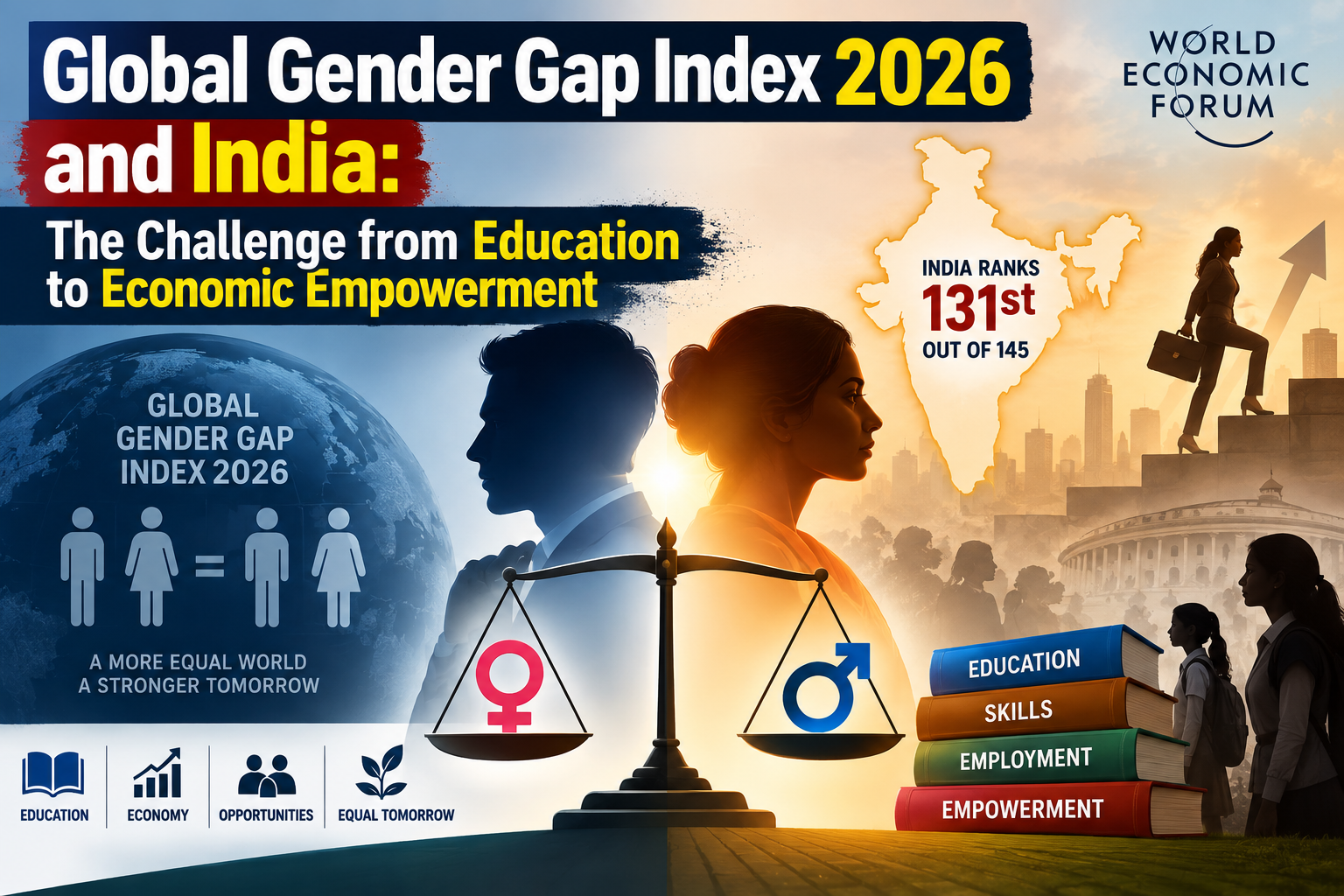
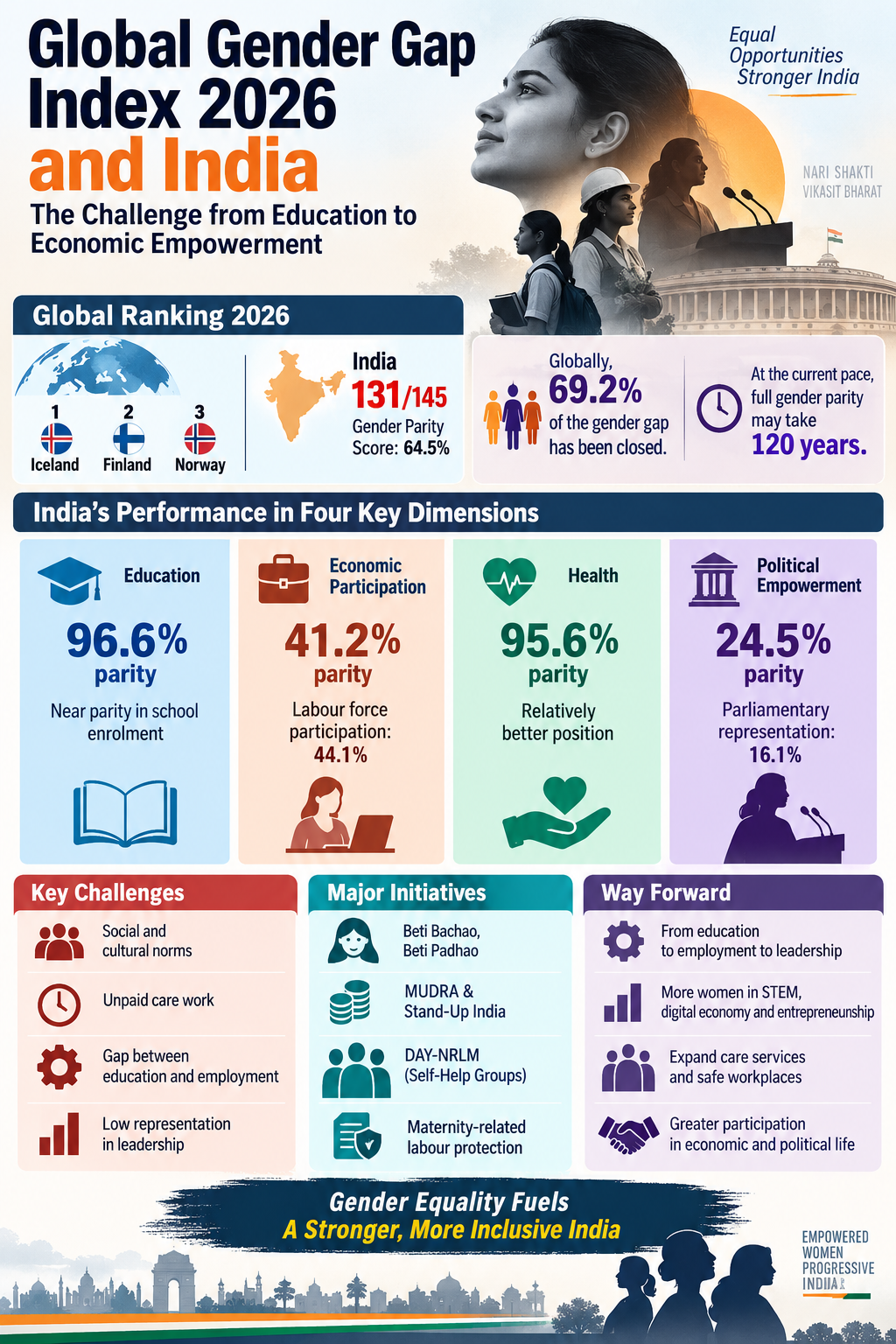
Recently, the World Economic Forum (WEF) released the Global Gender Gap Report 2026. India ranked 131st among 145 economies, while Iceland, Finland and Norway occupied the top three positions. Globally, 69.2% of the gender gap has been closed, but the World Economic Forum estimates that at the current pace, it may still take around 120 years to achieve complete gender parity.
-
-
- Published since 2006, the index measures the gap between women and men in terms of opportunities and outcomes across four key dimensions: Economic Participation and Opportunity, Educational Attainment, Health and Survival, and Political Empowerment.
- India ranked 131st with an overall gender parity score of 64.5%. Although India’s score has improved by 4.3 percentage points since 2006, its position indicates that transforming progress in education into equal participation in economic opportunities, leadership and decision-making remains a major challenge.
- Published since 2006, the index measures the gap between women and men in terms of opportunities and outcomes across four key dimensions: Economic Participation and Opportunity, Educational Attainment, Health and Survival, and Political Empowerment.
-
India’s Position in the Global Gender Gap Index 2026:
India’s performance is not uniform across all four dimensions. This is one of the most important aspects of the index.
-
-
- Education:
- India has achieved 96.6% gender parity in educational attainment. At the level of secondary and higher education enrolment, India has almost achieved parity. However, a gender gap still exists in adult literacy, where the level of parity stands at 82.5%.
- This represents an important achievement in India’s development. Over the past decades, initiatives related to girls’ education, school enrolment, scholarships, mid-day meals, sanitation facilities and social awareness have improved girls’ access to education.
- However, the challenge is that educational equality does not automatically translate into economic equality. If an educated woman is unable to enter the workforce or reach leadership positions, the economy cannot fully benefit from education as human capital. Therefore, India’s next challenge is not merely to ensure that girls reach school, but to build a complete pathway from “education to employment and employment to leadership.”
- India has achieved 96.6% gender parity in educational attainment. At the level of secondary and higher education enrolment, India has almost achieved parity. However, a gender gap still exists in adult literacy, where the level of parity stands at 82.5%.
- Economic Participation:
- India’s score in Economic Participation and Opportunity is only 41.2%. Gender parity in labour force participation stood at 44.1%. Meanwhile, parity in professional and technical occupations increased from 26.6% in 2006 to 49.9% in 2026. In contrast, gender parity in the share of legislators, senior officials and managers stood at only 13.1%.
- These figures highlight a fundamental challenge for India: although women’s educational attainment is improving, this progress is not being adequately translated into equal participation in employment and leadership.
- Therefore, women’s employment should not be viewed merely as an issue of social justice. It is also closely linked with economic growth, productivity and the demographic dividend.
- India’s score in Economic Participation and Opportunity is only 41.2%. Gender parity in labour force participation stood at 44.1%. Meanwhile, parity in professional and technical occupations increased from 26.6% in 2006 to 49.9% in 2026. In contrast, gender parity in the share of legislators, senior officials and managers stood at only 13.1%.
- Health:
- India recorded 95.6% gender parity in Health and Survival, indicating a relatively better position. However, the existing gap related to the sex ratio at birth shows that health equality cannot be understood merely in terms of the availability of healthcare services.
- Women’s health in India is influenced by nutrition, maternal health, anaemia among adolescent girls, sanitation, reproductive health and prevailing social norms. Therefore, achieving gender equality requires moving beyond a maternity-centric approach towards a life-cycle-based approach to women’s health.
- India recorded 95.6% gender parity in Health and Survival, indicating a relatively better position. However, the existing gap related to the sex ratio at birth shows that health equality cannot be understood merely in terms of the availability of healthcare services.
- Political Empowerment:
- In the area of Political Empowerment, India scored 24.5% and ranked 67th globally in this sub-index. Gender parity in parliamentary representation stood at 16.1%, while parity at the ministerial level was only 5.9%.
- Here too, numerical representation alone is not sufficient. Genuine political empowerment requires representation, decision-making power, leadership opportunities and influence over policymaking.
- Reservation for women in local bodies has expanded women’s political participation at the grassroots level. However, women’s representation remains limited at higher levels of politics.
- In this context, the Nari Shakti Vandan Adhiniyam, 2023 is significant. It provides a constitutional framework for one-third reservation for women in the Lok Sabha and State Legislative Assemblies. However, its implementation is linked to delimitation and the associated constitutional process.
- Political empowerment therefore requires not only constitutional provisions but also greater opportunities within political parties, electoral financing, leadership training and social acceptance.
- In the area of Political Empowerment, India scored 24.5% and ranked 67th globally in this sub-index. Gender parity in parliamentary representation stood at 16.1%, while parity at the ministerial level was only 5.9%.
- Education:
-
Major Reasons Behind India’s Current Position:
-
-
- Social and Cultural Norms: In several sections of Indian society, women are expected to bear the primary responsibility for household work and caregiving. This affects the continuity of their education, employment and careers.
- Unpaid Care Work: Women spend more time than men on household work, childcare, eldercare and other forms of unpaid care work. This directly affects their employment choices and participation in the labour market.
- Gap Between Education and Employment: India has increased girls’ access to school and higher education. However, ensuring that a sufficient number of women enter the labour market after education and remain in employment over the long term continues to be a challenge.
- Nature of Employment: A significant proportion of women in rural areas are engaged in agriculture and the informal sector. Such employment may involve challenges related to income, social security and workplace safety.
- Lack of Leadership Opportunities: Although women’s participation in professional and technical fields is increasing, their representation in senior management and decision-making positions remains considerably low.
- Social and Cultural Norms: In several sections of Indian society, women are expected to bear the primary responsibility for household work and caregiving. This affects the continuity of their education, employment and careers.
-
Major Initiatives for Gender Equality:
-
-
- Beti Bachao, Beti Padhao: Focuses on girls’ education and safety and addresses the issue of the declining child sex ratio.
- Pradhan Mantri MUDRA Yojana: Provides loans to women for starting small and micro enterprises.
- Stand-Up India: Provides institutional credit to women entrepreneurs for establishing greenfield enterprises.
- Deendayal Antyodaya Yojana- National Rural Livelihoods Mission (DAY-NRLM): Connects rural women with livelihoods, financial inclusion and self-employment through Self-Help Groups (SHGs).
- Maternity-related Labour Protection: Strengthens the rights of women workers through maternity leave and employment-related protections.
- Beti Bachao, Beti Padhao: Focuses on girls’ education and safety and addresses the issue of the declining child sex ratio.
-
Way Forward:
India needs to strengthen the entire chain from education to employment and employment to leadership for achieving gender equality. Along with increasing women’s participation in skill development, STEM, AI and the digital economy, safe and flexible employment opportunities must be provided. Expanding crèches, daycare and care services can reduce the burden of household responsibilities on women. Women’s entrepreneurship should be supported not only through credit but also through access to markets, technology and training. Increasing women’s ownership of assets and financial inclusion, along with ensuring their effective participation in political institutions, is also essential.
Conclusion:
The key message of the Global Gender Gap Index for India is that although the country has made significant progress in education, the pace of translating this progress into equal opportunities in economic independence, employment, leadership and decision-making remains inadequate. Instead of viewing women merely as beneficiaries, India needs to establish them as equal partners and decision-makers in economic activity, entrepreneurship, science, technology, administration and politics.
Ultimately, gender equality is not merely a women’s issue. It is a question of equal opportunity, social justice, human capital, productivity and inclusive development. If India wants to transform its demographic dividend into real economic strength, fully utilising women’s talent and workforce must remain a central component of its development strategy.



