

Context:
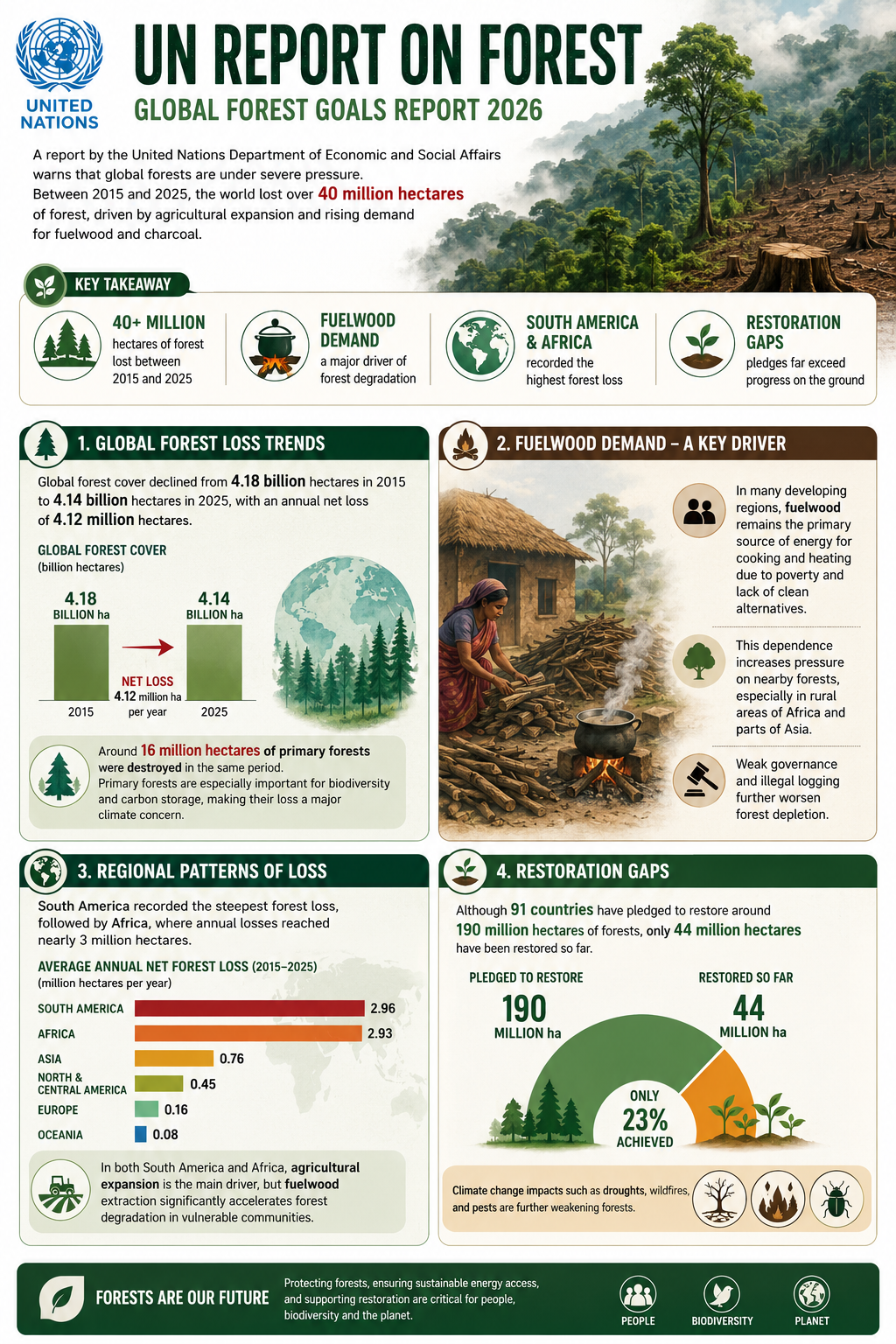
The recently released Global Forest Goals Report 2026 by the United Nations has warned the world about the deteriorating condition of forests. According to the report, the global forest area declined by approximately 40 million hectares between 2015 and 2025. One of the report’s most significant findings is that, in addition to agricultural expansion, the growing demand for fuelwood and charcoal has emerged as a major driver of forest degradation, particularly in developing regions of Africa and Asia.
-
-
- This finding comes at a time when forests are widely recognized as one of the most critical natural resources for addressing climate change, biodiversity conservation, and the achievement of Sustainable Development Goals (SDGs). For India and most countries across the world, this report is not merely an environmental concern but a comprehensive policy document linked to development, energy security, food security, and social justice.
- This finding comes at a time when forests are widely recognized as one of the most critical natural resources for addressing climate change, biodiversity conservation, and the achievement of Sustainable Development Goals (SDGs). For India and most countries across the world, this report is not merely an environmental concern but a comprehensive policy document linked to development, energy security, food security, and social justice.
-
Global Forest Goals Report 2026:
-
-
- The report is prepared by the United Nations Department of Economic and Social Affairs (UNDESA) and the United Nations Forum on Forests (UNFF). Its objective is to assess progress toward the six Global Forest Goals and 26 associated targets established under the United Nations Strategic Plan for Forests (2017–2030).
- These goals aim to promote forest conservation, restoration, and sustainable management worldwide while utilizing forests to address global challenges such as climate change and poverty.
- The report is prepared by the United Nations Department of Economic and Social Affairs (UNDESA) and the United Nations Forum on Forests (UNFF). Its objective is to assess progress toward the six Global Forest Goals and 26 associated targets established under the United Nations Strategic Plan for Forests (2017–2030).
-
Key Findings of the Report:
-
-
- Continued Decline in Global Forest Area: According to the report, the world's total forest area declined from 4.18 billion hectares in 2015 to 4.14 billion hectares in 2025. This means that nearly 40 million hectares of forest cover were lost within a decade, highlighting the limitations of global forest conservation efforts.
- Rapid Degradation of Primary Forests: The world lost approximately 16 million hectares of primary forests between 2015 and 2025. Primary forests are natural forests that have experienced minimal human disturbance. They are extremely important for biodiversity conservation, water regulation, and carbon storage. South America witnessed the highest loss of these forests.
- Agricultural Expansion Remains the Largest Driver: The conversion of forests into agricultural land continues to be the leading cause of deforestation globally. Rising food demand and commercial agricultural activities have significantly affected forest landscapes across the world.
- Growing Demand for Fuelwood and Charcoal: One of the report’s most notable findings is that energy poverty has forced millions of households in developing countries to continue relying on fuelwood and charcoal. As a result, immense pressure is being placed on forest resources. This challenge is particularly severe in Sub-Saharan Africa and parts of Asia.
- Increasing Impacts of Climate Change: Droughts, heatwaves, wildfires, pest infestations, and forest diseases are increasingly weakening forest ecosystems. Consequently, forests are gradually losing their capacity to function as effective carbon sinks.
- Slow Progress in Forest Restoration: A total of 91 countries pledged to restore nearly 190 million hectares of forest land, but by 2025, only 44 million hectares had been restored. This indicates that the pace of global forest restoration remains far below expectations.
- Continued Decline in Global Forest Area: According to the report, the world's total forest area declined from 4.18 billion hectares in 2015 to 4.14 billion hectares in 2025. This means that nearly 40 million hectares of forest cover were lost within a decade, highlighting the limitations of global forest conservation efforts.
-
Energy Poverty and the Forest Crisis: A New Perspective
-
-
- One of the most significant contributions of the Global Forest Goals Report 2026 is its recognition that forest degradation is not merely an environmental issue but is deeply connected to energy access and poverty.
- Many poor communities across the world continue to depend on wood for cooking and household energy needs. Under such circumstances, forest conservation laws alone cannot be fully effective unless alternative sources of clean energy are made available.
- Therefore, expanding access to LPG, biogas, solar energy, and clean cooking technologies is not only an energy policy measure but also a crucial strategy for forest conservation. This perspective reflects the integrated nature of the Sustainable Development Goals.
- One of the most significant contributions of the Global Forest Goals Report 2026 is its recognition that forest degradation is not merely an environmental issue but is deeply connected to energy access and poverty.
-
The Relationship Between Forest Conservation and Climate Change:
-
-
- Forests play a vital role in regulating the Earth’s temperature by absorbing carbon dioxide from the atmosphere. It is estimated that global forests absorb nearly one-third of the carbon emissions generated by human activities.
- However, when forests are destroyed, a double loss occurs. Not only is the carbon-absorbing capacity reduced, but the carbon stored in trees and soils is also released into the atmosphere. Consequently, forest conservation is regarded as one of the most effective natural strategies for climate change mitigation.
- Forests play a vital role in regulating the Earth’s temperature by absorbing carbon dioxide from the atmosphere. It is estimated that global forests absorb nearly one-third of the carbon emissions generated by human activities.
-
Implications for India:
India is among the countries that have sought to balance forest conservation with environmental commitments and developmental aspirations. The country has announced its goal of achieving net-zero emissions by 2070 and has emphasized increasing forest and tree cover to create additional carbon sinks.
Major Initiatives of India:
-
-
- Green India Mission (GIM): Launched in 2014 under the National Action Plan on Climate Change (NAPCC), the mission aims to enhance forest and tree cover while strengthening ecosystem resilience against climate change.
- National Afforestation Programme (NAP): Initiated in 2000, the programme seeks to rehabilitate degraded forest areas and promote community participation through Joint Forest Management Committees.
- CAMPA Fund (Compensatory Afforestation Fund Management and Planning Authority): The concept evolved following Supreme Court directives in 2002 and received a statutory basis through the Compensatory Afforestation Fund Act (CAF Act), 2016. Funds collected from the diversion of forest land for non-forest purposes are utilized for afforestation and forest conservation activities.
- Forest Conservation Act: Enacted in 1980, the Act aims to regulate the diversion of forest land for non-forest purposes and ensure forest protection. Significant amendments were introduced in 2023.
- Land Degradation Neutrality (LDN) Target: Under the United Nations Convention to Combat Desertification (UNCCD), India announced its commitment in 2019 to achieve Land Degradation Neutrality by 2030. The objective is to prevent land degradation while restoring degraded landscapes.
- Mission LiFE (Lifestyle for Environment): The concept was introduced by Prime Minister Modi at COP-26 in Glasgow in 2021 and formally launched in 2022. It seeks to promote environmentally sustainable lifestyles and responsible consumption patterns.
- Green India Mission (GIM): Launched in 2014 under the National Action Plan on Climate Change (NAPCC), the mission aims to enhance forest and tree cover while strengthening ecosystem resilience against climate change.
-
According to India's latest forest surveys, the country's forest and tree cover is gradually increasing. However, challenges related to forest quality, biodiversity conservation, and the protection of natural forests continue to persist.
Furthermore, fuelwood dependence remains prevalent in many rural and tribal regions. Therefore, integrating clean energy programmes with forest conservation strategies has become increasingly important.
Way Forward:
Achieving the global forest goals will require much more than tree plantation drives. A multidimensional strategy is essential:
-
-
- Stronger policies to prevent deforestation.
- Balanced land-use planning between agriculture and forestry.
- Universal access to clean energy.
- Greater participation of indigenous and local communities.
- Adequate financial resources for forest restoration programmes.
- Integration of biodiversity conservation and climate policies.
- Promotion of deforestation-free supply chains.
- Stronger policies to prevent deforestation.
-
Conclusion:
The Global Forest Goals Report 2026 makes it clear that forest conservation is not merely an environmental responsibility but a question linked to the future of human civilization. Forests are fundamental to climate stability, biodiversity conservation, water security, food security, and livelihoods. The report’s most important message is that the forest crisis cannot be viewed in isolation from poverty, energy access, development, and climate change. The challenge before India and the world is to move beyond the artificial dichotomy between development and environmental protection and adopt a model in which economic progress and ecological conservation advance together. The success of the 2030 Global Forest Goals will ultimately depend on this balanced and integrated approach.



