

Context:
Recently, Chief Justice of India (CJI) Surya Kant inaugurated statewide skill development centers, ITI-level vocational training modules, and polytechnic diploma courses in Haryana jails. This initiative marks a significant shift in the approach of Indian prisons, emphasizing rehabilitation, reform, and reintegration rather than a purely punitive model of incarceration. This initiative aligns with the United Nations Nelson Mandela Rules and modern approaches to correctional justice, which place a strong emphasis on equality, employability, and mental health.
The New Vision for Modern Prisons:
1. Technology and Digital Skills as the Core of Rehabilitation
-
-
- Prison training should reflect the “economy of tomorrow.” With rapid changes in the labour market, he argued that inmates must develop skills that hold relevance beyond prison walls—such as digital literacy, logistics management, and new-age vocational abilities.
- This shift signals a move away from traditional crafts taught in prisons toward high-value skills that increase employability. According to him, the goal is not just training but enabling real opportunities after release.
- Prison training should reflect the “economy of tomorrow.” With rapid changes in the labour market, he argued that inmates must develop skills that hold relevance beyond prison walls—such as digital literacy, logistics management, and new-age vocational abilities.
-
2. Industry Collaboration: Adopting Prisons for Apprenticeships
-
-
- A key proposal is encouraging deeper collaboration between prisons and private companies. The CJI suggested that industries could “adopt” prisons, offer apprenticeships, conduct training, and ultimately employ trained inmates.
- This model has the potential to break the stigma associated with hiring former prisoners while giving inmates structured work experience, steady income, and dignity.
- A key proposal is encouraging deeper collaboration between prisons and private companies. The CJI suggested that industries could “adopt” prisons, offer apprenticeships, conduct training, and ultimately employ trained inmates.
-
3. UK-Style Electronic Monitoring for Low-Risk Convicts
· One of his most striking suggestions draws from the United Kingdom’s system of electronically monitored convicts. Referring to work undertaken with a Bengaluru-based tech company, he noted that offenders can be allowed to stay at home within a defined radius, with their movements tracked through a chip and advanced software.
· This approach supports:
o Continued family life
o Emotional and financial stability
o Reduced psychological harm
o Better outcomes for children, who often suffer silently when a parent is incarcerated
· The model balances supervision with humanity, easing the harsh social consequences of incarceration.
4. Expansion of Open Prisons
· The CJI also called for creating more open prisons—low-security facilities where inmates live with minimal restrictions and engage in productive work. Open prisons have already shown success in Rajasthan and are internationally recognised for reducing recidivism, building responsibility, and boosting mental well-being.
Why Reformative Justice Matters:
-
-
- CJI Kant emphasised that reintegration is not an afterthought but central to a functional criminal justice system. When individuals leave prisons without education, skills, counselling, or community support, they face marginalisation, unemployment, and isolation—conditions that can push them back into crime.
- He noted that prisons, or “correctional homes,” should prevent—not deepen—disadvantages. Reformative justice, therefore, demands coordinated action, measurable outcomes, and institutions that focus on renewal rather than repeated incarceration.
- CJI Kant emphasised that reintegration is not an afterthought but central to a functional criminal justice system. When individuals leave prisons without education, skills, counselling, or community support, they face marginalisation, unemployment, and isolation—conditions that can push them back into crime.
-
Legal and Administrative Framework of Indian Prisons:
1. Constitutional Scheme
-
-
- Prisons fall under the State List (Entry 4, Seventh Schedule), making state governments primarily responsible for administration, infrastructure, and management of prisoners.
- However, the Union Ministry of Home Affairs (MHA) provides policy guidance, funding support, and model frameworks to promote uniform standards across states.
- Prisons fall under the State List (Entry 4, Seventh Schedule), making state governments primarily responsible for administration, infrastructure, and management of prisoners.
-
2. From Colonial Laws to Modern Legislation
For over a century, Indian prisons were governed by the Prisons Act, 1894, and state-specific prison manuals rooted in colonial ideas of control. To move beyond this outdated framework, the MHA introduced the Model Prisons and Correctional Services Act, 2023.
This new law:
-
-
-
- Replaces colonial provisions
- Integrates the Prisoners Act, 1900 and Transfer of Prisoners Act, 1950
- Encourages states to adopt modern, humane, and correction-focused principles
- Replaces colonial provisions
-
-
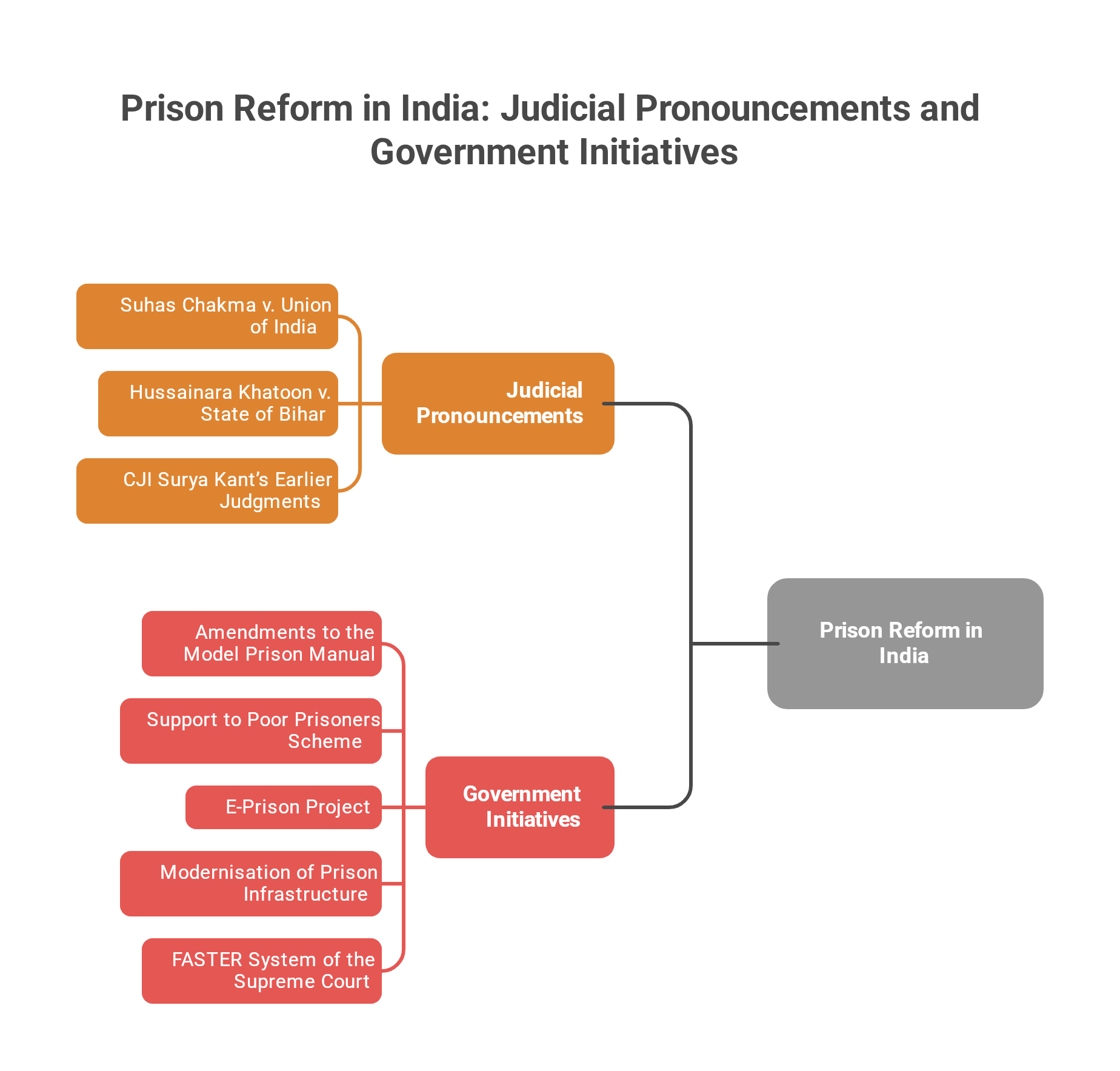
Judicial Pronouncements Shaping Prison Reform:
-
- Suhas Chakma v. Union of India (2024): The Supreme Court recognised open prisons as a viable solution to overcrowding and an important tool for rehabilitation.
- Hussainara Khatoon v. State of Bihar (1979): This landmark judgment established speedy trial as a fundamental right under Article 21, leading to the release of thousands of undertrial prisoners languishing in jails.
- CJI Surya Kant’s Earlier Judgments: In the Jasbir Singh case, he held that conjugal visits or artificial insemination for prisoners is part of their fundamental right, underscoring dignity even in custody.
- Suhas Chakma v. Union of India (2024): The Supreme Court recognised open prisons as a viable solution to overcrowding and an important tool for rehabilitation.
Recent Measures and Government Initiatives:
-
- Amendments to the Model Prison Manual (2016): Following directions of the Supreme Court in Sukanya Santha v. Union of India, the MHA amended rules to eliminate caste-based discrimination within prisons—an important step toward equality and humane treatment.
- Support to Poor Prisoners Scheme: Financial assistance is provided to help poor prisoners who cannot pay fines or secure bail due to economic constraints. This reduces unnecessary detention of indigent individuals.
- E-Prison Project: A nationwide digital system developed by NIC that maintains comprehensive prisoner records, streamlines management, and improves transparency.
- Modernisation of Prison Infrastructure: Funds are provided to upgrade security, surveillance, and technological tools in jails, matching modern standards.
- FASTER System of the Supreme Court: The Fast and Secured Transmission of Electronic Records (FASTER) ensures that bail orders reach prison authorities immediately, reducing delays in release.
- Amendments to the Model Prison Manual (2016): Following directions of the Supreme Court in Sukanya Santha v. Union of India, the MHA amended rules to eliminate caste-based discrimination within prisons—an important step toward equality and humane treatment.
Expert Committee Recommendations:
1. Principles Laid Down by the Supreme Court
Three core ideas must guide prison administration:
· A prisoner does not become a non-person
· A prisoner retains all human rights except those restricted by lawful imprisonment
· Suffering inherent in incarceration must not be aggravated by the state
2. Parliamentary Committee Suggestions
· Use technology such as trackable bracelets for monitoring out-on-bail offenders
· Renovate historic prisons and encourage heritage tourism
· Create Prison Development Funds for inmate welfare
3. Justice A.N. Mulla Committee
· Establish an All India Prisons & Correctional Service
· Make after-care, rehabilitation, and probation central to prison work
· Allow press and public inspections to promote transparency
· Minimise undertrials and keep them separate from convicts
4. Justice Amitava Roy Committee
· Set up fast-track courts for petty and long-pending cases
· Use video conferencing for producing elderly or sick prisoners
· Establish dedicated women’s prisons and welfare schemes for transgender inmates
· Ensure strict segregation of undertrials, first-time offenders, and convicts
The Way Forward: Building Prisons for the Future:
-
- Data-Driven Correctional Systems: The CJI emphasised tracking behavioural progress and post-release outcomes. Data helps evaluate what works, improve programmes, and reduce repeat offences.
- Humanised Punishment and Rehabilitation: The system should focus on dignity, mental health, counselling, and social reintegration. A humane environment reduces violence and supports transformation.
- Technology as an Enabler, Not a Threat: Electronic monitoring, digital skills, and smart administrative tools can modernise the system and create transparency.
- Industry and Community Partnerships: Employment is the strongest deterrent to reoffending. Stronger ties between prisons, industries, NGOs, and local communities can create sustainable support networks.
- Data-Driven Correctional Systems: The CJI emphasised tracking behavioural progress and post-release outcomes. Data helps evaluate what works, improve programmes, and reduce repeat offences.
Conclusion:
India’s correctional landscape is shifting toward a more humane and forward-looking approach. The Model Prisons Act, judicial pronouncements, and emerging technological interventions reflect a growing recognition that justice is not limited to punishment—it must uphold dignity, rights, and the possibility of change. If prisons are redesigned as centres of learning, skill-building, emotional healing, and community reintegration, they can break the cycle of crime and contribute meaningfully to society. The challenge now lies in implementing these ideas with consistency, compassion, and long-term commitment.
| UPSC/PCS Main Question: Examine the potential and challenges of integrating electronic monitoring systems, digital training, and data-driven rehabilitation tools in India’s correctional administration. |



