
Context:
Food security forms the foundation of any nation’s public health system, economic stability, and social welfare. In the wake of changing global food consumption patterns, rising population, increasingly complex supply chains, and the interconnected nature of international food trade, it has become clear that universal access to safe and high-quality food is not merely a moral obligation but also a policy priority.
-
- For a country like India, with a population approaching 1.4 billion, ensuring the availability of safe food and maintaining its quality is a prerequisite for sustainable development. In this context, the Ministry of Food Processing Industries’ recent move to invite proposals for establishing 100 NABL-accredited food testing laboratories and irradiation units marks a significant, forward-looking, and structural reform. The government has approved a financial outlay of ₹500 crore for this initiative, making it a substantial investment in strengthening the country’s food quality testing infrastructure.
- For a country like India, with a population approaching 1.4 billion, ensuring the availability of safe food and maintaining its quality is a prerequisite for sustainable development. In this context, the Ministry of Food Processing Industries’ recent move to invite proposals for establishing 100 NABL-accredited food testing laboratories and irradiation units marks a significant, forward-looking, and structural reform. The government has approved a financial outlay of ₹500 crore for this initiative, making it a substantial investment in strengthening the country’s food quality testing infrastructure.
Food Security: A Multidimensional Challenge:
-
- Food security is not limited to availability and accessibility; it also encompasses the nutritional quality, safety, standards, and consumer protection associated with food. In India, persistent issues such as food contamination, adulteration, pesticide residues, chemical preservatives, mislabeling, and weak surveillance across the supply chain continue to pose challenges.
- The rising demand for packaged and processed foods in urban areas and the lack of standardization in traditional food products in rural regions make robust food testing imperative.
- A well-established network of food testing laboratories enhances the operational effectiveness of the Food Safety and Standards Authority of India (FSSAI). Without scientific testing and surveillance, consumer protection, global food trade competitiveness, and public health security remain significantly compromised.
- Food security is not limited to availability and accessibility; it also encompasses the nutritional quality, safety, standards, and consumer protection associated with food. In India, persistent issues such as food contamination, adulteration, pesticide residues, chemical preservatives, mislabeling, and weak surveillance across the supply chain continue to pose challenges.
Role of Laboratories in the National Food Safety Framework:
· Food testing laboratories are the backbone of the food safety system. Their key functions include:
1. Testing chemical, biological, and physical purity of food products
2. Verification of food products as per prescribed standards
3. Detection of harmful adulterants, toxic substances, and microbial contamination
4. Providing quality improvement guidance to industries and manufacturers
5. Supporting export certification processes aligned with global food standards
-
- NABL (National Accreditation Board for Testing and Calibration Laboratories) accreditation ensures that these laboratories follow internationally recognized quality management systems.
- The establishment of 100 new laboratories will expand the country’s testing capacity, ensure food safety even in geographically remote and underserved regions, reduce delays in sample analysis, and ultimately save time and resources for the food industry.
- NABL (National Accreditation Board for Testing and Calibration Laboratories) accreditation ensures that these laboratories follow internationally recognized quality management systems.
Incentives for the Food Industry:
The government’s allocation of ₹500 crore provides opportunities for industries, start-ups, research institutions, private organizations, and state governments. This financial assistance will particularly support:
1. Establishment of Modern Testing Equipment
-
- Chromatography
- Microbiology analyzers
- Toxicology testing tools
- Nano-analysis instruments
- Chromatography
2. Availability of Skilled Human Resources
-
- Food technologists
- Laboratory analysts
- Quality assurance experts
- Food technologists
3. Infrastructure Aligned with International Standards
-
- Advanced equipment
- Standardized procedures
- Adoption of global quality protocols to ensure world-class testing capacities
- Advanced equipment
4. Establishment of Irradiation Units
-
- To enhance shelf life
- To ensure microbial safety
- To meet export compliance requirements
- To enhance shelf life
This investment will allow India to emerge as a hub for high-quality food processing, increase farm income, improve MSME competitiveness, and significantly boost export potential.
Food Irradiation:
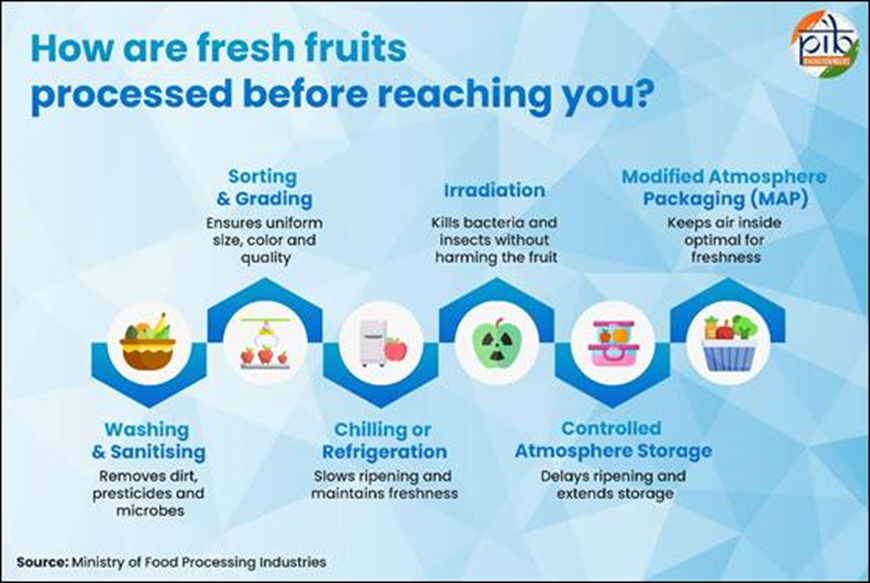
Public skepticism regarding food irradiation remains a major challenge. Many assume irradiated food becomes “radioactive” or harmful, whereas scientific research proves otherwise. Controlled irradiation:
-
- Preserves food quality
- Removes microbial contamination
- Eliminates mold and pest risks
- Extends shelf life
- Preserves food quality
FAO, WHO, and IAEA recognize it as a safe and effective technology.
Thus, the government’s support for establishing irradiation facilities will offer structural benefits to farmers, exporters, and the food processing industry.
|
What is Food Irradiation? Food irradiation involves exposing fruits and vegetables to a controlled dose of ionizing radiation that destroys bacteria, molds, and insects without making the food radioactive or unsafe. Three radiation sources, Gamma rays, X-rays, Electron beams (E-beam), are used depending on the application. |
Why This Initiative Matters?
1. Accelerates the Goals of the Food Safety Act, 2006
FSSAI standards cannot be effectively enforced without a strong laboratory network.
2. Strengthens Consumer Protection
Food adulteration complaints have been increasing; enhanced testing capacity will help curb violations.
3. Enhances Export Competitiveness
Global markets demand strict food certification standards.
Regions with stringent regulations include:
· European Union
· United States
· Gulf Nations
4. Boosts MSME and Start-up Ecosystem
Most Indian food processing units are MSMEs, which lack resources to set up private labs.
5. Ensures Food Safety in Remote Regions
Northeast India, hilly states, and tribal areas suffer from poor lab access, delaying testing and enforcement.
6. Promotes Scientific Research
Universities and research institutions will gain access to advanced testing facilities.
Potential Challenges and Corrective Measures:
For any policy reform to succeed, underlying structural issues must be resolved. Key challenges include:
1. Shortage of skilled manpower
Operating high-end equipment requires specialized training.
2. Uneven distribution of laboratory infrastructure across states
3. Low participation by small industries
Large industries can invest, but MSMEs require greater support.
4. Long-term operational sustainability
Merely establishing labs is insufficient; consistent functioning is critical.
Suggested Reforms
-
- Develop state-level food lab cluster models
- Strengthen Public–Private Partnership (PPP) for lab management
- Enhance regulatory transparency through digital governance
- Launch skill-development programs for laboratory technicians
- Develop state-level food lab cluster models
Conclusion:
India is among the world’s leading agricultural producers, yet its food safety and quality assurance systems still require significant strengthening. The initiative to establish 100 NABL-accredited laboratories and irradiation units is not just an infrastructural expansion—it is a decisive intervention in food governance, agricultural economics, consumer protection, and global trade enhancement. This step will make India’s food industry more competitive internationally, strengthen public health systems, and advance the national goal of making safe, high-quality food accessible to all citizens. India stands at a juncture where food security is no longer confined to availability; it now encompasses the right to safe and high-quality food. The government’s investment of ₹500 crore in new labs and irradiation units is a transformative milestone in India’s development journey.
| UPSC/PCS Mains Question: The Government of India’s initiative to establish food testing laboratories and irradiation units represents a significant policy intervention in strengthening food quality governance. Critically analyze its key benefits, potential challenges, and wider socio-economic implications. |



