
Context:
The role of the Election Commission of India (ECI) is extremely important in ensuring the integrity, fairness and credibility of Indian democracy. In recent months, reports of differences between the Chief Election Commissioner (CEC) and other Election Commissioners have emerged over issues related to SIR, Form 6, ECINet and internal decision-making processes. This development is linked to broader constitutional questions concerning free and fair elections in India, the accuracy of electoral rolls, institutional transparency and the autonomy of the Election Commission.
Constitutional Framework:
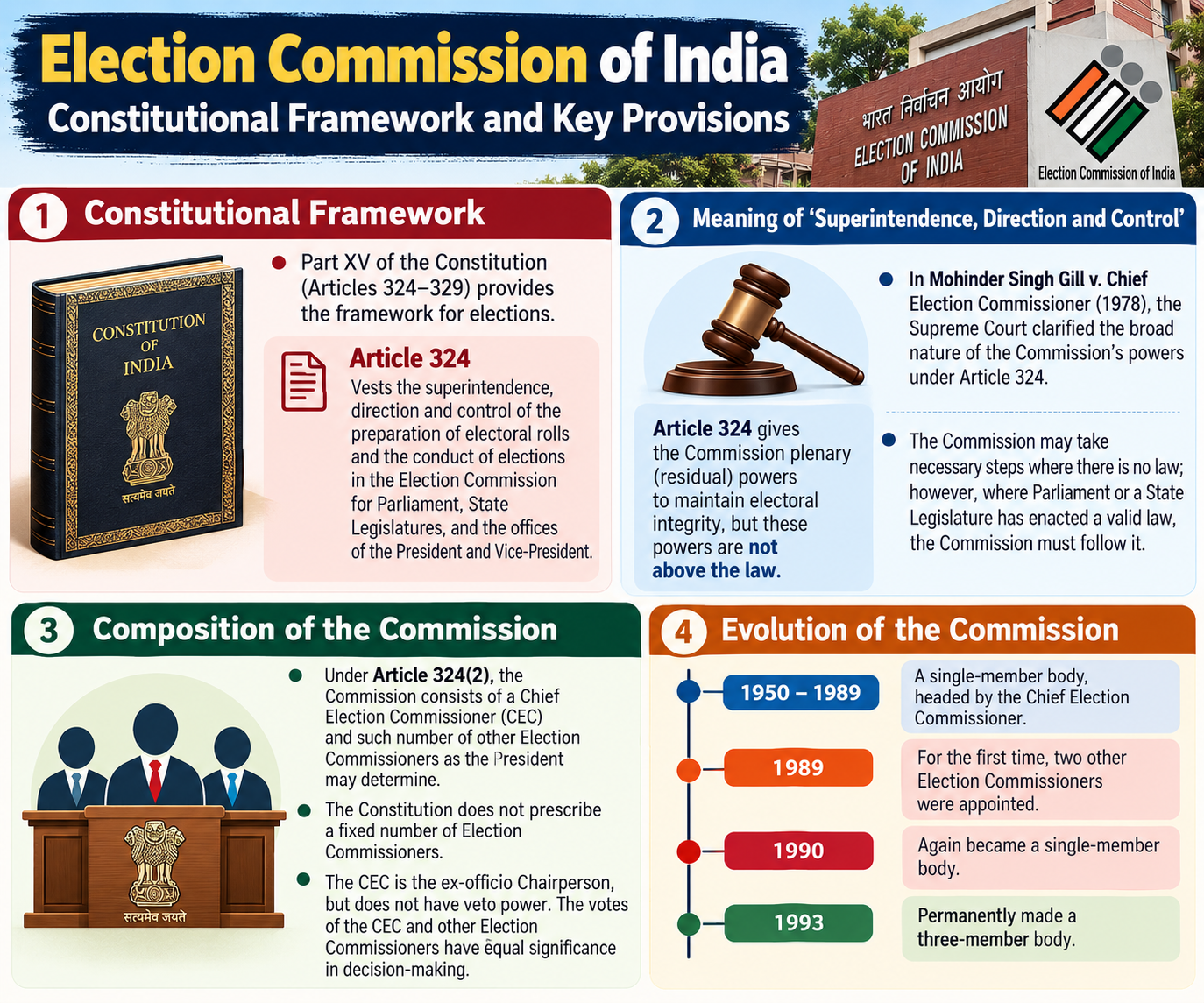
Part XV of the Constitution (Articles 324–329) provides for the constitutional framework relating to elections. Under Article 324, the Election Commission has been entrusted with the “superintendence, direction and control” of the preparation of electoral rolls and the conduct of elections to Parliament, State Legislatures, and the offices of the President and Vice-President.
Meaning of ‘Superintendence, Direction and Control’:
-
-
- The Supreme Court, in Mohinder Singh Gill v. Chief Election Commissioner (1978), clarified the broad nature of the powers of the Election Commission under Article 324. The Commission may have the constitutional power to take necessary steps in circumstances where there is no law; however, these powers are not unlimited. Where Parliament or a State Legislature has enacted a valid law, the Commission is required to follow it.
- Thus, Article 324 gives the Commission plenary/residual powers to maintain electoral integrity, but these powers are not above the law.
- The Supreme Court, in Mohinder Singh Gill v. Chief Election Commissioner (1978), clarified the broad nature of the powers of the Election Commission under Article 324. The Commission may have the constitutional power to take necessary steps in circumstances where there is no law; however, these powers are not unlimited. Where Parliament or a State Legislature has enacted a valid law, the Commission is required to follow it.
-
Composition of the Commission:
-
-
- According to Article 324(2), the Election Commission shall consist of a Chief Election Commissioner and such number of other Election Commissioners as the President may from time to time determine. Thus, the Constitution does not prescribe a fixed number of Election Commissioners.
- From 1950 to 1989, the Election Commission of India was essentially a single-member body, headed by the Chief Election Commissioner.
- 1989: For the first time, two other Election Commissioners were appointed.
- 1990: The Commission again became a single-member body.
- 1993: The Election Commission was permanently made a three-member body.
- 1989: For the first time, two other Election Commissioners were appointed.
- The CEC is the ex-officio Chairperson of the Commission, but does not have veto power. The votes of the CEC and other Election Commissioners have equal institutional significance in decision-making. The basic objective of the multi-member arrangement was to prevent excessive concentration of power in a single individual and maintain checks and balances.
- According to Article 324(2), the Election Commission shall consist of a Chief Election Commissioner and such number of other Election Commissioners as the President may from time to time determine. Thus, the Constitution does not prescribe a fixed number of Election Commissioners.
-
Recent Internal Differences:
According to recent reports, differences between the CEC and other Election Commissioners have mainly emerged over procedures related to SIR, Form 6 and ECINet.
-
-
- SIR: The objective of the Special Intensive Revision is to remove dead, duplicate and ineligible entries from electoral rolls while retaining eligible voters. However, concerns have been raised regarding the possibility of exclusion of eligible voters due to documentary verification requirements.
- Physical Hearings: During SIR, several voters were required to receive notices and undergo document verification. Under the reforms, emphasis has been placed on BLOs collecting documents at voters’ homes and on personal hearings only in exceptional cases. The key challenge is to balance the accuracy of electoral rolls with voter convenience.
- Form 6: Questions have been raised regarding the additional Declaration introduced in Form 6 related to the registration of new voters. Therefore, the change needs to be examined from the perspective of legal validity, administrative procedure and voter convenience.
- ECINet: Concerns have emerged regarding the role of field officials following its centralisation. According to the ECI, role-based access and expert review are being used to ensure accountability. The issue is about balancing digital efficiency, legal accountability and data transparency.
- SIR: The objective of the Special Intensive Revision is to remove dead, duplicate and ineligible entries from electoral rolls while retaining eligible voters. However, concerns have been raised regarding the possibility of exclusion of eligible voters due to documentary verification requirements.
-
Judicial Intervention: Anoop Baranwal Case, 2023
-
-
- The most significant judicial intervention concerning the independence of the Election Commission came in Anoop Baranwal v. Union of India (2023).
- The main question before the Court was why, despite Article 324(2) of the Constitution, Parliament had not established a comprehensive statutory mechanism for the appointment of Election Commissioners for a long period.
- On 2 March 2023, a five-judge Constitution Bench held that free and fair elections are part of the basic structure of the Constitution and that the Election Commission should be free from exclusive executive control in matters relating to appointments.
- Until Parliament enacted a law, the Court prescribed an interim arrangement for appointments:
- Prime Minister
- Leader of the Opposition in the Lok Sabha
- Chief Justice of India
- Prime Minister
- This arrangement was interim, meaning that it was to remain in force until Parliament enacted a law.
- Parliament enacted the Chief Election Commissioner and Other Election Commissioners Act, 2023, replacing the Chief Justice of India with a Union Cabinet Minister in the Selection Committee.
- The most significant judicial intervention concerning the independence of the Election Commission came in Anoop Baranwal v. Union of India (2023).
-
Thus, the Committee has two members from the executive. This arrangement is now again at the centre of judicial scrutiny.
Current Developments in 2026:
On 23 September 2026, differences emerged between two judges of a Supreme Court Bench over whether the petitions challenging the 2023 law should be referred to a Constitution Bench. The two judges expressed separate views, and ultimately the matter was referred to the Chief Justice of India for consideration regarding the constitution of an appropriate Constitution Bench. Importantly, the Supreme Court did not declare the 2023 law unconstitutional on 23 September 2026. The final decision on the constitutional validity of the law is still pending.
Electoral Reform Committees and Their Major Recommendations:
-
-
- Dinesh Goswami Committee, 1990: The Committee recommended several measures to make the Election Commission more independent and effective, including a multi-member Election Commission, wider consultation in the appointment of the CEC, a role for the CEC in the appointment of other ECs, expansion of EPIC, phased use of EVMs, and stronger measures against booth capturing. However, it would not be appropriate to equate these recommendations with the interim PM–LoP–CJI committee prescribed in the Anoop Baranwal case, as the institutional designs of the two were different.
- Tarkunde Committee: The Committee emphasised making the appointment process of the Election Commission more independent, transparent and consultative. Its main objective was to reduce excessive executive influence in appointments.
- Law Commission’s 255th Report, 2015: The Law Commission recommended wider consultation in the appointment of the CEC and other Election Commissioners, greater institutional protection for all Election Commissioners, consideration of extending the same removal protection available to the CEC to other Election Commissioners, and a more independent administrative structure for the Election Commission. The broader objective of all these recommendations is to strengthen the independence, impartiality and institutional autonomy of the Election Commission.
- Dinesh Goswami Committee, 1990: The Committee recommended several measures to make the Election Commission more independent and effective, including a multi-member Election Commission, wider consultation in the appointment of the CEC, a role for the CEC in the appointment of other ECs, expansion of EPIC, phased use of EVMs, and stronger measures against booth capturing. However, it would not be appropriate to equate these recommendations with the interim PM–LoP–CJI committee prescribed in the Anoop Baranwal case, as the institutional designs of the two were different.
-
Way Forward:
-
-
- Strengthening the institutional independence and credibility of the Election Commission requires reforms in the appointment process, constitutional safeguards, administrative autonomy and digital systems. First, considering the 2:1 executive influence in the 2023 Selection Committee, a balanced arrangement should be considered in which the roles of the government, opposition and independent institutions are better balanced. However, the potential institutional concerns associated with involving the judiciary in the appointment process must also be considered.
- The difference in removal protection between the CEC and other Election Commissioners should be reduced so that Commissioners can independently express dissent and take decisions. At the same time, an independent Election Commission Secretariat can strengthen administrative, financial and operational autonomy.
- Independent technical and cybersecurity audits of digital systems such as ECINet, along with data protection, algorithmic accountability and audit trails, should be ensured. Technical efficiency should not become a substitute for legal accountability.
- Finally, under SIR, a balance between the accuracy of electoral rolls and voter inclusion is essential. Along with removing ineligible names, it must be ensured that no eligible citizen is deprived of the right to vote because of procedural difficulties. This represents the fundamental spirit of democratic elections.
- Strengthening the institutional independence and credibility of the Election Commission requires reforms in the appointment process, constitutional safeguards, administrative autonomy and digital systems. First, considering the 2:1 executive influence in the 2023 Selection Committee, a balanced arrangement should be considered in which the roles of the government, opposition and independent institutions are better balanced. However, the potential institutional concerns associated with involving the judiciary in the appointment process must also be considered.
-
Conclusion:
Elections in India are not merely a process of voting; they are the foundation of democratic legitimacy. Therefore, both the accuracy of electoral rolls and the rights of voters must be given equal importance. Processes such as SIR can play an important role in enhancing the credibility of electoral rolls, but they must be conducted in accordance with the principles of legal clarity, due process, transparency and citizen convenience. Similarly, digital systems such as ECINet can make election management more effective, but they must be accompanied by independent technical audits, data security and accountability. Ultimately, the institutional independence of the Election Commission will be strengthened not merely by its constitutional powers, but through a fair appointment process, secure tenure, equal constitutional protection, internal collegiality, administrative autonomy, technological transparency and protection of voter rights.



