
Context:
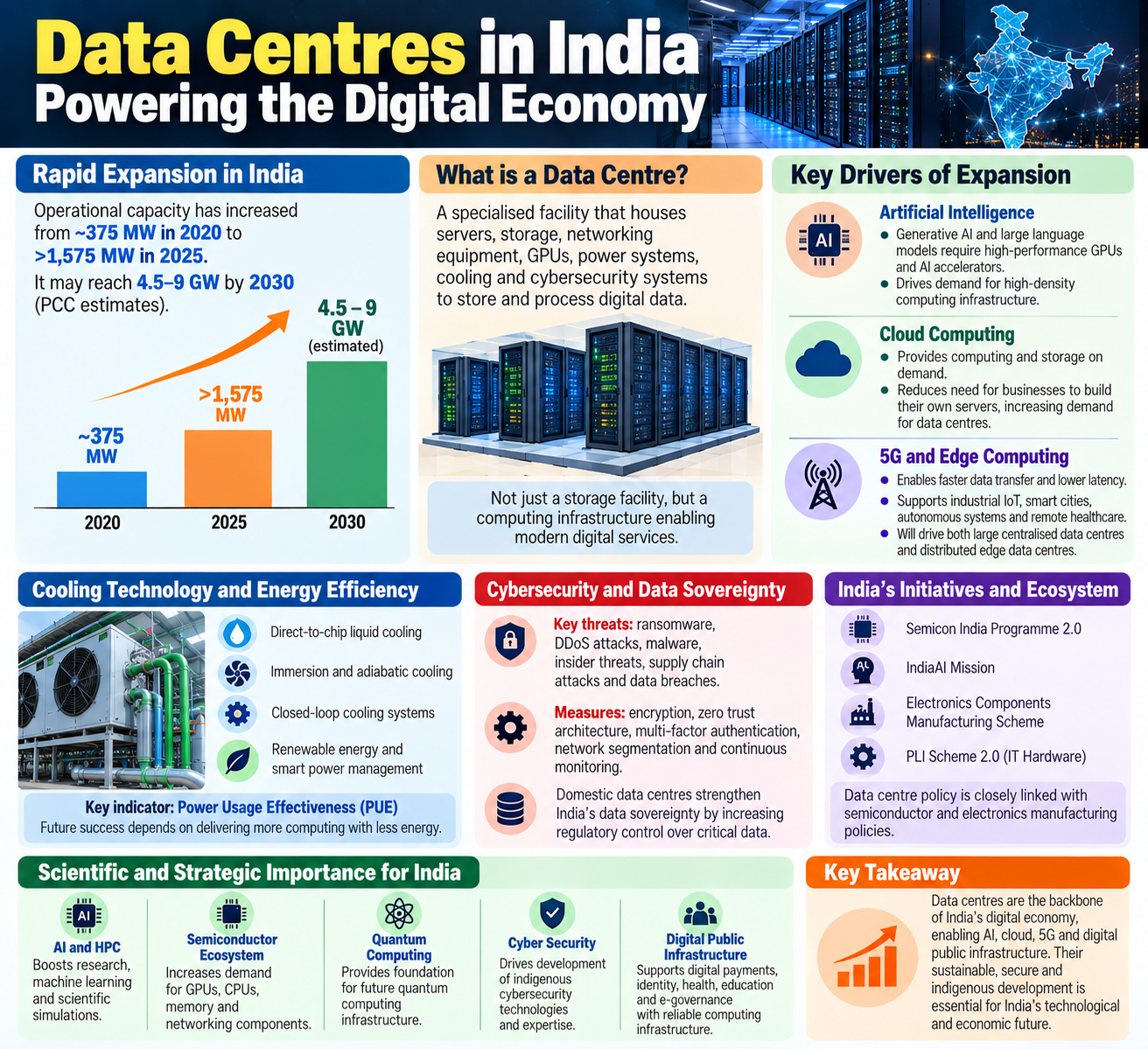
With the rapid expansion of digital technologies in India, Data Centres are emerging as an important scientific and technological infrastructure of the modern digital economy. Recently, the independent research organisation Policy Consensus Centre (PCC) stated that India’s operational data centre capacity increased from around 375 megawatts in 2020 to more than 1,575 megawatts in 2025. According to PCC, this capacity could reach 4.5–9 gigawatts by 2030.
-
-
- According to the Government of India, as of August 2026, the country’s installed data centre capacity had reached approximately 1.57 gigawatts. This expansion is mainly being driven by the growing use of Artificial Intelligence (AI), cloud computing, 5G, Internet of Things (IoT), Digital Public Infrastructure and data localisation.
- Therefore, it would be more appropriate to understand data centres not merely as facilities for data storage and processing, but as the core of modern technological infrastructure that enables AI, cloud computing, semiconductors, cybersecurity and digital services.
- According to the Government of India, as of August 2026, the country’s installed data centre capacity had reached approximately 1.57 gigawatts. This expansion is mainly being driven by the growing use of Artificial Intelligence (AI), cloud computing, 5G, Internet of Things (IoT), Digital Public Infrastructure and data localisation.
-
Data Centres: The Physical Backbone of the Digital Economy
-
-
- A data centre is a specially designed facility where servers, storage, networking equipment, GPUs, power systems, cooling systems and cybersecurity systems store and process digital data.
- The computing resources present in data centres work behind every digital payment, e-governance service and AI-based query. Generally, processing a digital request, or advanced applications such as AI, requires large amounts of data and high-capacity computing. Therefore, data centres are not merely storage facilities for modern digital services, but computing infrastructure.
- A data centre is a specially designed facility where servers, storage, networking equipment, GPUs, power systems, cooling systems and cybersecurity systems store and process digital data.
-
AI, Cloud and 5G: Major Drivers of Data Centre Expansion
-
-
- To understand the demand for data centres in India, three technological changes are particularly important: AI, cloud computing and 5G.
- Artificial Intelligence: The training and operation of Generative AI and Large Language Models require significantly more GPUs and AI accelerators compared to conventional computing. This is increasing the demand for high-density computing.
- Cloud Computing: Cloud computing has enabled the use of computing and storage resources according to requirements. This has reduced the need for businesses to develop expensive server infrastructure of their own and has increased the demand for data centres.
- 5G and Edge Computing: 5G and edge computing enable faster data transfer and lower latency. This promotes applications such as Industrial IoT, smart cities, autonomous systems and remote healthcare.
- Artificial Intelligence: The training and operation of Generative AI and Large Language Models require significantly more GPUs and AI accelerators compared to conventional computing. This is increasing the demand for high-density computing.
- For many of these services, processing data closer to the user is more effective than sending it to a distant data centre. This is the concept of edge computing. Therefore, in the future, India may witness the expansion of distributed edge data centres along with large centralised data centres.
- To understand the demand for data centres in India, three technological changes are particularly important: AI, cloud computing and 5G.
-
Rapid Expansion of Data Centres in India:
-
-
- The development of data centres in India has accelerated rapidly with digital transformation. The National Informatics Centre (NIC) operates National Data Centres in New Delhi, Pune, Hyderabad and Bhubaneswar. Alongside this, large hyperscale and cloud data centres are also being developed in the private sector. The most important technological factor driving demand for data centres in India is AI.
- AI-based data centres require high-capacity GPUs, CPUs, memory, networking equipment and power electronics. Therefore, data centre policy cannot be viewed separately from semiconductor and electronics manufacturing policies.
- In this direction, initiatives such as the Semicon India Programme 2.0, IndiaAI Mission, Electronics Components Manufacturing Scheme and PLI Scheme 2.0 for IT Hardware are important for strengthening India’s digital-industrial ecosystem. From this perspective, these initiatives can help India become not only a consumer of digital services but also a producer of diverse and AI technologies.
- The development of data centres in India has accelerated rapidly with digital transformation. The National Informatics Centre (NIC) operates National Data Centres in New Delhi, Pune, Hyderabad and Bhubaneswar. Alongside this, large hyperscale and cloud data centres are also being developed in the private sector. The most important technological factor driving demand for data centres in India is AI.
-
Cooling Technology and Energy Efficiency in Data Centres:
-
-
- Due to AI and high-performance computing, the computing capacity and energy density of servers are increasing. Along with this, the heat generated by servers is also increasing. Therefore, heat management has become an important technological challenge for data centres.
- Along with traditional air cooling, new technologies are increasingly being used, such as Direct-to-Chip Liquid Cooling, Immersion Cooling, Adiabatic Cooling and Closed-Loop Cooling, which aim to achieve better heat management with lower energy and water consumption.
- Along with this, smart power management, renewable energy, energy storage and AI-based cooling optimisation need to be promoted in data centres.
- Here, Power Usage Effectiveness (PUE) is an important indicator that helps in understanding the energy efficiency of a data centre.
- Thus, the technological success of future data centres will not only depend on higher computing capacity, but also on providing more computing with lower energy consumption.
- Due to AI and high-performance computing, the computing capacity and energy density of servers are increasing. Along with this, the heat generated by servers is also increasing. Therefore, heat management has become an important technological challenge for data centres.
-
Cybersecurity and Data Sovereignty:
-
-
- Large amounts of financial, health, government and business data are stored in data centres. Therefore, they are critical infrastructure for national cybersecurity. Major threats include ransomware, DDoS attacks, malware, insider threats, supply chain attacks and data breaches. To address these threats, technologies such as encryption, Zero Trust Architecture, multi-factor authentication, network segmentation and continuous monitoring are required.
- At the same time, domestic data centres can strengthen India’s data sovereignty. This increases India’s regulatory control over the storage and processing of critical data.
- However, data localisation alone is not sufficient. Along with it, data protection, cybersecurity and responsible data governance are also essential.
- Large amounts of financial, health, government and business data are stored in data centres. Therefore, they are critical infrastructure for national cybersecurity. Major threats include ransomware, DDoS attacks, malware, insider threats, supply chain attacks and data breaches. To address these threats, technologies such as encryption, Zero Trust Architecture, multi-factor authentication, network segmentation and continuous monitoring are required.
-
Scientific and Technological Significance for India:
The development of data centres can accelerate several emerging technologies in India.
-
-
- AI and High-Performance Computing: Adequate computing infrastructure in the country can promote AI research, machine learning and scientific simulations.
- Semiconductor Ecosystem: The growing demand for GPUs, CPUs, memory and networking components for data centres can encourage the domestic electronics and semiconductor industry.
- Quantum Computing: In the future, quantum computing will require specialised computing and cooling infrastructure. Therefore, the current data centre capacity can become the foundation of an advanced computing ecosystem of the future.
- Cybersecurity: Securing critical digital infrastructure will encourage the development of indigenous cybersecurity technologies and expertise in India.
- Digital Public Infrastructure: Data centres provide reliable computing support to India’s Digital Public Infrastructure, including digital payments, identity, healthcare, education and e-governance.
- AI and High-Performance Computing: Adequate computing infrastructure in the country can promote AI research, machine learning and scientific simulations.
-
Major Challenges:
India faces some important technological challenges in the data centre sector:
-
-
- Dependence on imports for high-capacity GPUs, advanced processors and other critical components.
- Increasing energy and cooling requirements due to AI-based high-density computing.
- Growing cyberattacks on sensitive digital infrastructure.
- E-waste generated due to rapidly changing technology.
- Dependence on imports for high-capacity GPUs, advanced processors and other critical components.
-
Way Forward:
India should adopt an integrated and technology-driven approach for the development of data centres. This should include:
-
-
- Data centres should be linked with Artificial Intelligence, semiconductors and electronics manufacturing.
- Domestic manufacturing of GPUs, servers and networking equipment should be promoted.
- Technologies such as liquid cooling and AI-based energy efficiency should be adopted.
- Renewable energy and energy storage should be expanded.
- Strong standards for cybersecurity and disaster recovery should be developed.
- Edge computing and advanced digital infrastructure should be expanded.
- Skilled technical human resources should be developed for Artificial Intelligence, cloud computing and cybersecurity.
- Data centres should be linked with Artificial Intelligence, semiconductors and electronics manufacturing.
-
Conclusion:
-
-
- Data centres are not merely facilities for storing digital data, but the scientific and technological backbone connecting AI, cloud computing, 5G, semiconductors, cybersecurity and Digital Public Infrastructure. Their expansion in India can accelerate the country’s digital economy while also strengthening technological self-reliance and strategic capabilities.
- However, future success will depend not only on increasing the installed capacity of data centres, but on providing greater computing power with lower energy consumption, lower water use and higher security. For Viksit Bharat @2047, data centres can become not merely digital infrastructure but the foundation of India’s next-generation scientific and technological capabilities.
- Data centres are not merely facilities for storing digital data, but the scientific and technological backbone connecting AI, cloud computing, 5G, semiconductors, cybersecurity and Digital Public Infrastructure. Their expansion in India can accelerate the country’s digital economy while also strengthening technological self-reliance and strategic capabilities.
-



