
Context:
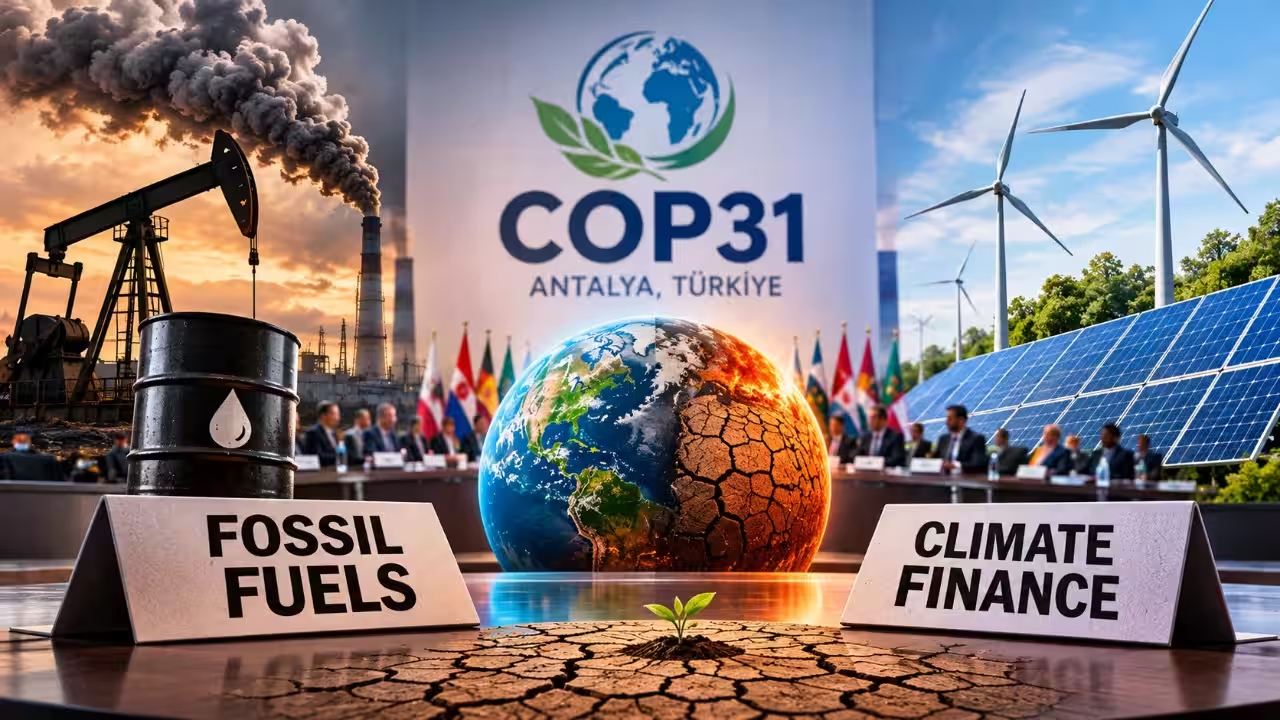
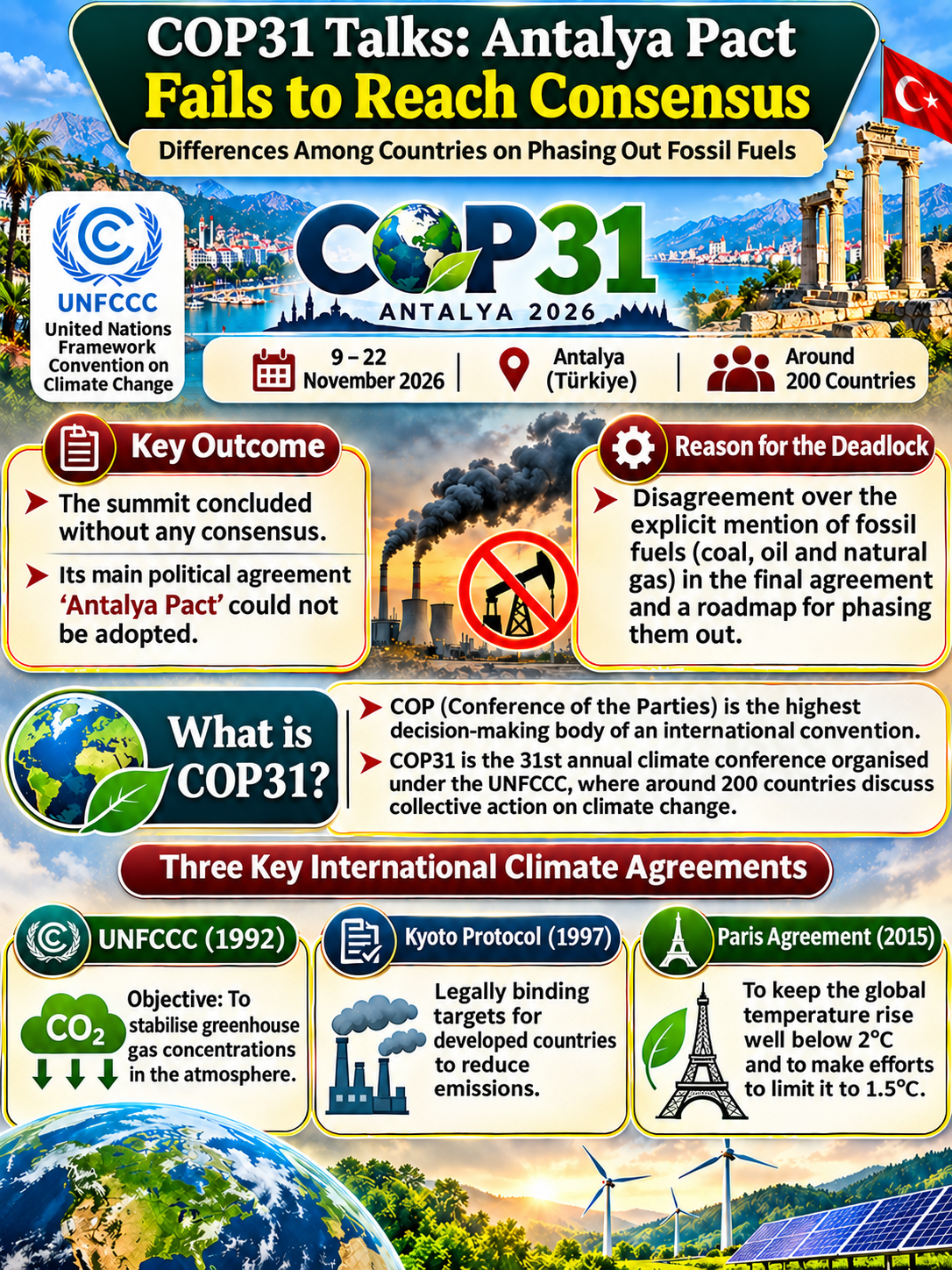
Recently, the 31st Conference of the Parties (COP31) to the United Nations Framework Convention on Climate Change (UNFCCC) was held in Antalya, Turkey, from 9 to 22 November 2026. The conference ended without reaching consensus on its main political agreement, known as the Antalya Pact. The primary reason behind the failure was disagreement among countries over whether the final agreement should explicitly mention fossil fuels and establish a roadmap for transitioning away from coal, oil and natural gas.
About COP31:
-
-
- COP stands for Conference of the Parties, which is the supreme decision-making body of an international convention. COP31 is the 31st annual climate conference organised under the UNFCCC, bringing together nearly 200 countries to negotiate collective responses to climate change. The conference was held in Antalya, Türkiye, in November 2026, with Türkiye hosting the conference and Australia playing a key role in the negotiation process.
- To understand the importance of COP31, it is necessary to understand three major international climate agreements. The United Nations Framework Convention on Climate Change (UNFCCC), adopted in 1992, aims to stabilise greenhouse gas concentrations in the atmosphere. The Kyoto Protocol, adopted in 1997, established legally binding emission reduction targets for developed countries. Subsequently, the Paris Agreement, adopted in 2015, established the objective of keeping global warming well below 2°C above pre-industrial levels while pursuing efforts to limit the temperature increase to 1.5°C.
- COP stands for Conference of the Parties, which is the supreme decision-making body of an international convention. COP31 is the 31st annual climate conference organised under the UNFCCC, bringing together nearly 200 countries to negotiate collective responses to climate change. The conference was held in Antalya, Türkiye, in November 2026, with Türkiye hosting the conference and Australia playing a key role in the negotiation process.
-
Key reasons for the failure of COP31 negotiations:
-
-
- The failure of COP31 was primarily due to disagreements over fossil fuel phase-out. The EU and climate-vulnerable countries demanded a clear roadmap for transitioning away from coal, oil and natural gas, while Saudi Arabia, Russia and other oil-producing countries opposed strict commitments that could affect their economies.
- Other major disagreements included the historical responsibility of developed countries, climate finance and technology transfer. Developing countries demanded greater financial assistance for climate adaptation and a just energy transition, arguing that developed nations have contributed more to historical emissions.
- Differences also emerged over Carbon Capture and Storage (CCS). While some countries supported it as a way to reduce emissions while continuing fossil fuel use, critics argued that excessive dependence on CCS could delay the transition towards renewable energy.
- The failure of COP31 was primarily due to disagreements over fossil fuel phase-out. The EU and climate-vulnerable countries demanded a clear roadmap for transitioning away from coal, oil and natural gas, while Saudi Arabia, Russia and other oil-producing countries opposed strict commitments that could affect their economies.
-
Evolving Global Perspectives on Fossil Fuels:
-
-
- Global climate negotiations have gradually shifted towards reducing fossil fuel dependence. At COP26 (Glasgow, 2021), countries agreed to phase down unabated coal power and phase out inefficient fossil fuel subsidies.
- COP27 (2022) established the Loss and Damage Fund to support vulnerable countries facing climate-related losses.
- COP28 (Dubai, 2023) marked a historic step as countries agreed to transition away from fossil fuels in energy systems in a just, orderly and equitable manner.
- COP29 (Baku, 2024) focused on climate finance, setting a goal of mobilising at least $300 billion annually for developing countries by 2035.
- COP30 (Belém, 2025) continued discussions on a fossil fuel transition roadmap, while COP31 (Antalya, 2026) failed to reach consensus on its main political agreement due to disagreements over fossil fuel commitments and climate finance.
- Overall, countries recognise the need for a clean energy transition but disagree over its speed, financing and implementation.
- Global climate negotiations have gradually shifted towards reducing fossil fuel dependence. At COP26 (Glasgow, 2021), countries agreed to phase down unabated coal power and phase out inefficient fossil fuel subsidies.
-
India's stand at COP31:
-
-
- India's stand reflects the need to balance climate action with economic development, energy security and climate justice. India argues that a uniform fossil fuel phase-out approach is unsuitable because countries have different developmental needs and economic capacities.
- Coal continues to play an important role in India's electricity generation, while affordable and reliable energy remains essential for industrialisation, urbanisation and poverty reduction. India also emphasises the historical responsibility of developed countries and demands adequate climate finance and technology transfer.
- India's position is guided by the principle of Common but Differentiated Responsibilities and Respective Capabilities (CBDR-RC), which recognises that all countries must address climate change, but their responsibilities differ according to historical emissions and respective capabilities. Developed countries are expected to take the lead and support developing nations financially and technologically.
- Thus, India advocates an equitable climate transition that protects developmental priorities without compromising environmental sustainability.
- India's stand reflects the need to balance climate action with economic development, energy security and climate justice. India argues that a uniform fossil fuel phase-out approach is unsuitable because countries have different developmental needs and economic capacities.
-
Major implications of COP31 failure:
-
-
- The failure of COP31 weakens confidence in multilateral climate governance and may delay stronger global commitments towards reducing fossil fuel dependence. It also creates uncertainty regarding climate finance, renewable energy investments and international cooperation.
- Developing and climate-vulnerable countries may face greater difficulties in securing resources for mitigation and adaptation. Furthermore, the failure to accelerate climate action increases the risks of exceeding the Paris Agreement's 1.5°C temperature threshold, leading to extreme heatwaves, sea-level rise, glacier melting, floods, droughts, biodiversity loss and food and water insecurity.
- However, the failure of the main political agreement does not mean that all climate cooperation has stopped, as separate decisions on adaptation and just transition continued.
- The failure of COP31 weakens confidence in multilateral climate governance and may delay stronger global commitments towards reducing fossil fuel dependence. It also creates uncertainty regarding climate finance, renewable energy investments and international cooperation.
-
Way Forward:
-
-
- The COP31 deadlock highlights the need for a more equitable and inclusive global climate framework. Countries should develop flexible, time-bound roadmaps for reducing fossil fuel dependence while considering national circumstances and energy security.
- Developed countries must fulfil their climate finance commitments and strengthen technology transfer to make renewable energy, battery storage and green hydrogen more accessible to developing nations. The principle of just transition should also be prioritised by protecting workers and communities dependent on fossil fuel industries through reskilling and alternative employment opportunities.
- Finally, international cooperation must be strengthened through inclusive negotiations based on climate justice and CBDR-RC. Greater attention should also be given to climate adaptation, disaster preparedness, early-warning systems and climate-resilient infrastructure.
- The COP31 deadlock highlights the need for a more equitable and inclusive global climate framework. Countries should develop flexible, time-bound roadmaps for reducing fossil fuel dependence while considering national circumstances and energy security.
-
Conclusion:
-
-
- COP31 demonstrates that climate change is not merely an environmental issue but also a question of economic justice, energy security and international cooperation. The failure to adopt the Antalya Pact highlights the limitations of the existing global climate negotiation framework and the persistent divisions between developed and developing countries.
- The way forward lies in balancing environmental sustainability with developmental priorities. A successful global climate framework must ensure that developed countries fulfil their historical responsibilities while developing countries receive adequate finance, technology and policy flexibility. For India, the challenge is to pursue a low-carbon development pathway without compromising energy security, poverty reduction and inclusive economic growth.
- COP31 demonstrates that climate change is not merely an environmental issue but also a question of economic justice, energy security and international cooperation. The failure to adopt the Antalya Pact highlights the limitations of the existing global climate negotiation framework and the persistent divisions between developed and developing countries.
-