

Introduction:
The International Day of Persons with Disabilities (3 December) symbolizes global values of human dignity, equality, and inclusion. India not only embraced this international discourse initiated by the United Nations in 1976, but also placed it at the core of its social development model. In a society as diverse as India, the issue of disability rights stands at the intersection of socio-economic justice, human rights, and development policy.
-
- Initiatives such as the Rights of Persons with Disabilities Act, 2016, the Accessible India Campaign, the UDID Project, the Divya Kala Mela, and the systematic development of sign language demonstrate that India’s objective is not merely to build a welfare system but to create a society that is barrier-free, discrimination-free, and rich in opportunities.
- According to the 2011 Census, India has nearly 2.68 crore (26.8 million) persons with disabilities (2.21%). This demographic reality is significant enough that their participation becomes essential in any national development strategy. It is this reality that transformed India’s disability policy from a welfare-oriented to a rights-based framework.
- Initiatives such as the Rights of Persons with Disabilities Act, 2016, the Accessible India Campaign, the UDID Project, the Divya Kala Mela, and the systematic development of sign language demonstrate that India’s objective is not merely to build a welfare system but to create a society that is barrier-free, discrimination-free, and rich in opportunities.
India’s Legal Framework:
1. Rights of Persons with Disabilities (RPwD) Act, 2016
· This Act is the cornerstone of India's disability policy. It moves beyond the 1995 Act and recognizes 21 categories of disabilities. Its key provisions include:
o Expanded reservation in education and government employment
o Legal obligation to promote inclusive education
o Mandatory accessibility of public buildings, transport systems, and ICT
o Centralized certification system
o Promotion of community living instead of institutional care
· This Act aligns India’s commitments with international standards, especially the UN Convention on the Rights of Persons with Disabilities (UNCRPD).
2. Institutional Framework for Rehabilitation and Capacity Development
-
-
- Rehabilitation Council of India (RCI) Act, 1992
Standardizes the training and certification of rehabilitation professionals. - National Trust Act, 1999
Establishes a dedicated body for autism, cerebral palsy, intellectual disabilities, and multiple disabilities. - Scheme for Implementation of the Rights of Persons with Disabilities Act (SIPDA)
Provides financial and technical support to states and union territories for effective implementation of the RPwD Act.
- Rehabilitation Council of India (RCI) Act, 1992
-
Collectively, these legislations and schemes build a robust welfare and empowerment structure that emphasizes participation alongside service delivery.
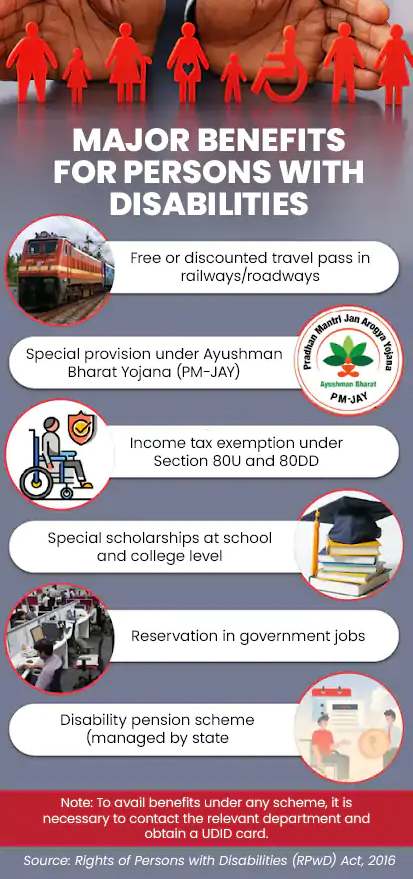
Major Policy Initiatives of India:
1. Accessible India Campaign
Launched on 3 December 2015, the campaign seeks to ensure accessibility in three domains:
-
-
- Built environment
- Transport systems
- Information and communication technology (ICT)
- Built environment
-
The revised Accessible India App strengthens digital accessibility through Accessibility Mapping, grievance redressal, a multilingual interface, and integrated information on government schemes. It exemplifies India's technology-for-inclusion strategy.
2. ADIP Scheme and ALIMCO
The Assistance to Disabled Persons for Purchase/Fitting of Aids and Appliances (ADIP) Scheme (1981) and the Artificial Limbs Manufacturing Corporation of India (ALIMCO) work collectively to ensure access to:
-
-
- Artificial limbs
- Hearing aids
- Wheelchairs
- Modern assistive devices
- Artificial limbs
-
The establishment of PM-Divyangjan Divyasha Kendras expands this access at the local level.
3. Deendayal Disabled Rehabilitation Scheme (DDRS)
Provides financial support to voluntary organizations engaged in education, training, and rehabilitation. It stands as a strong example of government–civil society partnership.
4. National Handicapped Finance and Development Corporation (NDFDC)
Supports economic empowerment through schemes such as:
-
-
- Divyangjan Swavalamban Yojana (DSY)
- Vishesh Microfinance Yojana (VMY)
- Divyangjan Swavalamban Yojana (DSY)
-
These schemes encourage self-employment, entrepreneurship, and financial independence—crucial pillars of inclusion.
Digital and Educational Inclusion:
1. PM-DAKSH–DEPwD Portal
A one-stop digital ecosystem providing:
-
-
- Skill training
- Employment linkages
- Geo-tagged job vacancies
- Online courses (250+ skill modules)
- Skill training
-
This framework significantly advances economic inclusion.
2. UDID Project: Integrated Identification System
Through the Unique Disability ID (UDID) card, individuals gain:
-
-
- Transparent access to government schemes
- Elimination of duplicate records
- Online certification and renewal
- Real-time national-level data for policymaking
- Transparent access to government schemes
-
It enhances efficiency in service delivery and database management.
3. Development of Indian Sign Language (ISL)
The Indian Sign Language Research and Training Centre (ISLRTC), established in 2015, has transformed the sign language landscape. Major accomplishments include:
-
-
- A 10,000+ word ISL Dictionary
- A digital repository with 3,189 videos
- ISL training on PM e-Vidya Channel 31
- ISL translation of NCERT textbooks (to be completed by 2026)
- A 10,000+ word ISL Dictionary
-
These reforms promote linguistic inclusion and ensure equal educational opportunities.
Socio-Cultural Empowerment: Art, Entrepreneurship, and Festivals
1. Divya Kala Mela: Inclusive Expansion of “Vocal for Local”
The 2025 editions held in Patna, Vadodara, and Jammu featured:
-
-
- Participation from 20 states
- 75+ stalls of Divyang artisans and entrepreneurs
- Exhibition of handicrafts, eco-friendly products, food items
- Job fairs and assistive device centers
- Participation from 20 states
-
This initiative positions persons with disabilities as central participants in economic activity.
2. Purple Fest 2025
India’s largest inclusion festival showcasing:
-
-
- Assistive technology
- Cultural performances
- Global sign-language training
- Knowledge-sharing platforms
- Assistive technology
-
It aims to establish India as an inclusive innovation hub.
Policy Analysis and Challenges:
Despite significant progress, several challenges persist:
1. Incomplete Implementation of Accessibility Standards
Many public buildings, transport systems, and digital platforms fail to fully meet accessibility norms.
2. Gaps in Certification and Data
Despite the UDID program, many states lag behind in certification and data collection.
3. Barriers in Inclusive Education
Shortage of trained special educators, assistive technology, and inclusive classroom resources remains a concern.
4. Structural Barriers in Employment
Private sector participation remains low due to social biases and inadequate workplace accommodations.
5. Limited Services in Rural Areas
Assistive devices, rehabilitation services, and screening facilities remain largely urban-centric.
Way Forward:
1. Mandatory Real-Time Accessibility Audits
All public institutions should undergo compulsory digital accessibility audits.
2. Inclusive Education Framework 2.0
Reforms must focus on teacher training, classroom infrastructure, and digital learning resources.
3. Industry-Based Employment Plans
Corporate incentives and strict monitoring mechanisms can significantly enhance hiring.
4. Boost to Assistive Technology Innovation
Tax incentives, R&D grants, and procurement support for start-ups and MSMEs can strengthen the ecosystem.
5. Wider Inclusion in Sports and Culture
National initiatives such as a Divyang Sports Mission and Inclusive Arts Programme can broaden participation.
Conclusion
India’s journey toward disability rights is not merely about expanding policies, it is the story of a profound shift in societal attitudes. Through legal frameworks, digital innovations, educational reforms, financial inclusion, and cultural empowerment, India is progressing toward a future where every individual can live a barrier-free, dignified, and active life.
| UPSC/PCS Mains Question: |



