
Coal Gasification: India’s New Strategy Between Energy Security, Self-Reliance and Green Transition
Context:
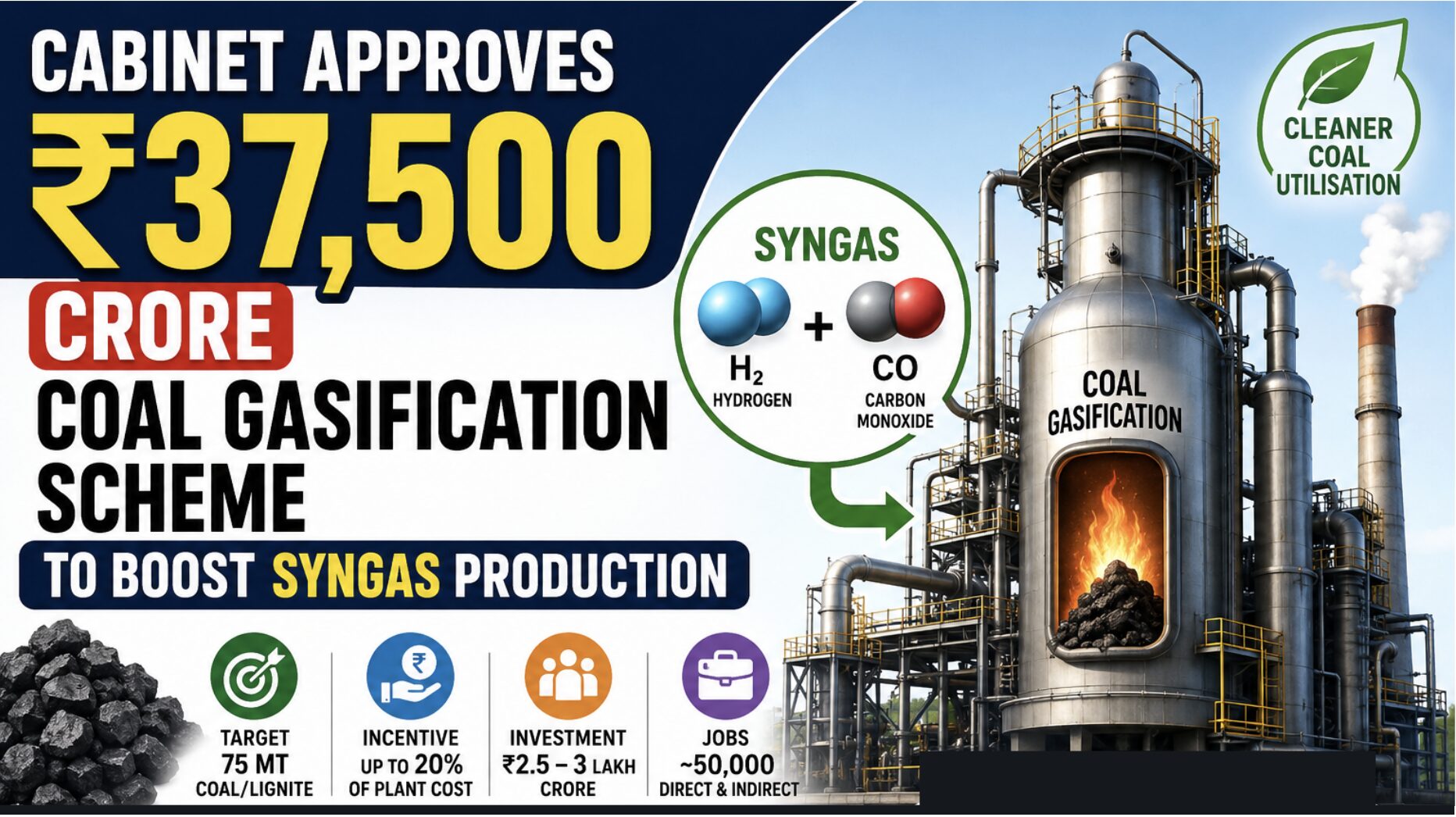
Recently, the Central Government approved an incentive scheme worth ₹37,500 crore for coal/lignite gasification projects located near the Earth’s surface. Along with this, India has set an ambitious target of gasifying 100 million tonnes of coal by the year 2030. This initiative has emerged at a time when the global energy crisis, geopolitical tensions in West Asia, volatile crude oil prices, and increasing import dependence have become serious economic challenges for India.
-
-
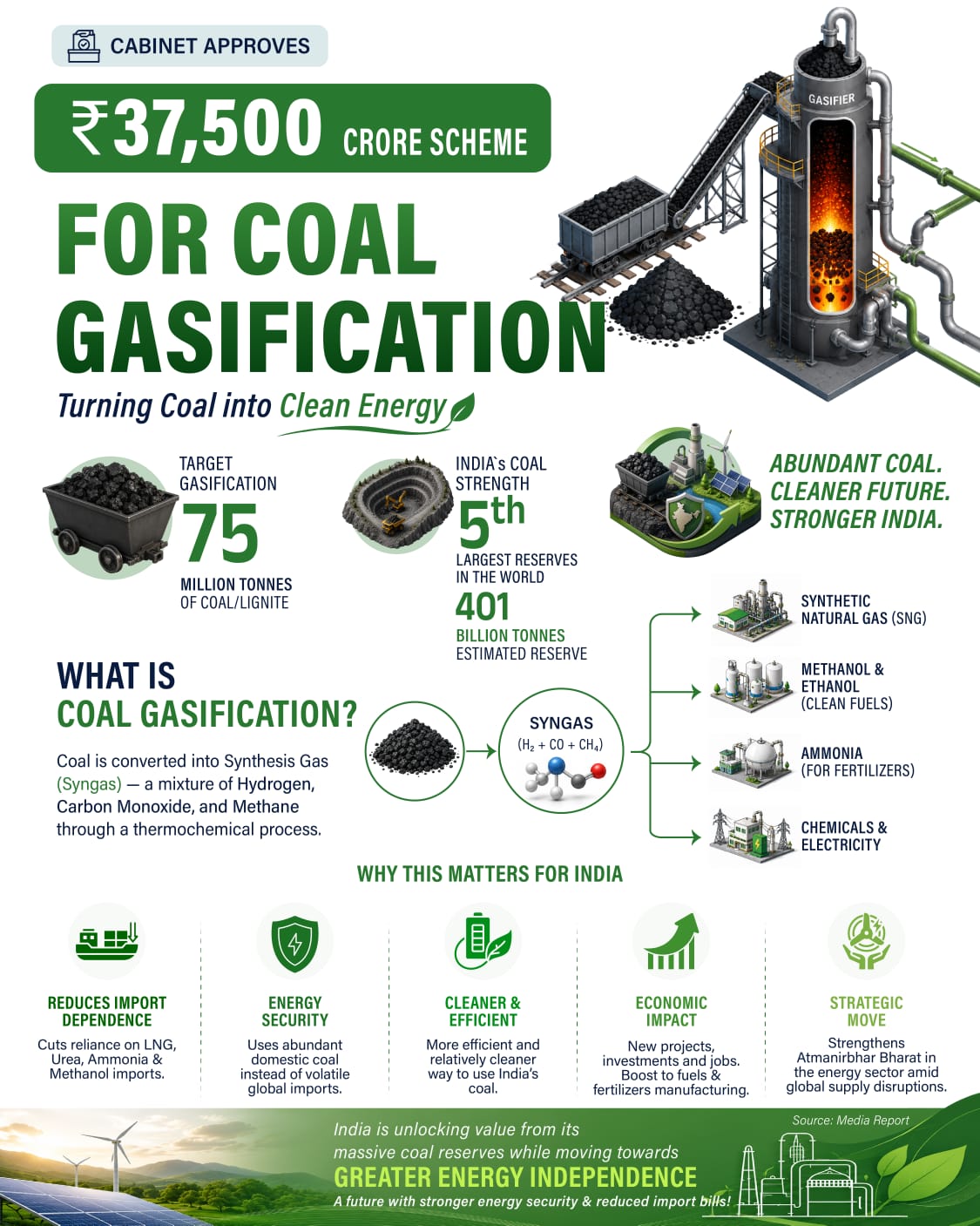
- India is the world’s second-largest coal producer. The country possesses one of the largest coal reserves in the world (around 401 billion tonnes) along with nearly 47 billion tonnes of lignite reserves (a lower grade of coal). Coal accounts for more than 55 percent of India’s energy mix.
- Through the gasification process, coal/lignite is converted into synthetic gas (syngas), which serves as a versatile raw material for the domestic production of fuels and chemicals. In this context, “coal gasification” is being viewed as a new foundation for energy security, industrial self-reliance, and an alternative fuel economy.
- India is the world’s second-largest coal producer. The country possesses one of the largest coal reserves in the world (around 401 billion tonnes) along with nearly 47 billion tonnes of lignite reserves (a lower grade of coal). Coal accounts for more than 55 percent of India’s energy mix.
-
Coal Gasification:
Coal Gasification is a process in which coal is converted into “syngas” (Synthesis Gas or Syngas) in an environment of limited oxygen, steam, and high temperature. This gas mainly contains carbon monoxide and hydrogen.
This syngas can be used in the production of several industrial products, such as:
-
-
- Methanol
- Ammonia
- Urea
- Synthetic Natural Gas (SNG)
- Hydrogen
- Petrochemical products
- Methanol
-
This means coal will no longer remain limited to electricity generation alone but can also become the basis of the chemical and fuel industries.
Importance of Coal Gasification:
-
-
- Need for Energy Security:
- India imports nearly 85% of its total crude oil requirement and a significant portion of its natural gas needs. In addition, the country remains dependent on foreign sources for methanol, ammonia, and fertilizers.
- Any geopolitical crisis at the global level directly impacts India’s energy costs. The Russia-Ukraine war and the West Asia crisis have clearly demonstrated that an import-dependent energy system may not remain sustainable in the long run.
- In such a situation, India wants to utilize its vast domestic coal reserves in a more alternative and productive manner. Coal gasification can become an important medium in this direction.
- India imports nearly 85% of its total crude oil requirement and a significant portion of its natural gas needs. In addition, the country remains dependent on foreign sources for methanol, ammonia, and fertilizers.
- Reduction in Import Expenditure: In the financial year 2025, India’s import expenditure on LNG, urea, ammonium nitrate, ammonia, coking coal, methanol, DME, and other major substitutable products stood at nearly ₹2.77 lakh crore. If gas, methanol, and fertilizers are produced domestically from coal:
- LNG imports will decline,
- Methanol imports will reduce,
- The fertilizer industry will get domestic raw materials.
- It is estimated that this could save India billions of dollars in foreign exchange annually.
- LNG imports will decline,
- Self-Reliant India and Industrial Development: The government now wants to develop coal not merely as a “fuel” but also as a “feedstock.” This means coal will be used beyond electricity generation in sectors such as the chemical industry, transportation fuels, and green hydrogen. This policy also strengthens initiatives like Make in India, Atmanirbhar Bharat, and the National Manufacturing Policy.
- Employment Generation: Under this scheme, around 50,000 (direct and indirect) jobs are expected to be generated through 25 projects located in coal-producing regions.
- Revenue for Governments: Under the proposed 75 million tonnes of gasification-based coal/lignite utilization, annual benefits worth ₹6,300 crore are expected. In addition, revenue will also be generated through Goods and Services Tax (GST) and other taxes.
- Technological Ecosystem: By promoting indigenous technologies and reducing dependence on foreign EPC (Engineering, Procurement and Construction) contractors, India’s domestic near-surface coal gasification capacity will be strengthened.
- Need for Energy Security:
-
Potential Benefits:
-
-
- Cleaner and More Efficient Use of Coal: Compared to conventional coal combustion, gasification is considered a relatively more controlled and efficient process. This can improve energy efficiency.
- Boost to the Methanol Economy: India seeks to move towards a “Methanol Economy.” Methanol can be used as:
- Transportation fuel,
- Marine fuel,
- Feedstock for the chemical industry.
- If methanol begins to be produced domestically, import dependence will decline.
- Transportation fuel,
- A Step Towards Green Hydrogen: Hydrogen can also be derived from syngas. In the future, this could accelerate India’s Hydrogen Economy.
- Employment and Regional Development: In coal-rich states such as Jharkhand, Odisha, Chhattisgarh, and West Bengal:
- New industries will develop,
- Employment opportunities will increase,
- Local economies will gain momentum.
- New industries will develop,
- Cleaner and More Efficient Use of Coal: Compared to conventional coal combustion, gasification is considered a relatively more controlled and efficient process. This can improve energy efficiency.
-
Challenges:
Although coal gasification is being considered a relatively better technology, it is still associated with several challenges:
-
-
- Carbon Emissions: Coal ultimately remains a fossil fuel. The gasification process also generates carbon dioxide emissions. Unless technologies such as Carbon Capture Utilisation and Storage (CCUS) are adopted, it may go against climate goals. CCUS is an advanced clean technology that prevents carbon dioxide emitted from industrial plants from entering the atmosphere.
- Water Usage Problem: Gasification projects require large quantities of water. Many of India’s coal-bearing regions are already facing water scarcity.
- High Cost and Technological Challenges: This is a highly capital-intensive technology. Both project establishment and operation require heavy investment. Moreover, India is not yet fully self-reliant in this technology.
- Balancing with Renewable Energy: On one hand, India is promoting solar and wind energy, while on the other hand it is increasing investment in coal gasification. Therefore, policymakers face the challenge of balancing development and green transition.
- Carbon Emissions: Coal ultimately remains a fossil fuel. The gasification process also generates carbon dioxide emissions. Unless technologies such as Carbon Capture Utilisation and Storage (CCUS) are adopted, it may go against climate goals. CCUS is an advanced clean technology that prevents carbon dioxide emitted from industrial plants from entering the atmosphere.
-
Global Perspective:
-
-
- China is the world’s largest user of coal gasification technology. It has developed large industrial models for producing chemicals and gas from coal. South Africa has also been using this technology for a long time.
- India is now attempting to reshape its energy strategy by learning from the experiences of these countries.
- China is the world’s largest user of coal gasification technology. It has developed large industrial models for producing chemicals and gas from coal. South Africa has also been using this technology for a long time.
-
Way Forward:
-
-
- For India, coal gasification is neither merely an energy policy nor just an industrial project. It is part of a broader vision for the strategic utilization of resources. However, its success will depend upon several important factors:
- Development of indigenous technology,
- Environmental safeguards,
- Adoption of clean technologies such as CCUS,
- Effective water management,
- Private investment and policy stability.
- Development of indigenous technology,
- If these challenges are addressed, coal gasification can help India move from being an energy-importing nation towards becoming an energy self-reliant country.
- For India, coal gasification is neither merely an energy policy nor just an industrial project. It is part of a broader vision for the strategic utilization of resources. However, its success will depend upon several important factors:
-
Conclusion:
Today, the world is passing through an era of energy transition. India faces a dual challenge- rising energy demand on one side and climate commitments on the other. In such a scenario, coal gasification is emerging as a transitional solution amid the debate of “development versus environment.” This technology offers India new possibilities in the direction of energy security, industrial self-reliance, and an alternative fuel economy. However, its real success will depend on how balanced, clean, and long-term India’s implementation strategy proves to be.



