
Introduction:
Child marriage is one of the deep-rooted social evils in India which, despite being legally prohibited, continues to adversely affect the lives, health, education and dignity of millions of children, particularly girls. It is not merely a social problem but also a violation of human rights, a public health crisis, a manifestation of gender injustice, and a developmental barrier. According to the National Family Health Survey-5 (2019–21), nearly 23% of women aged 20–24 years were married before attaining the age of 18. This statistic highlights the reality that despite economic progress and legal reforms, child marriage remains deeply entrenched in India’s social fabric.
-
-
- In view of this grave challenge, the Child Marriage Free India (BMFI) initiative, launched by the Government of India on 27 November 2024, represents a bold national commitment of the Ministry of Women and Child Development (MWCD) to eliminate child marriages across the country. The mission aims to reduce the incidence of child marriage to 10% by 2026 and to make India completely child-marriage-free by 2030. This objective is aligned not only with Sustainable Development Goal (SDG) 5.3, but also with India’s constitutional values of dignity, equality and individual liberty.
- In view of this grave challenge, the Child Marriage Free India (BMFI) initiative, launched by the Government of India on 27 November 2024, represents a bold national commitment of the Ministry of Women and Child Development (MWCD) to eliminate child marriages across the country. The mission aims to reduce the incidence of child marriage to 10% by 2026 and to make India completely child-marriage-free by 2030. This objective is aligned not only with Sustainable Development Goal (SDG) 5.3, but also with India’s constitutional values of dignity, equality and individual liberty.
-
Historical Perspective:
-
-
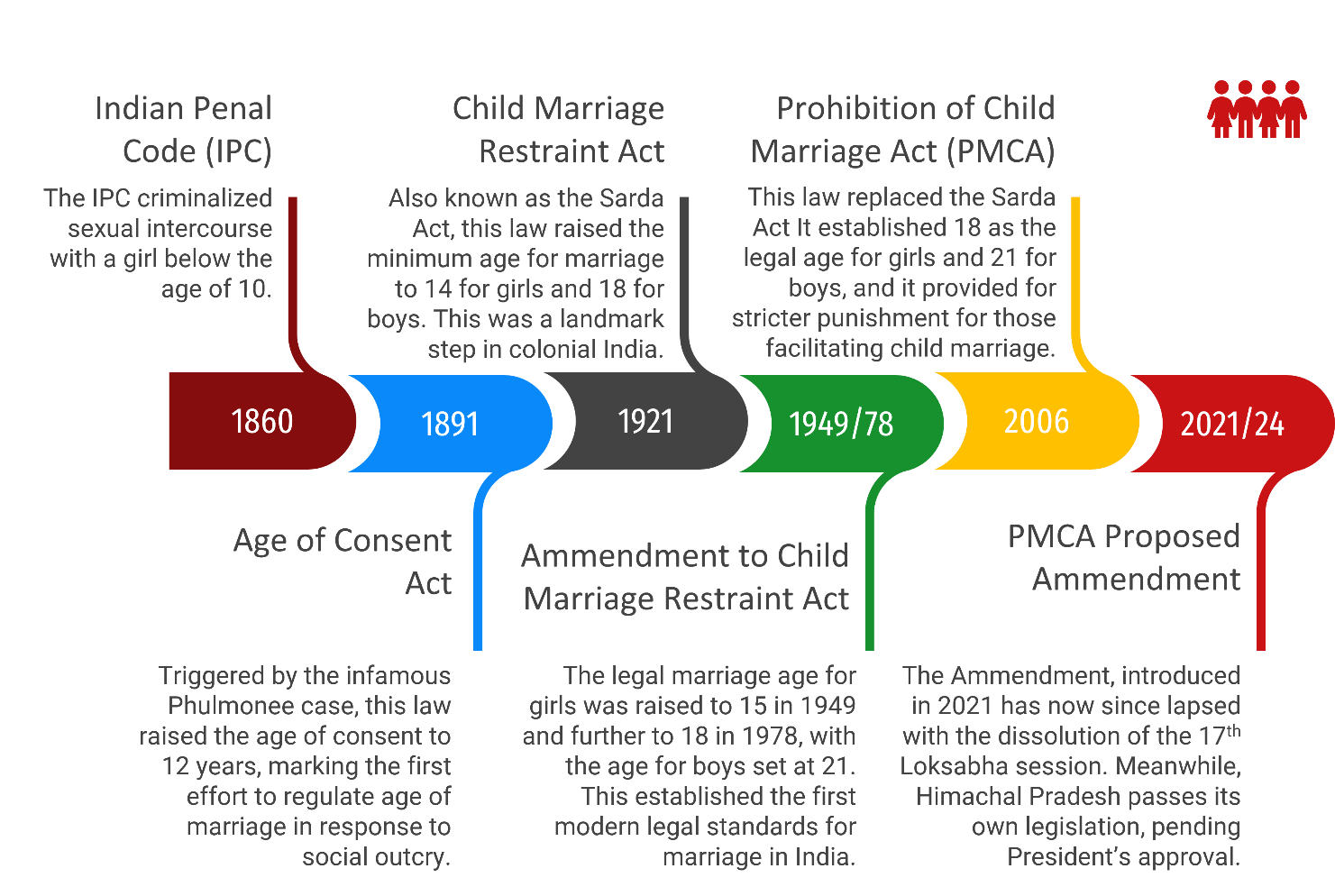
- The struggle against child marriage in India is not new. In the 19th century, social reformers such as Raja Ram Mohan Roy, Ishwar Chandra Vidyasagar, and Jyotirao Phule raised strong voices against this practice. Their efforts led to the enactment of the Age of Consent Act, 1891, followed by the Child Marriage Restraint Act, 1929 (Sharda Act). After Independence, the minimum age of marriage was progressively raised through the 1948 and 1978 amendments.
- Ultimately, the Prohibition of Child Marriage Act, 2006 proved to be a decisive step, as it sought to completely prohibit child marriage rather than merely regulate it.
- The struggle against child marriage in India is not new. In the 19th century, social reformers such as Raja Ram Mohan Roy, Ishwar Chandra Vidyasagar, and Jyotirao Phule raised strong voices against this practice. Their efforts led to the enactment of the Age of Consent Act, 1891, followed by the Child Marriage Restraint Act, 1929 (Sharda Act). After Independence, the minimum age of marriage was progressively raised through the 1948 and 1978 amendments.
-
Child Marriage Free India: A Transformative Initiative
Launched on 27 November 2024, the Child Marriage Free India (BMFI) mission offers a comprehensive and technology-driven approach to address this issue. The initiative is aligned with SDG 5.3, which seeks the complete elimination of child marriage and other harmful practices by 2030. A key strength of BMFI lies in the fact that it goes beyond punitive measures and focuses on prevention, protection and empowerment. Under this mission: Appointment of dedicated Child Marriage Prohibition Officers (CMPOs) have been promoted, along with active participation of communities, schools, anganwadi centres, and religious leaders. |
Child Marriage: Concept and Legal Framework:
The Prohibition of Child Marriage Act, 2006 is the principal legislation aimed at preventing child marriage in India. According to the Act, any marriage where the girl is below 18 years of age or the boy is below 21 years of age is classified as a child marriage. The Act not only prescribes minimum age limits but also declares child marriage a punishable offence and provides mechanisms for protection, relief and justice to victims.
-
-
- Minimum age of marriage: 18 years for girls and 21 years for boys
- Punishment: If an adult man marries a minor girl, he may face rigorous imprisonment up to two years and/or a fine up to ₹1 lakh
- Punishment for facilitators: Persons who promote, conduct or participate in child marriage (including parents, priests or qazis) are also liable for punishment
- The Bharatiya Nyaya Sanhita, 2023 has further strengthened this framework. Under Section 63, sexual relations with a wife below 18 years of age are classified as rape
- The Supreme Court, in recent judgments, has clarified that the concept of consent does not apply within child marriage, as a child is legally incapable of giving consent
- In October 2024, the Supreme Court issued comprehensive directions to States and Union Territories for preventing child marriage, declaring it a violation of personal autonomy and often a form of forced marriage
- Voidable marriage: Under Section 3 of the Prohibition of Child Marriage Act, 2006, a child marriage can be declared voidable at the option of the minor party
- POCSO Act: As per Supreme Court rulings, sexual relations with a wife below 18 years constitute rape, irrespective of marriage, and attract stringent punishment under the POCSO Act, including life imprisonment
- Minimum age of marriage: 18 years for girls and 21 years for boys
-
Impact of Child Marriage on Human Development:
-
-
- Adverse impact on maternal health: Early pregnancy significantly increases the risk of maternal mortality among adolescents, as their bodies are not fully developed. Anaemia, hypertension and childbirth complications are more common.
- Infant health and nutritional crisis: Children born from child marriages are more likely to suffer from low birth weight, malnutrition and higher infant mortality, leading to inter-generational health crises.
- Negative impact on mental health: Early marital responsibilities, heightened risk of domestic violence and lack of decision-making autonomy result in depression, anxiety and low self-esteem among young girls.
- Disruption of education: Child marriage often leads to premature discontinuation of girls’ education, limiting their academic attainment and skill development.
- Barriers to employment and economic independence: Due to lack of education and skills, women affected by child marriage remain excluded from formal employment, reinforcing economic dependence and poverty.
- Adverse impact on human capital formation: Weakened health, education and productivity undermine human capital development, adversely affecting long-term national economic growth and development goals.
- Adverse impact on maternal health: Early pregnancy significantly increases the risk of maternal mortality among adolescents, as their bodies are not fully developed. Anaemia, hypertension and childbirth complications are more common.
-

Socio-Economic Causes of Child Marriage:
The persistence of child marriage in India is not merely a result of inadequate laws, but is deeply rooted in poverty, gender inequality, social customs and lack of education. These factors reinforce one another and transform child marriage into a cycle of inter-generational deprivation.
-
-
- Poverty and economic insecurity: In economically vulnerable families, early marriage of girls is often viewed as a means to reduce financial burden. According to NFHS-5 (2019–21), the prevalence of child marriage among women from the lowest wealth quintile is nearly double that of women from the highest quintile. States such as Bihar, Jharkhand and Uttar Pradesh demonstrate a clear correlation between poverty and child marriage.
- Gender inequality and social structure: In many communities, girls are still perceived as an “economic burden” or “paraya dhan”, limiting their access to education and autonomy. NFHS-5 data reveals that women with education below the eighth grade face a significantly higher likelihood of child marriage compared to those with higher education.
- Traditions, social norms and community pressure: In parts of West Bengal, Assam and Rajasthan, social customs, caste practices and religious traditions often override legal provisions. Mass marriage events and festivals frequently lend social legitimacy to child marriages, making detection and prevention difficult.
- Lack of education and legal awareness: NFHS-5 indicates that child marriage rates are substantially higher in rural areas compared to urban regions, reflecting disparities in information access, awareness and institutional reach.
- Poverty and economic insecurity: In economically vulnerable families, early marriage of girls is often viewed as a means to reduce financial burden. According to NFHS-5 (2019–21), the prevalence of child marriage among women from the lowest wealth quintile is nearly double that of women from the highest quintile. States such as Bihar, Jharkhand and Uttar Pradesh demonstrate a clear correlation between poverty and child marriage.
-
|
Case Study: Balod District, Chhattisgarh The achievement of Balod district in Chhattisgarh becoming India’s first child-marriage-free district is a historic milestone. Similarly, the declaration of 75 gram panchayats in Surajpur district as “child-marriage-free panchayats” demonstrates that community participation combined with administrative will can bring about tangible change. These examples serve as replicable models for other states. |
Challenges:
-
-
- Although the prevalence of child marriage in India has declined significantly over the decades, the foremost challenge remains the gap between law and social behaviour. Despite strong legislation like the Prohibition of Child Marriage Act, 2006, social acceptance and traditional norms often override legal mandates.
- Another major challenge is regional disparity in enforcement. In several states and districts, lack of administrative commitment, resources and trained personnel hampers effective implementation. Monitoring and prevention are particularly difficult in rural and remote areas.
- Although the prevalence of child marriage in India has declined significantly over the decades, the foremost challenge remains the gap between law and social behaviour. Despite strong legislation like the Prohibition of Child Marriage Act, 2006, social acceptance and traditional norms often override legal mandates.
-
A third challenge lies in limitations of data collection, reporting and monitoring systems. Many child marriages go unreported as they are socially accepted or conducted clandestinely.
Way Forward:
-
-
- Research clearly indicates that with each additional year of education, the probability of child marriage declines significantly. Alongside this, economic empowerment, skill development and social security schemes are essential to reduce families’ economic dependence.
- Active participation of local self-government institutions, panchayats, self-help groups and community-based organisations can strengthen social vigilance and collective responsibility against child marriage. Only through coordinated efforts across law, awareness, education and community engagement can India decisively move towards a child-marriage-free future.
- Research clearly indicates that with each additional year of education, the probability of child marriage declines significantly. Alongside this, economic empowerment, skill development and social security schemes are essential to reduce families’ economic dependence.
-
Conclusion:
India’s journey towards eliminating child marriage has evolved from early social reform movements to a robust legal framework and contemporary policy initiatives. The Child Marriage Free India mission provides renewed direction to this struggle, where law, technology and community participation converge. This initiative not only advances the attainment of SDG 5.3, but also lays the foundation for an India where every child can grow with education, health and autonomy. With sustained political will, social awareness and collective action, India can undoubtedly progress towards a child-marriage-free future.
| UPSC/PCS Mains Exam Mock Question: Child marriage is not merely a legal offence but also a question of human rights and morality. In the light of this statement, critically evaluate the role of society, the State, and local self-government institutions in the elimination of child marriage. |



